There is a particular stillness before something begins to see. In space, that moment carries a quiet weight—the transition from silence to signal, from darkness to data. When a new instrument opens its eyes for the first time, it does not announce itself loudly. Instead, it gathers light gently, as if learning how to look.
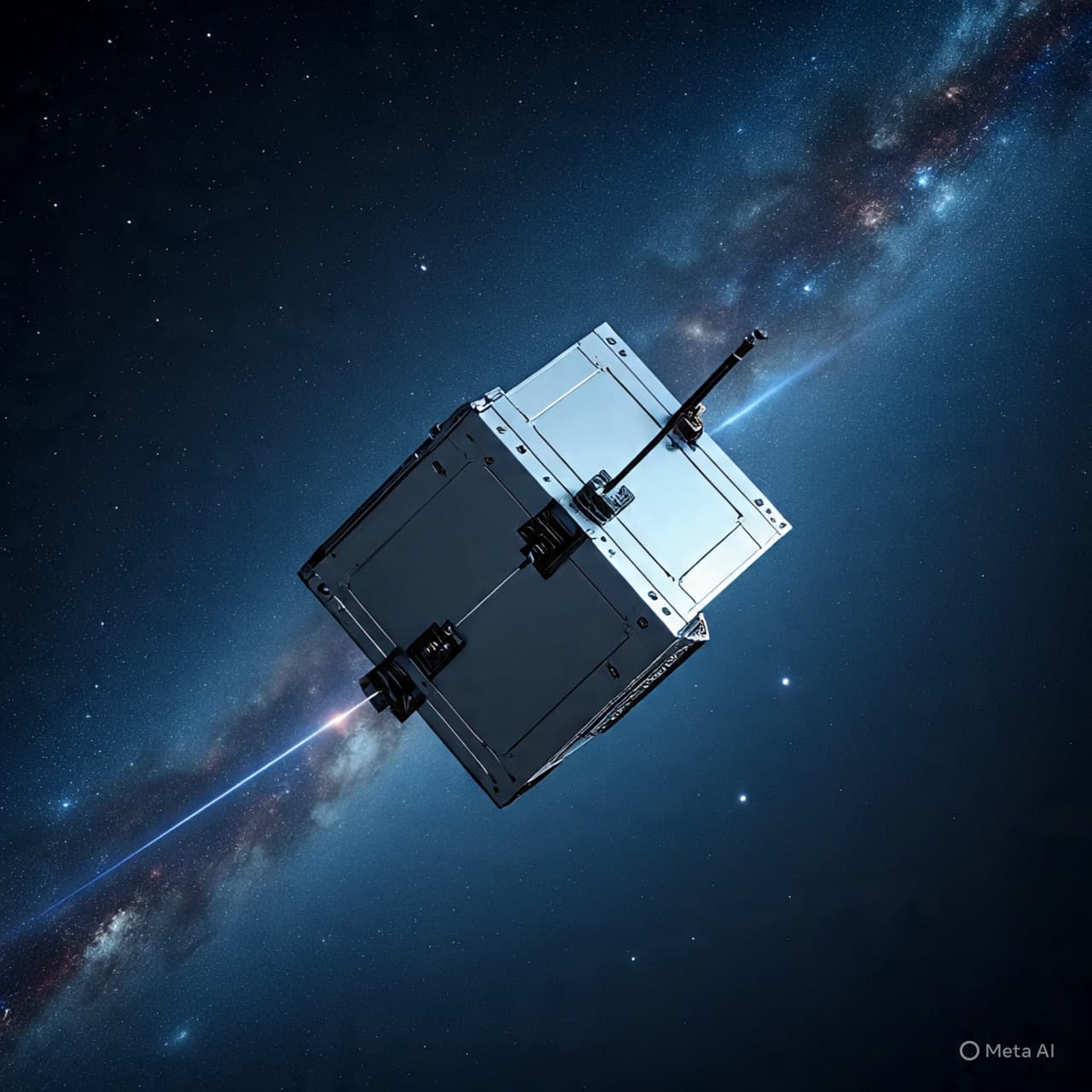
Such a moment has recently unfolded with a small but purposeful mission: a CubeSat designed to study distant worlds. Developed under the guidance of , this compact spacecraft has now delivered its “first light” images, marking the beginning of its journey into observation. The phrase itself, often used in astronomy, refers to the first successful collection of light by a telescope—a quiet milestone that signals readiness.
Unlike larger, more familiar observatories, CubeSats are modest in scale. They are built to be efficient, focused, and adaptable, often carrying out specific tasks with precision rather than breadth. Yet their size does not diminish their ambition. In this case, the satellite’s mission is to assist in the search for exoplanets—planets that orbit stars beyond our solar system—by observing subtle changes in starlight.
The early images, while not intended to dazzle, serve an essential purpose. They allow engineers and scientists to confirm that the instrument is functioning as expected: that its optics are aligned, its sensors responsive, and its data reliable. Each pixel becomes a form of reassurance, a quiet confirmation that the spacecraft can do what it was designed to do.
Instruments like this often rely on a method known as transit photometry, where a telescope watches for the faint dimming of a star as a planet passes in front of it. The change is small, almost imperceptible, yet consistent enough to reveal the presence of worlds that cannot be seen directly. It is a practice that requires patience and precision, qualities well suited to a satellite that works steadily, far from distraction.
There is also a broader significance in the use of CubeSats for such missions. Traditionally, the search for exoplanets has been led by large, complex observatories. By contrast, smaller satellites offer a complementary approach—one that is more flexible, often more cost-effective, and capable of expanding the reach of space-based observation. They do not replace larger missions, but rather extend their vision.
As the CubeSat continues its work, its role will likely grow from calibration to contribution. The data it gathers may help refine existing observations, identify new targets, or support ongoing studies of distant star systems. Each observation adds a small piece to a much larger puzzle, one that seeks to understand how common—or how rare—worlds like our own might be.
In closing, the arrival of “first light” marks a measured beginning rather than a dramatic breakthrough. The CubeSat has demonstrated that it can observe, record, and transmit data as intended. From here, its mission will proceed through continued monitoring and analysis, contributing to the broader effort led by and its partners to study planets beyond our solar system. The work unfolds quietly, one observation at a time, guided by patience and the steady collection of light.
AI Image Disclaimer Images in this article are AI-generated illustrations, meant for concept only.
Sources NASA Jet Propulsion Laboratory (JPL) Space.com Ars Technica Sky & Telescope
Published by Banx Network. This article is part of the Banx decentralized media programme, powered by the BXE token on the XRP Ledger.