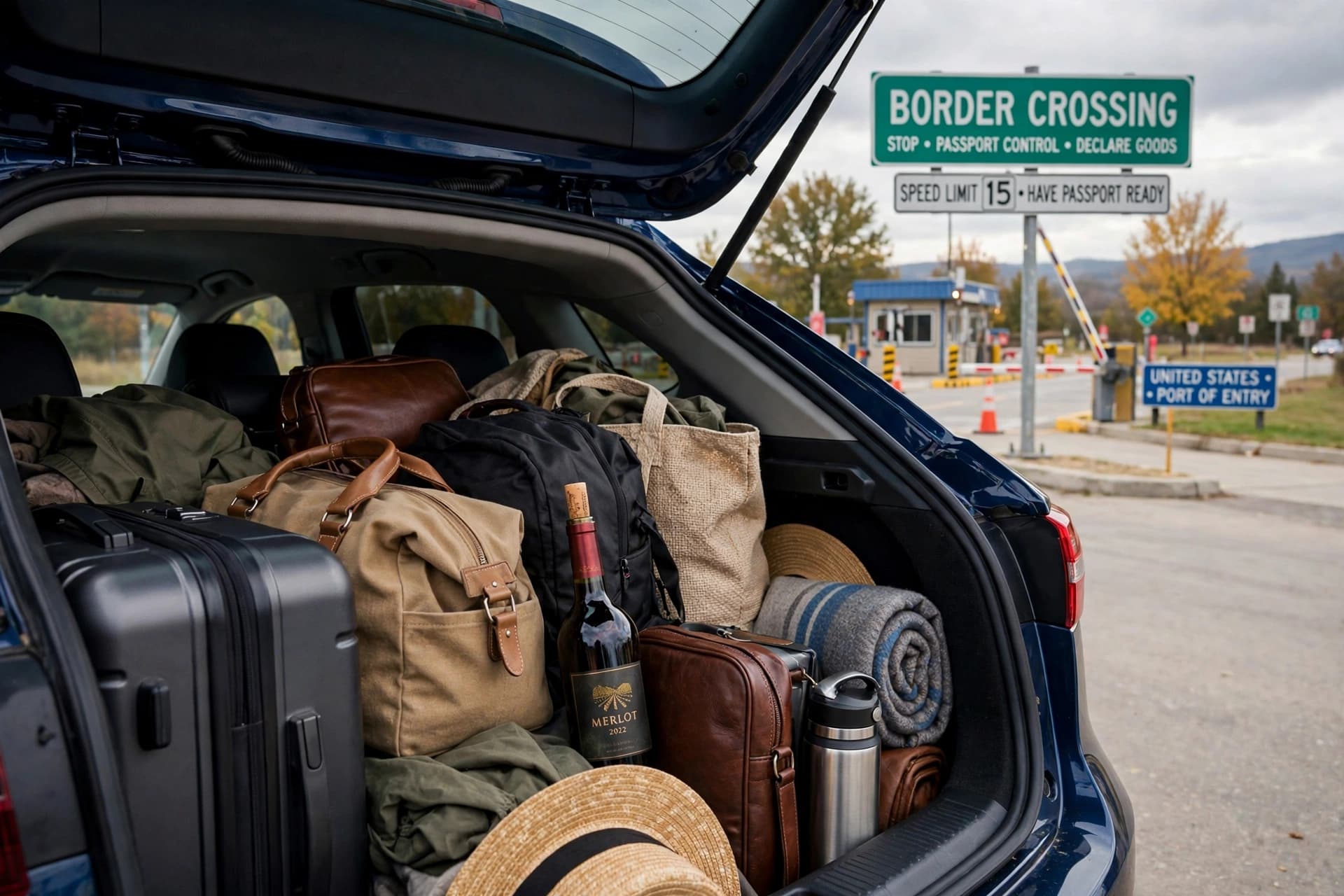
There is a ritual familiar to generations of Canadian travelers heading south for the winter: the careful packing of the car, the checking of documents, the decision about what to bring and what to leave behind. For many snowbirds, that decision has long included a bottle or two of Canadian wine or spirits—a small comfort, a taste of home carried into a warmer place. That ritual has now become complicated by a trade dispute that has moved from tariffs and boardroom negotiations into the trunk of the family car.
The Canadian Snowbird Association has issued a warning to travelers heading to the United States, advising against packing alcoholic beverages and certain dairy products. The guidance follows a new U.S. import ban on some Canadian goods that took effect on September 29, 2026 . The ban was announced by President Donald Trump on September 8, the same day Canada imposed retaliatory tariffs on nearly $28 billion worth of U.S. imports .
The import ban covers a wide range of Canadian-origin alcoholic beverages, including packaged beer, sparkling wine, many table wines, cider, sake, rum, vodka, gin, and certain whiskies and other spirits . Dairy-related restrictions are more limited but could affect whey protein products, certain other whey products, molasses, and non-alcoholic beer . Evan Rachkovsky, director of research and communications at the Canadian Snowbird Association, told the National Post that U.S. Customs and Border Protection has not provided clear guidance confirming that Canadian travelers carrying these products for personal use are exempt from the new restrictions .
The practical implications for travelers are significant. Rachkovsky advised that travelers should declare all alcohol and other applicable products when entering the U.S. and be prepared for border officers to determine whether they are permitted entry. "These items could potentially be refused entry or seized at the border," he said . The association is advising Canadians to avoid bringing these products altogether as a precaution "until clearer guidance is available" .
The trade dispute has already produced tangible consequences beyond the border crossing. On Tuesday, a bonded truck headed for Campobello Island, New Brunswick, was denied entry at the St. Stephen-Calais crossing because it was carrying over 1,000 bottles of spirits . The truck was permitted to return to Canada and eventually reached the island via a provincial ferry and a privately run ferry, the latter of which is scheduled to cease operations for the season on October 12 . The truck typically services the island's fewer than 1,000 residents with mail and other goods .
Prime Minister Mark Carney has said he does not believe in escalating the trade conflict following Canada's retaliatory response. "That's not constructive," he said in a video address released on September 8. "But our tariffs are necessary to protect our workers, protect our companies, and our communities" . For now, the snowbirds and other travelers who once packed a bottle for the journey south must weigh the inconvenience of leaving it behind against the possibility of having it confiscated at the border. It is a small decision, but it carries the weight of a larger dispute.
AI Image Disclaimer: All images in this article are AI-generated and are intended for illustrative purposes only.
Sources: Calgary Herald, National Post, PressReader (Montreal Gazette), CTV News
Published by Banx Network. This article is part of the Banx decentralized media programme, powered by the BXE token on the XRP Ledger.