
For decades, the prevailing narrative of cosmology has been one of expansion, driven by a mysterious force known as dark energy. This invisible hand was thought to be pushing the universe apart at an accelerating rate, a discovery that earned the Nobel Prize and reshaped our understanding of reality. But now, a new study suggests that this acceleration may be an illusion, challenging the very existence of dark energy. If true, it would rewrite the textbooks and force scientists to rethink the fundamental laws governing the cosmos.
The original evidence for cosmic acceleration came from observations of distant supernovae, which appeared fainter than expected. This led to the conclusion that the universe’s expansion is speeding up. However, recent analyses of larger datasets, including galaxy distributions and cosmic microwave background radiation, hint at a different story. Some researchers argue that the data can be explained by a universe that is expanding at a constant rate, or even slowing down, without the need for dark energy.
This provocative idea stems from a reevaluation of how we measure distances in the universe. Systematic errors in calibration or assumptions about the uniformity of space could have skewed earlier results. By applying new statistical methods and accounting for local variations in matter density, scientists are finding that the evidence for acceleration is less robust than previously thought. It is a reminder that science is a self-correcting process, always open to revision.
If dark energy does not exist, the implications are profound. It would mean that the standard model of cosmology, known as Lambda-CDM, is incomplete or incorrect. Physicists would need to explore alternative theories of gravity or modify our understanding of general relativity. Such a shift would be comparable to the revolution sparked by Einstein’s theories a century ago, opening new avenues for exploration and discovery.
Skepticism remains high within the scientific community, as the evidence for dark energy is supported by multiple independent lines of inquiry. Many experts caution against discarding the current model too quickly, noting that anomalies can often be resolved within the existing framework. However, the willingness to question established truths is what drives scientific progress. The debate itself is healthy, fostering rigorous testing and deeper investigation.
For the public, this uncertainty may seem unsettling, but it is also exciting. It highlights the dynamic nature of knowledge and the endless quest for understanding. The universe is vast and complex, and our grasp of it is always evolving. Whether dark energy exists or not, the mystery of cosmic expansion continues to captivate the human imagination.
The possibility that the universe is not accelerating challenges a cornerstone of modern physics. While the verdict is far from settled, the discussion underscores the importance of curiosity and critical thinking. As astronomers gather more data and refine their models, we move closer to the truth, whatever it may be. The journey of discovery is far from over.
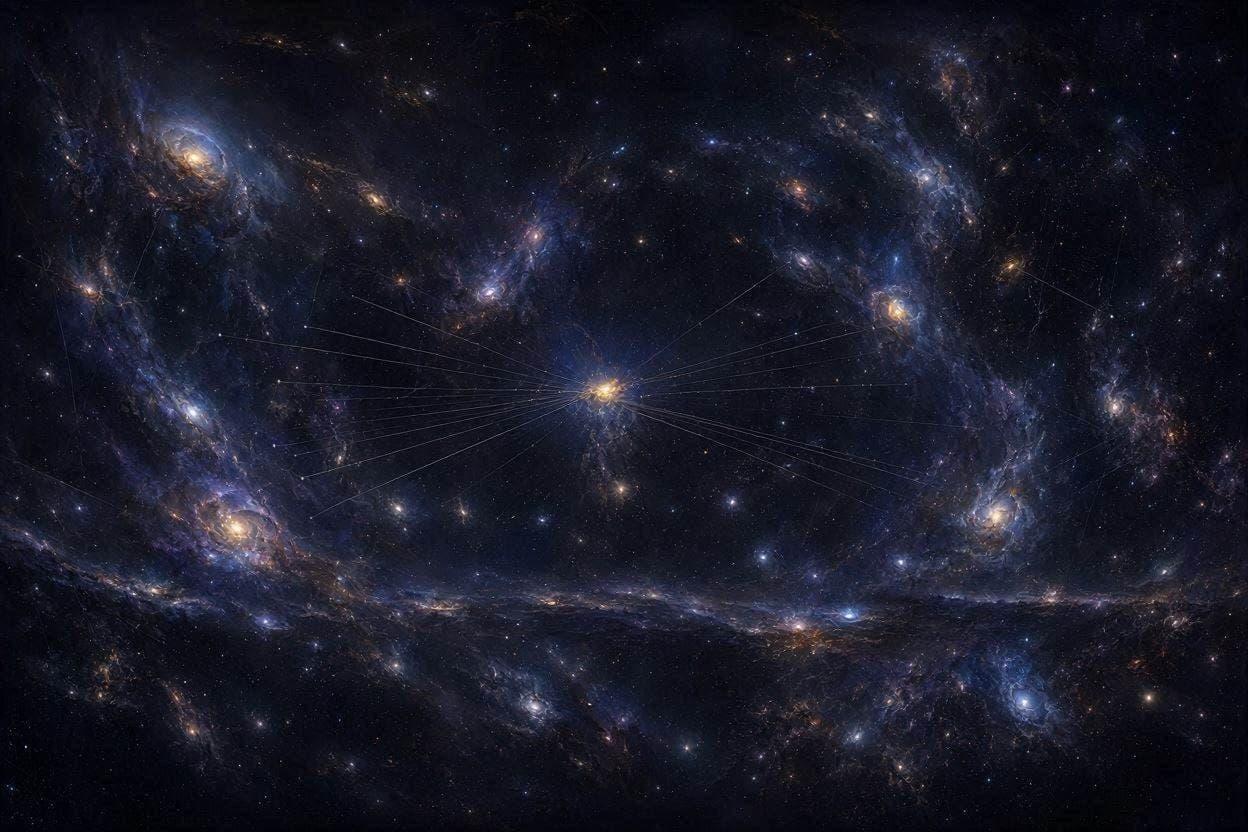
AI Image Disclaimer: The images provided are AI-generated to visually represent the conceptual and theoretical nature of the scientific debate.
Sources: Nature Astronomy Scientific American Phys.org
Published by Banx Network. This article is part of the Banx decentralized media programme, powered by the BXE token on the XRP Ledger.



