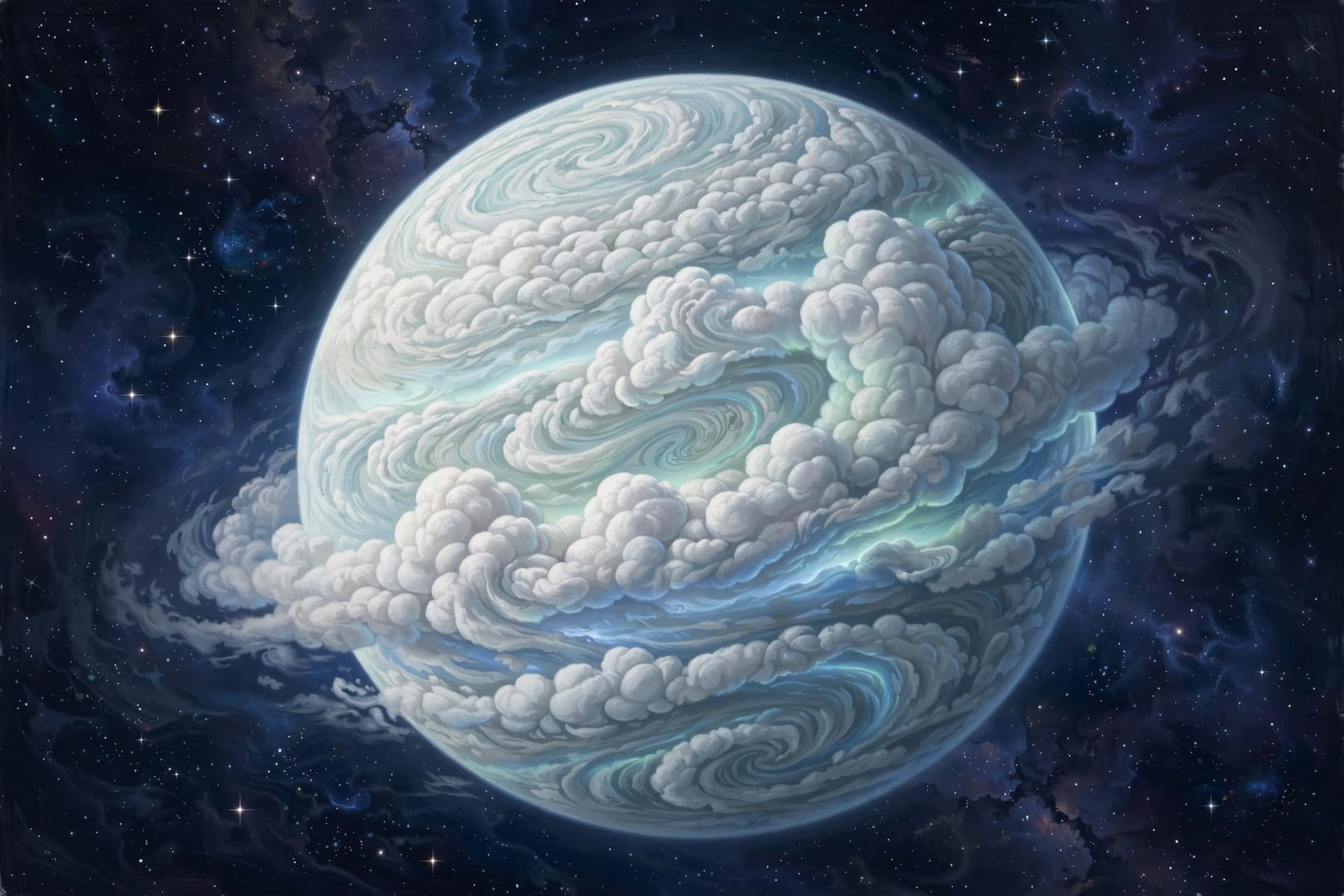
On a deep‑dark canvas stretched across 12 billion light‑years of space and time, there lies a cosmic reservoir so vast it challenges the way we imagine water in the universe. In the glow surrounding a distant quasar — a galaxy’s luminous heart powered by a supermassive black hole — astronomers have detected what amounts to enough water to fill about 140 trillion Earth‑size oceans. This staggering figure was derived from spectral observations of water vapor in the quasar’s environs, showing that even in the early universe, water was abundant in places of great energy and light.
The quasar in question, APM 08279+5255, shines with extraordinary brightness, a signature of gas and dust spiraling into the hungry maw of its central black hole. While we cannot see the water directly with our eyes, instruments detect its fingerprints in the form of emission lines — tiny imprints in the light that tell scientists that water molecules are present. What makes this water remarkable isn’t merely its scale but its age and context: the quasar appears as it did more than ten billion years ago, offering a window into a time when galaxies and black holes were still young.
Though sometimes described as “containing” vast oceans, the water does not lie in liquid seas as on Earth, but rather as an enormous cloud of water vapor and molecules distributed across hundreds of light‑years. In this energetic environment, water exists mixed with other gases, bathed in intense radiation and moving with the galaxy’s powerful winds. Its detection confirms that even in the most extreme reaches of the cosmos — near swirling black holes and radiant quasars — the essential ingredients of water can form and persist.
This discovery reinforces a key lesson of modern astronomy: water, the life‑giving substance we cherish on Earth, is not unique to our world or solar system but a fundamental part of the universe’s makeup, present even when the cosmos was young and unsettled. It reminds us that humanity’s search for water across distant worlds and galaxies is a journey not just of curiosity, but of connection — tracing the threads of hydrogen and oxygen that bind across space and time.
AI Image Disclaimer “Illustrations were produced with AI and serve as conceptual depictions.”
Sources: Earth.com, The Statesman, LiveNOW Fox and other credible outlets reporting on the cosmic water reservoir around a distant black hole/quasar.
Published by Banx Network. This article is part of the Banx decentralized media programme, powered by the BXE token on the XRP Ledger.