There are nights when the sky feels like a quiet storyteller—subtle, patient, and vast. And then there are nights when it speaks in color. In the early hours of March 3, 2026, the Moon will slip into Earth’s shadow and emerge transformed, glowing in a muted red—a reminder that even in darkness, light finds a way to bend, scatter, and return.
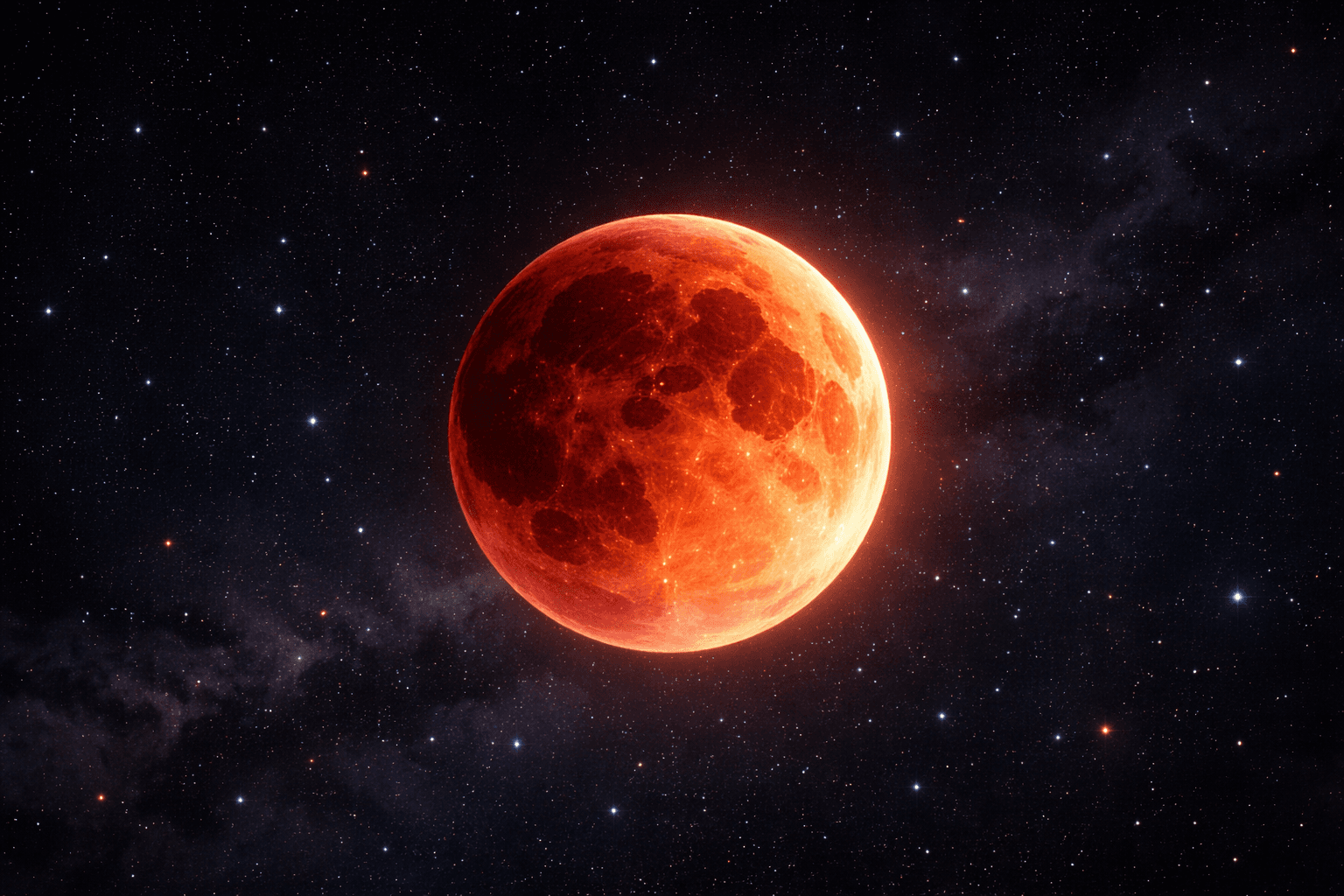
This is the total lunar eclipse—often called a “blood moon”—and for many across the world, it will be one of the most striking celestial events of the year.
The eclipse occurs when Earth moves directly between the Sun and the Moon, casting its shadow across the lunar surface. Instead of disappearing, the Moon turns red because sunlight filters through Earth’s atmosphere, scattering shorter blue wavelengths and allowing the deeper reds to reach the Moon.
The result is not a sudden blackout, but a slow, almost poetic transition—from silver to shadow to ember.
Timing, however, is everything. The full event spans more than five hours, but the most dramatic phase—totality—lasts about 58 minutes.
Where you are on Earth determines not only if you see it—but how you experience it.
For viewers in North America, the eclipse unfolds in the early morning before sunrise. Those farther west will enjoy the best view, seeing the Moon high and fully immersed in Earth’s shadow. In eastern regions, the Moon may set while still eclipsed, creating a fleeting and delicate moment where night and dawn overlap.
Across the Pacific region, including places like Hawaii and island nations, the eclipse will appear high in the sky, offering one of the clearest and most complete views.
In Australia, New Zealand, and East Asia, the event shifts into the evening hours. Here, observers will watch the Moon rise already touched by shadow, deepening into red as night settles in.
Meanwhile, in parts of South and Southeast Asia, including Indonesia, the experience may be partial. The Moon may rise during or after the peak, meaning only fragments of the eclipse are visible—like catching the final lines of a story already unfolding.
And in Europe and much of Africa, the event will pass unseen, hidden below the horizon.
One of the more curious moments of this eclipse is something called a selenelion—a rare optical illusion where the eclipsed Moon and the rising Sun appear at the same time on opposite horizons. It’s a reminder that what we see is not always where things truly are, but how light chooses to travel.
No special equipment is needed to watch. A clear sky, a quiet place, and a little patience are enough. Telescopes and binoculars can deepen the experience, but the event itself belongs just as much to the naked eye.
Because in the end, this is not just an astronomical alignment—it is a moment of perspective. The same atmosphere that colors our sunsets paints the Moon red. The same shadow that darkens also reveals.
And for nearly an hour, the sky will hold that balance—between light and darkness, distance and connection—before quietly returning the Moon to its familiar glow.
AI Image Disclaimer Visuals are created with AI tools and are not real photographs.
Source Check (Credible Media & Science Sources) NASA Space.com Live Science Time and Date Sky at Night Magazine
Published by Banx Network. This article is part of the Banx decentralized media programme, powered by the BXE token on the XRP Ledger.