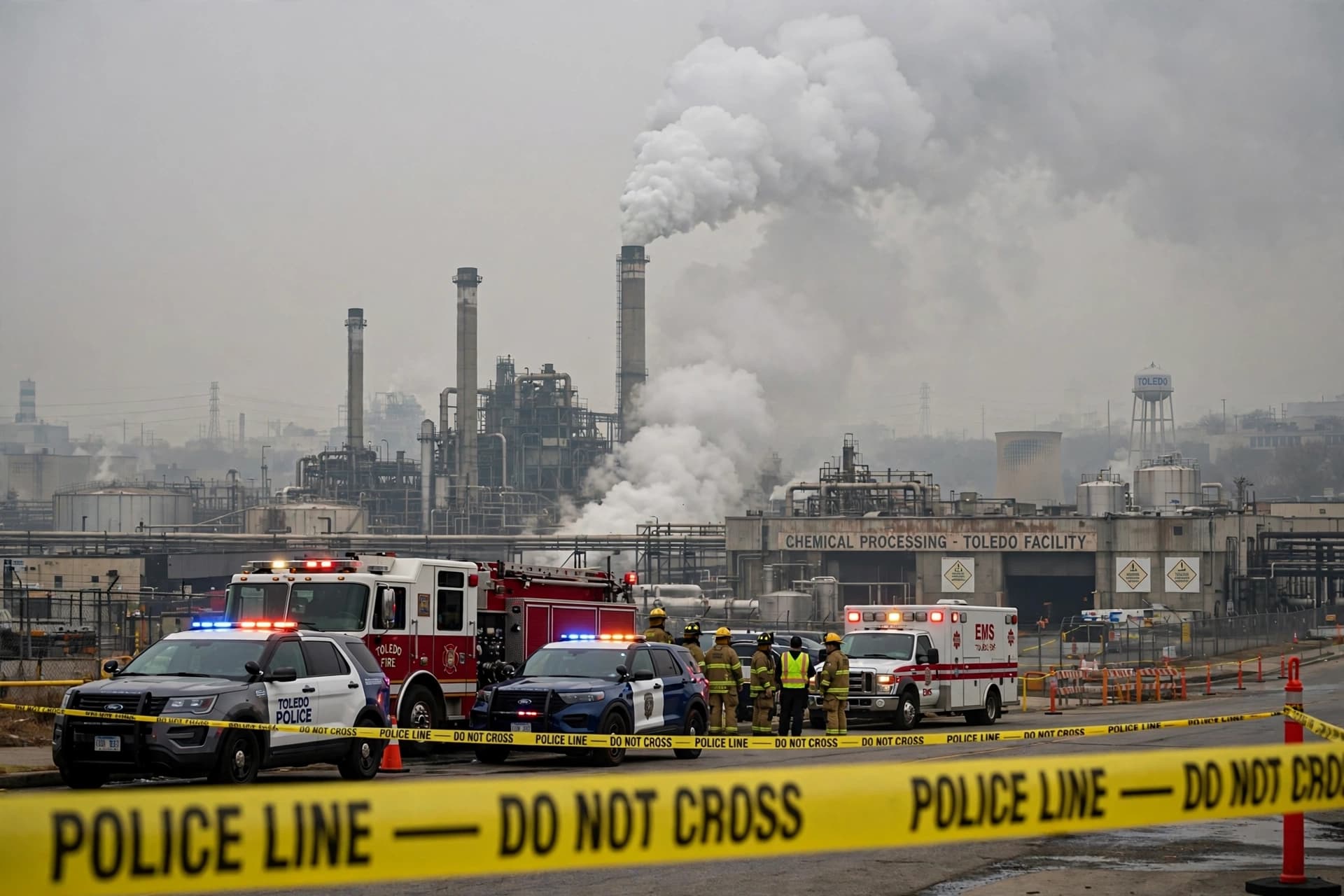
There is a particular unease that settles over a city when the air itself becomes suspect, when the simple act of opening a window or stepping outside requires a calculation that no one should have to make. In Toledo, Ohio, that unease arrived late Tuesday night when a chemical tank at a trucking company's facility began leaking a white plume into the sky. By Wednesday, nearly a thousand residents within a one-mile radius had been told to evacuate, more than fifty thousand within a three-mile radius were sheltering in place, and schools were closed across the city.
The chemical was glycidyl methacrylate, an industrial compound used to make plastics, paints, and coatings perform better. It is flammable, has a noticeable odor, and can cause irritation to the eyes, nose, mouth, and skin. Overexposure can bring headaches, dizziness, tiredness, nausea, and vomiting . The Ohio Environmental Protection Agency said the leak happened because of an "error that occurred when the material was being transferred" . The tank, which can hold 5,500 gallons of the chemical, was venting rather than being approached, because officials feared another explosion. Toledo Mayor Wade Kapszukiewicz said drones monitoring the tank showed its temperature dropping and the plume diminishing by Wednesday afternoon, but that it could take hours before the tank was safe to approach .
The human response was immediate and layered. ProMedica, the city's largest hospital system, evaluated and treated roughly thirty patients who reported symptoms potentially related to the leak, most of whom were treated and released . One sheriff's deputy who responded to the blast later drove himself to a hospital because he felt unwell . Mark White Jr., who lives within the affected area, woke to what he described as a burning plastic smell. Because of his asthma, he decided to evacuate to a shelter at an elementary school. "I don't know what this chemical can do to my lungs, long term or anything," he said .
There is a geography to this kind of emergency that makes it difficult to contain. The shelter-in-place order covered neighborhoods along the Lake Erie shoreline and stretched across the state line into Michigan . Schools across the city closed. Automaker Stellantis shut down production at its nearby Jeep assembly plant . Ships in port were held in place until the hazard was addressed, and CSX trains along rail lines near the property were stopped . A single tank, in a single facility, had ripple effects across an entire regional economy.
Ohio Governor Mike DeWine was monitoring the situation, and the state's Emergency Management Agency, Department of Public Safety, and Environmental Protection Agency were in close contact with local officials . The U.S. Environmental Protection Agency was conducting air monitoring around the evacuation zone . Health officials said the symptoms reported so far were primarily eye and throat irritation, and testing was ongoing to determine the chemical's concentration in the air and whether it posed additional health risks .
For the residents who stayed, the guidance was practical and unsettling in its ordinariness: close windows and doors, turn off air conditioning units drawing in outside air, keep pets inside, and if you feel irritation, take a shower . The water remained safe to drink, the city said, because the source was uncontaminated . These are the instructions that accompany a chemical release in a modern American city, a script that has become familiar in a country where industrial accidents are not rare.
What remains is the question of what the "error" was, and who made it, and whether it could have been prevented. The Ohio EPA has said only that it occurred during the transfer of the material, without elaborating . The company, Arkansas-based MC Tank Transport, said it was working with the fire department and other authorities, and that its overriding concern was the safety of residents, responders, and employees . For the people of Toledo, the plume is dissipating and the evacuation orders will eventually lift. But the smell of burning plastic, and the knowledge of how quickly the ordinary can become hazardous, will linger longer.
---
AI Image Disclaimer: The visuals accompanying this article are generated by artificial intelligence and are intended for illustrative purposes only.
Sources: The Canadian Press, CNN, WSVN
Published by Banx Network. This article is part of the Banx decentralized media programme, powered by the BXE token on the XRP Ledger.