There is a particular vertigo that comes from looking backward in time—from imagining our home not as a fixed place but as a process, a slow accumulation of pieces that were once separate and distinct. The Milky Way, as we see it today, is a spiral disk of hundreds of billions of stars, a structure so vast that light takes a hundred thousand years to cross it. But a new set of simulations suggests that this familiar shape is the end result of an assembly that began with thousands of smaller galaxies, each with its own history, its own stars, its own fate.
The simulations, led by Harley Katz at the University of Chicago, are the most detailed model to date of how a galaxy like the Milky Way might have evolved over the first several billion years of existence . The project, named MEGATRON, took three years to run on high-powered supercomputers and produced six research papers published in The Open Journal of Astrophysics . What the model shows is a picture of "cosmic dawn" that is far more complex than previous simulations had captured.
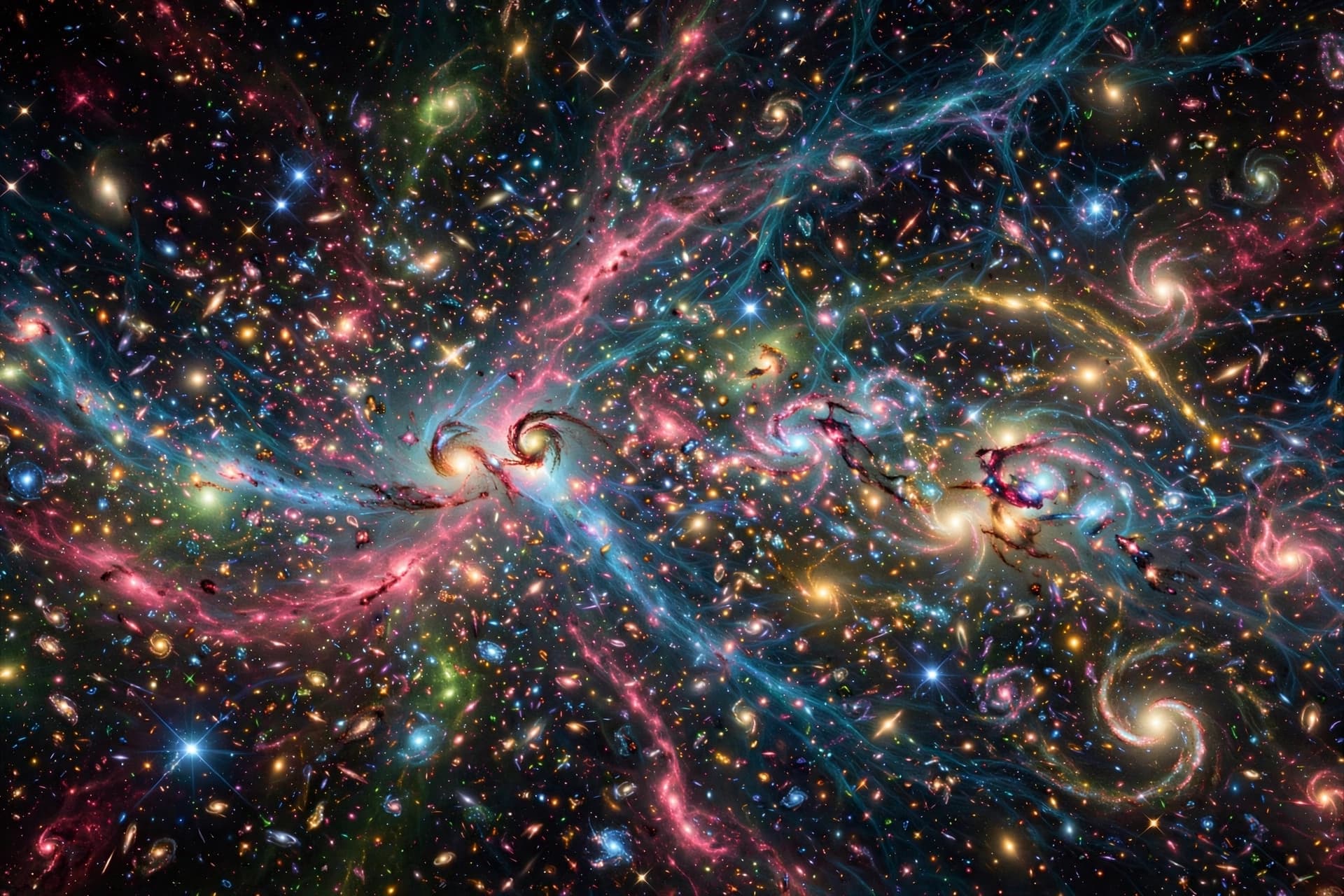
In the early universe, the region that would become our galaxy was a web of thousands of subsystems—some pumping out new stars at furious rates, others containing only gas, still others littered with dead stars and black holes . Over billions of years, these smaller galaxies merged, their gravity drawing them together, their contents combining into the structure we now call home. The simulation follows thousands of these subsystems, computing what they would have looked like to telescopes like Hubble or the James Webb Space Telescope .
One of the most surprising findings concerns "galaxies" that have no stars at all, but still shine. Some of these might have once had stars that exploded or collapsed directly into black holes; others might have only ever contained gas . Another discovery addresses a long-standing puzzle in stellar astrophysics: the observation that in extremely faint galaxies, the amount of iron appears constant regardless of mass. The simulation suggests the culprit is explosions from population III stars—the first stars in the universe, made only of hydrogen and helium—which produce more iron than other supernovae. If a galaxy is large enough, it holds onto that iron; if it is too small, the iron is lost to space .
The simulations also predict where population III stars might still exist, if any do. None have ever been directly observed, but knowing where they are most likely to be found could help astronomers search for them . And the model is the first to include a detailed computation of "non-equilibrium physics"—the real-world chemistry that occurs far from equilibrium, which most simulations simplify away .
What this research offers is not just a history of our galaxy but a tool for interpreting what telescopes see. As new data from Webb comes in, scientists can compare it to the model to see what matches and what is missing . The Milky Way, it turns out, was not always the grand spiral we know. It was once a crowd of smaller things, each with its own story, and the story of how they became one is still being written.
AI Image Disclaimer: The visual elements in this article were created using AI generation tools and are intended for illustrative purposes only.
Sources: University of Chicago News, Phys.org, News18 Hindi, The Open Journal of Astrophysics
Published by Banx Network. This article is part of the Banx decentralized media programme, powered by the BXE token on the XRP Ledger.