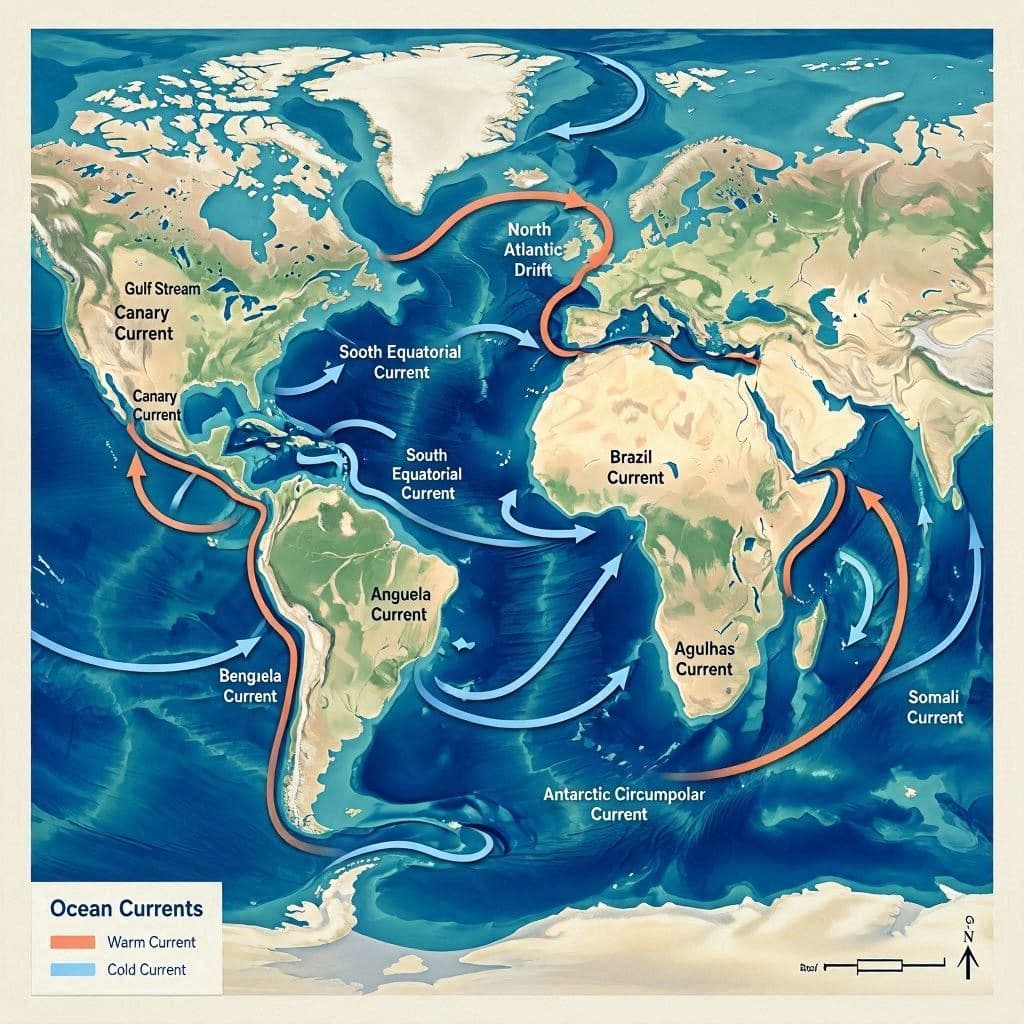
The oceans are often described as the Earth’s heartbeat, their currents pumping warmth and nutrients around the globe in a complex rhythm. For decades, scientists have sought to understand the precise drivers of this massive conveyor belt, particularly the Atlantic Meridional Overturning Circulation (AMOC). A prevailing theory suggested that salty water from the Indian Ocean played a direct role in powering this system. However, a new study challenges this assumption, offering a nuanced view of oceanic interconnectivity.
The AMOC is a critical component of the global climate system, responsible for transporting warm water northward and cold water southward. Its stability influences weather patterns, sea levels, and ecosystems across the Northern Hemisphere. Understanding what drives it is essential for predicting future climate change. The idea that Indian Ocean salinity was a primary driver stemmed from observations of salt transport through the Agulhas Current, which leaks water from the Indian Ocean into the Atlantic.
Recent research, however, indicates that while Indian Ocean water does enter the Atlantic, its salinity does not directly control the strength of the AMOC. Instead, the study suggests that other factors, such as wind patterns and freshwater input from melting ice, play more significant roles. The salt from the Indian Ocean appears to be diluted or mixed in ways that prevent it from having the previously assumed impact on deep-water formation in the North Atlantic.
This finding requires a reevaluation of climate models that have incorporated Indian Ocean salinity as a key variable. By removing this direct link, scientists can refine their predictions and focus on more influential drivers. It highlights the complexity of ocean dynamics, where multiple variables interact in non-linear ways. The ocean is not a simple machine but a chaotic system with many feedback loops.
The implications for climate science are significant. If the AMOC is less sensitive to Indian Ocean salinity than thought, it may respond differently to global warming. This could affect projections of sea-level rise and extreme weather events in Europe and North America. Accurate modeling is crucial for policymakers who rely on these predictions to plan adaptation strategies.
Furthermore, the study underscores the importance of continuous ocean monitoring. Data from satellites and underwater sensors provide the evidence needed to test and refine these theories. As technology improves, our ability to observe the oceans in real-time enhances our understanding of their behavior. This ongoing observation is vital for detecting changes and responding to emerging threats.
The revelation that Indian Ocean salinity does not directly control Atlantic circulation refines our understanding of global ocean dynamics. It serves as a reminder of the intricate balances that govern our climate. As research continues, each new discovery brings us closer to a comprehensive picture of how our planet’s systems function and interact.
AI Image Disclaimer: Visuals associated with this article are AI-generated to represent the oceanographic concepts and global water cycles.
Sources: Nature Geoscience ScienceDaily
Published by Banx Network. This article is part of the Banx decentralized media programme, powered by the BXE token on the XRP Ledger.