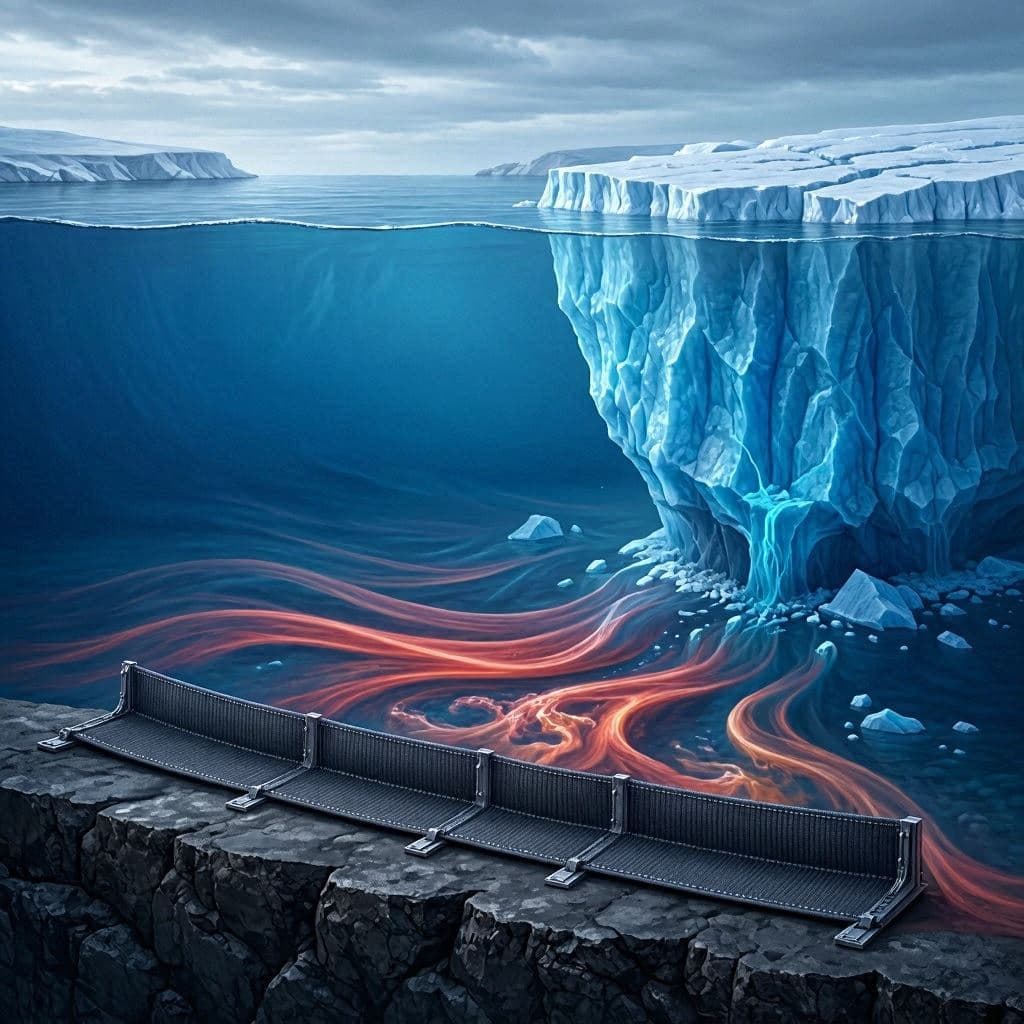
Beneath the icy surface of Antarctica, a silent crisis is unfolding. Warm ocean currents are gnawing at the base of massive glaciers, accelerating their melt and contributing to rising sea levels. Among the most vulnerable is the Thwaites Glacier, often called the "Doomsday Glacier" due to its potential to destabilize the entire West Antarctic Ice Sheet. In a bold proposal, scientists suggest constructing an 80-kilometer underwater curtain to block these warm waters. It is a plan that sounds like science fiction, yet it emerges from urgent scientific necessity.
Body: The mechanism of melting is subtle but powerful. While air temperatures affect the surface of the ice, it is the relatively warmer seawater that causes the most significant damage from below. This basal melting undermines the glacier’s stability, causing it to flow faster into the ocean. The Thwaites Glacier holds enough ice to raise global sea levels by over half a meter on its own, making its preservation critical for coastal communities worldwide.
The proposed solution involves building a flexible, porous barrier on the seafloor. This curtain would act as a shield, preventing warm deep-water currents from reaching the glacier’s grounding line. By blocking the heat source, the goal is to slow down the melting process and allow the glacier to stabilize. The structure would need to be durable enough to withstand extreme pressures and cold, yet flexible enough to adapt to the shifting ice.
Engineering such a structure presents immense challenges. The remote location, harsh conditions, and sheer scale of the project require innovative materials and construction methods. Researchers are currently modeling the feasibility of the curtain, studying how it would interact with ocean currents and ice dynamics. While still in the theoretical stage, the concept has gained traction as a potential geoengineering intervention.
Critics argue that such large-scale interventions carry unknown risks. Altering ocean currents could have unintended consequences for marine ecosystems and global climate patterns. There are also concerns about the cost and logistical complexity of deploying and maintaining such a structure in one of the most inaccessible places on Earth. Ethical questions arise about whether humans should attempt to engineer the planet on this scale.
Proponents, however, see it as a necessary risk. With traditional mitigation efforts failing to stop climate change, they argue that adaptive measures are needed to buy time. The curtain is not a permanent fix but a temporary shield, allowing for further reduction in greenhouse gas emissions. It represents a shift from passive observation to active intervention in the face of existential threat.
International collaboration will be key to any such endeavor. Antarctica is governed by the Antarctic Treaty System, which prioritizes peace and scientific cooperation. Any project of this magnitude would require consensus among nations, ensuring that it aligns with global environmental standards and scientific integrity.
Closing: The idea of an underwater curtain to save a glacier is a testament to human ingenuity and desperation. As the ice continues to melt, scientists are exploring every possible avenue to protect our planet. Whether this specific solution becomes reality or not, it highlights the urgent need for creative and bold actions in the fight against climate change.
AI Image Disclaimer: Images included here are AI-generated conceptual illustrations of underwater barriers and glacial environments, designed to visualize the scientific proposal.
Sources: Nature Communications BBC Science The Washington Post University of Gothenburg Research
Published by Banx Network. This article is part of the Banx decentralized media programme, powered by the BXE token on the XRP Ledger.