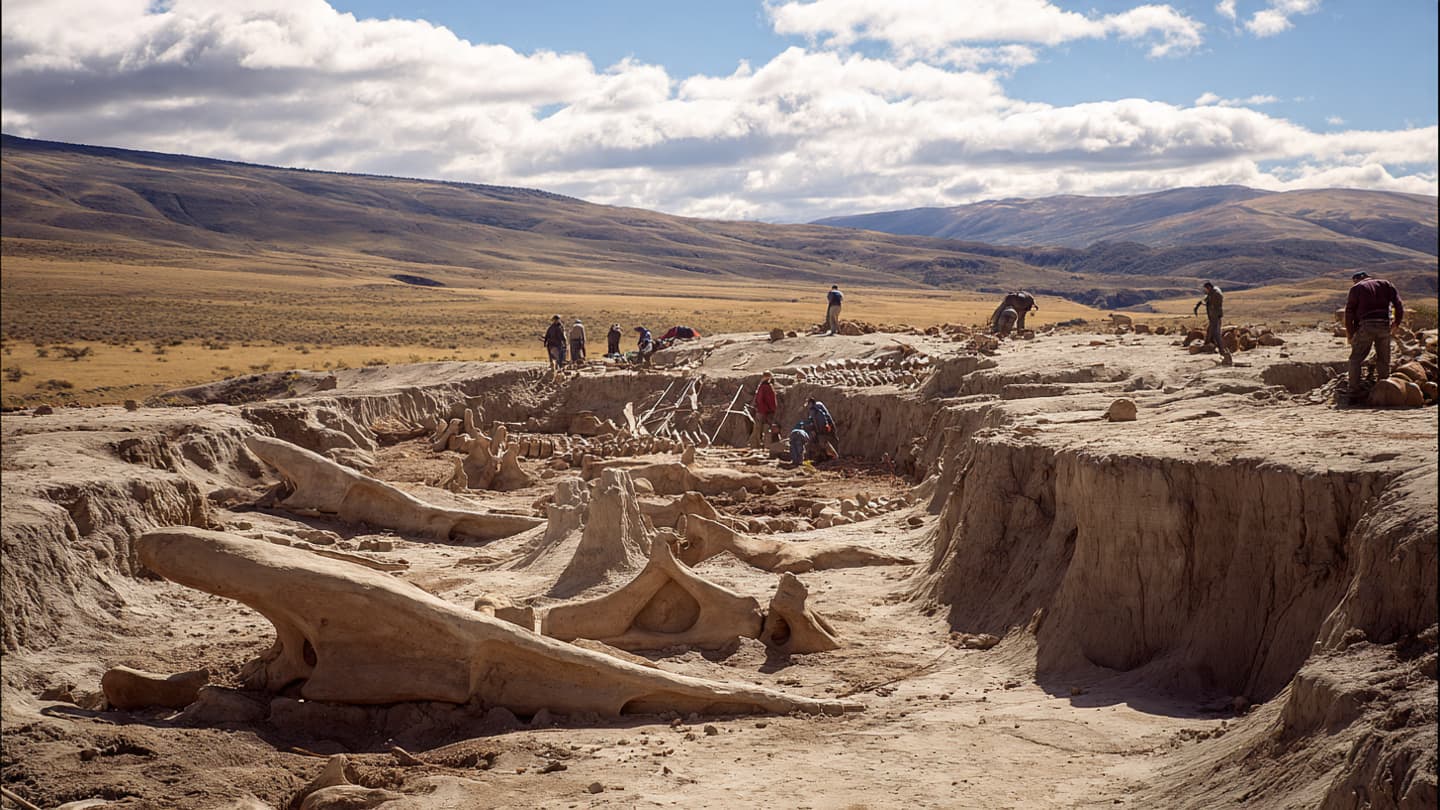
Some discoveries begin not in laboratories or universities, but in ordinary landscapes where history rests quietly beneath the soil. In Patagonia, where winds move across broad grasslands and ancient rock formations rise beneath open skies, a shepherd’s routine work unexpectedly led to the unearthing of enormous dinosaur fossils unlike any officially recognized group studied before. The discovery has drawn scientific attention not only because of the creature’s size, but because of the evolutionary mystery it may represent.
Researchers confirmed that fossil remains discovered beneath farmland in Patagonia belong to a massive dinosaur estimated at roughly 65 feet in length. Preliminary studies indicate that the skeletal structures do not fit neatly within any previously identified dinosaur classification, prompting paleontologists to begin a broader comparative analysis.
Patagonia has long been regarded as one of the world’s richest regions for dinosaur discoveries. Argentina’s southern fossil beds have produced some of the largest known prehistoric creatures, including enormous long-necked titanosaurs that once inhabited ancient floodplains during the Late Cretaceous period.
According to scientists involved in the excavation, several skeletal features appear distinct from established dinosaur groups documented in current paleontological records. Researchers caution, however, that identifying a new species or evolutionary branch requires extensive examination, peer review, and comparison with fossil databases collected from around the world.
Large fossil discoveries often emerge gradually over months or years of excavation work. Paleontologists must carefully remove sediment layers, stabilize fragile bone structures, and document surrounding geological conditions to ensure accurate scientific interpretation. The process can resemble assembling a fragmented puzzle whose missing pieces remain buried underground.
The discovery also highlights the important role local residents frequently play in paleontology. Farmers, miners, hikers, and construction workers have historically contributed to major fossil findings simply by recognizing unusual rock patterns or bone-like formations exposed by erosion and weather.
Scientists say the unusual characteristics of the newly discovered dinosaur may provide insight into evolutionary diversity among giant herbivorous species that lived in South America millions of years ago. During the age of dinosaurs, the continent formed part of a dramatically different global landscape shaped by shifting tectonic plates and evolving ecosystems.
Public fascination with giant dinosaurs continues partly because such creatures stretch the limits of imagination. Massive skeletal remains emerging from ordinary farmland remind observers that Earth’s prehistoric past remains physically present beneath modern landscapes, waiting to be uncovered piece by piece.
Researchers expect excavation and classification work to continue over the coming years. Until additional analysis is completed, scientists remain cautious about formal conclusions, though they acknowledge the discovery may represent one of Patagonia’s more unusual paleontological findings in recent years.
AI Image Disclaimer: Some images used alongside this article were created with AI-generated visual tools for illustrative purposes.
Sources: Reuters, Nature, BBC, Argentine paleontology institutes, National Geographic
Published by Banx Network. This article is part of the Banx decentralized media programme, powered by the BXE token on the XRP Ledger.