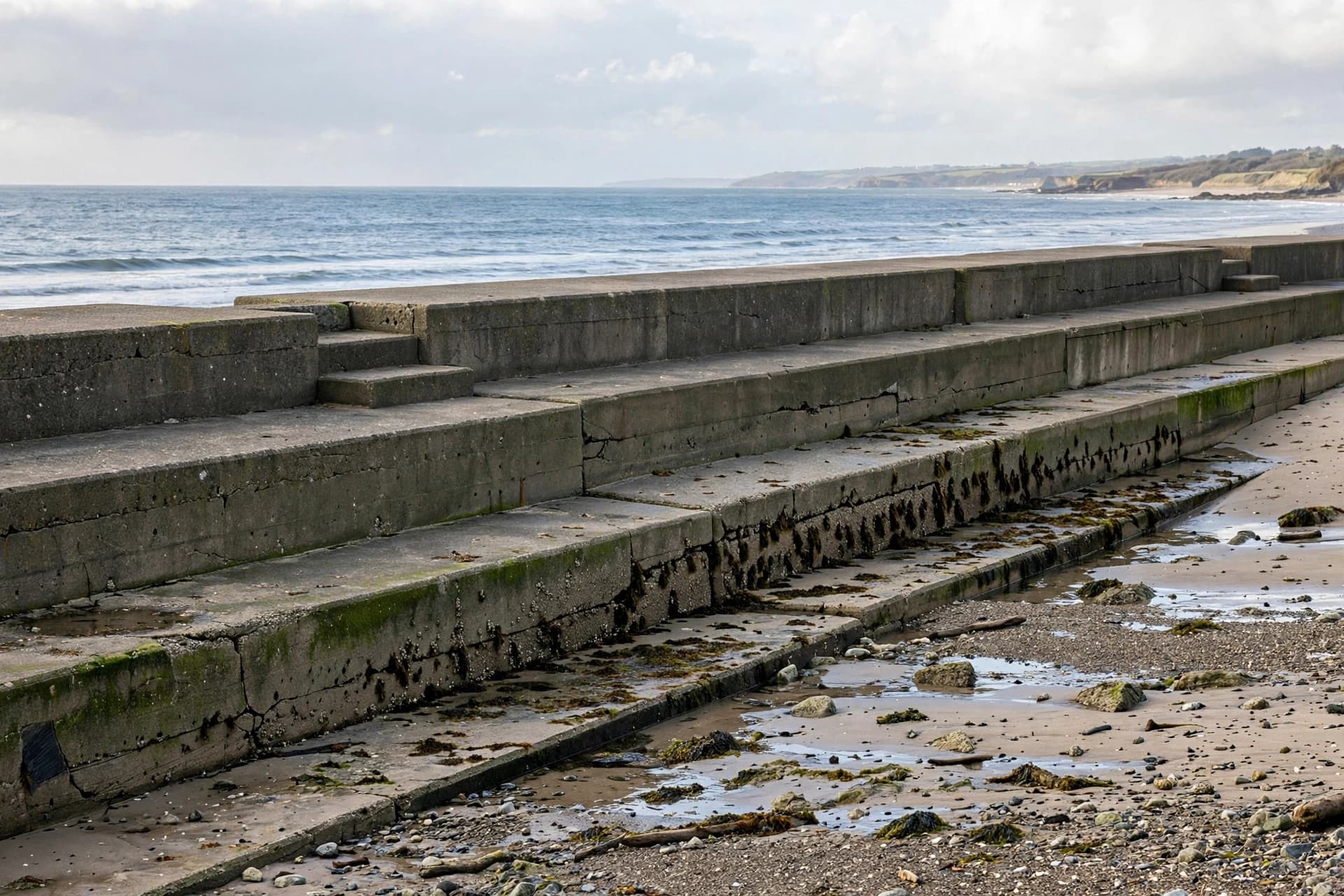
There is a particular tension that arises when a community builds something meant to protect it, and that something becomes a source of concern in its own right. The new terraced seawall at Mooloolaba, rising in stages along the Sunshine Coast foreshore, was designed to shield the beach and parkland from the sea's growing reach. Yet as summer approaches and thousands prepare to gather on its concrete tiers, questions have surfaced about whether the very material meant to safeguard will also cause discomfort—heat radiating from surfaces under a Queensland sun, or the risk of a misstep on steps that some find steep.
The project itself is substantial. The old vertical seawall, dating to the 1960s, had protected the foreshore for half a century, but investigations found it would not be sufficient against rising sea levels and more extreme weather events . The new terraced structure, approximately 290 meters long and half a meter higher than its predecessor, was designed to better protect parklands, paths, roads, and underground services . It received a $7.95 million contribution through the Federal Government's National Emergency Management Agency Disaster Ready Fund, a recognition of its importance to a region that has seen significant population growth and tourism demand .
The first section, in front of the surf club, opened during the September school holidays and drew crowds . But comments on social media reflected unease. "Won't be sitting on that concrete in summer," one person wrote. "Looks awesome but it will be hot on the concrete," another added. Some raised safety concerns: "Someone will fall down those steps," one comment read. "Steps too steep for older people. Very disappointed," another said .
The council has responded with explanations rooted in design choices. A spokesperson noted that the light sand-colored concrete was selected to blend with the natural surroundings and reflect light rather than absorb heat . Extensive landscaping—trees and vegetation throughout the seawall and parkland—will provide additional shade and cooling as it matures . The spokesperson acknowledged that any outdoor surface exposed to direct sunlight, including footpaths and beach sand, will vary in temperature depending on conditions, but emphasized that the wall has been independently reviewed and approved in accordance with engineering and safety requirements .
On the question of safety, the council pointed to specific design standards. The majority of the terraces are 900 millimeters wide and 450 millimeters high—the standard seating height . Four sets of beach access stairs will be installed along the foreshore, progressively opened as construction continues. An all-abilities access ramp and an ocean viewing deck are incorporated for people using wheelchairs, prams, or mobility devices. The project's design was intended to be "safer" with "reduced fall hazard" compared to the old vertical wall .
Not all responses have been critical. Several members of the public have voiced support. "Well done. I think it looks awesome. Take a towel to sit on, people," one comment read. "Awesome. Fantastic for Mooloolaba and the Sunshine Coast. Embrace it, be positive and enjoy it," another added. "How good! Such an improvement. Bring on summer" .
The council has said it will continue to monitor the foreshore as sections are progressively opened . The concerns raised are not unusual for any public infrastructure project—communities have a stake in the spaces they use, and their voices reflect a desire for those spaces to serve everyone. The seawall's purpose is protection; its success will be measured over decades. Whether the concrete becomes a place of gathering or avoidance in the summer months is a question only time and weather will answer.
AI Image Disclaimer: The imagery associated with this article is AI-generated and serves an illustrative purpose only.
Published by Banx Network. This article is part of the Banx decentralized media programme, powered by the BXE token on the XRP Ledger.