There is a particular cruelty in a championship decided not by the steady accumulation of skill over months, but by a single error in the final moments—a crash that transforms what should have been a coronation into an act of survival, and a season of consistency into a title that feels, to the winner, almost like a gift he did not ask for. On the final stage of the Rally Italia Sardegna, on the island where the World Rally Championship season had come to its last kilometers, Elfyn Evans became Britain's first world rally champion in twenty-five years. He did not win the rally. He finished fifth. But Oliver Solberg, his Toyota teammate, crashed two corners from the finish while on course to take the title, and the championship fell to Evans by the narrowest of margins.
The numbers tell a story of a season that could not have been closer. Evans, thirty-seven, from Dolgellau in north Wales, had led for much of the year and took a twenty-one-point advantage into the final round . But by the time the drivers lined up for the last of seventeen stages, that gap had shrunk to a solitary point. Solberg, twenty-five, the son of 2003 champion Petter Solberg, needed only to beat Evans in the final Power Stage to claim enough bonus points to become champion .
The final stage was a winner-takes-all contest. Solberg, starting third on the road, had the advantage of cleaner lines. Evans, running first, had to sweep the sandy, rutted surface for those behind him. He admitted afterward that he "overdrove" and that his stage was not clean . Solberg was faster at the first split. With a little more than a kilometer to go, he was 1.9 seconds ahead of Evans on the clock. The championship was, by the calculations of everyone watching, his to lose .
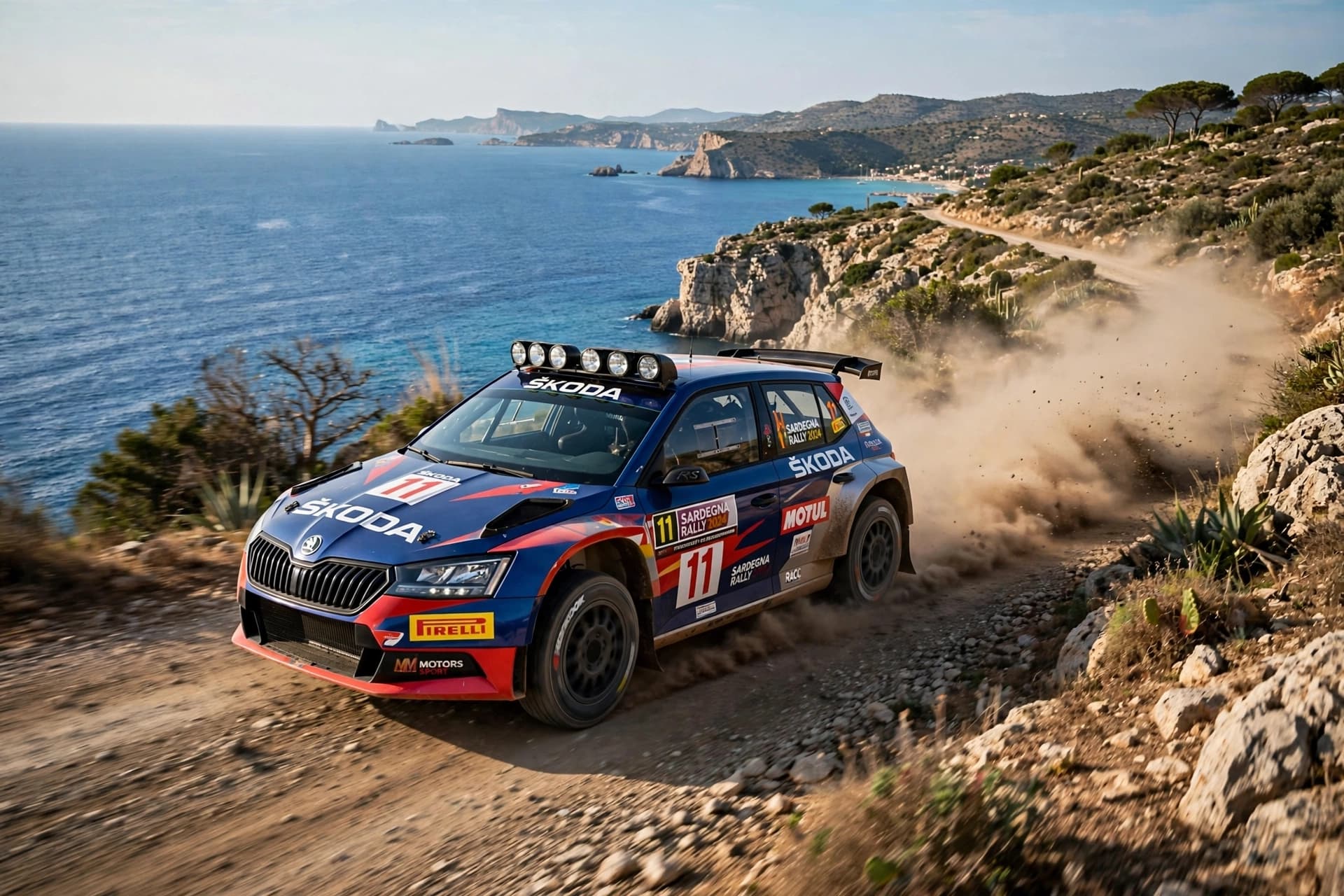
Then came the left-hander along the Argentiera coastline, the penultimate corner before the finish. Solberg's Toyota Yaris oversteered. The rear swung out. He tried to correct, but the car flew off the road and into the dunes. He recovered, returned to the stage, and finished—winning the rally by nearly a minute over nine-time champion Sébastien Ogier . But the nine seconds he lost in the crash meant he finished the Power Stage behind Evans, and with it, the championship slipped away. Solberg finished the season five points behind Evans in the standings .
Solberg remained in his car at the end of the stage, inconsolable. He had to be encouraged to take the podium by team principal Jari-Matti Latvala and Ogier, the Swedish national anthem playing as he struggled to hold back emotion . "Two corners, two corners," he said. "I tried everything. I knew I was pushing but didn't know if it was enough. I pushed even more and I couldn't save the car. I tried my very best" . Evans, for his part, was subdued. He had been runner-up five times, and had lost the title on the final day three times before. "It hasn't sunk in," he said. "I was sure it was over. I feel for Oliver—he had an incredible weekend. It wouldn't be my proudest way of winning it, but it's job done" .
Evans becomes only the third British man to win the WRC title, after Colin McRae in 1995 and Richard Burns in 2001 . Sami Pajari, the third Toyota driver in contention, finished third in the standings, one point behind Solberg . The season ended as it had begun: with the three of them separated by margins too small to be comfortable. The championship was decided by two corners, by a fraction of a second, by the thin line between control and disaster. Evans drove across that line. Solberg did not.
AI Image Disclaimer: All images in this article are AI-generated and are intended for illustrative purposes only.
Sources: BBC, Motorsport.com, DirtFish, San Marino RTV
Published by Banx Network. This article is part of the Banx decentralized media programme, powered by the BXE token on the XRP Ledger.