

Key Highlights
- Meteor Crater is nearly a mile wide and over 500 feet deep.
- The site has been studied for over a century, revealing insights into cosmic impacts.
- NASA astronauts trained at Meteor Crater for the Apollo missions.
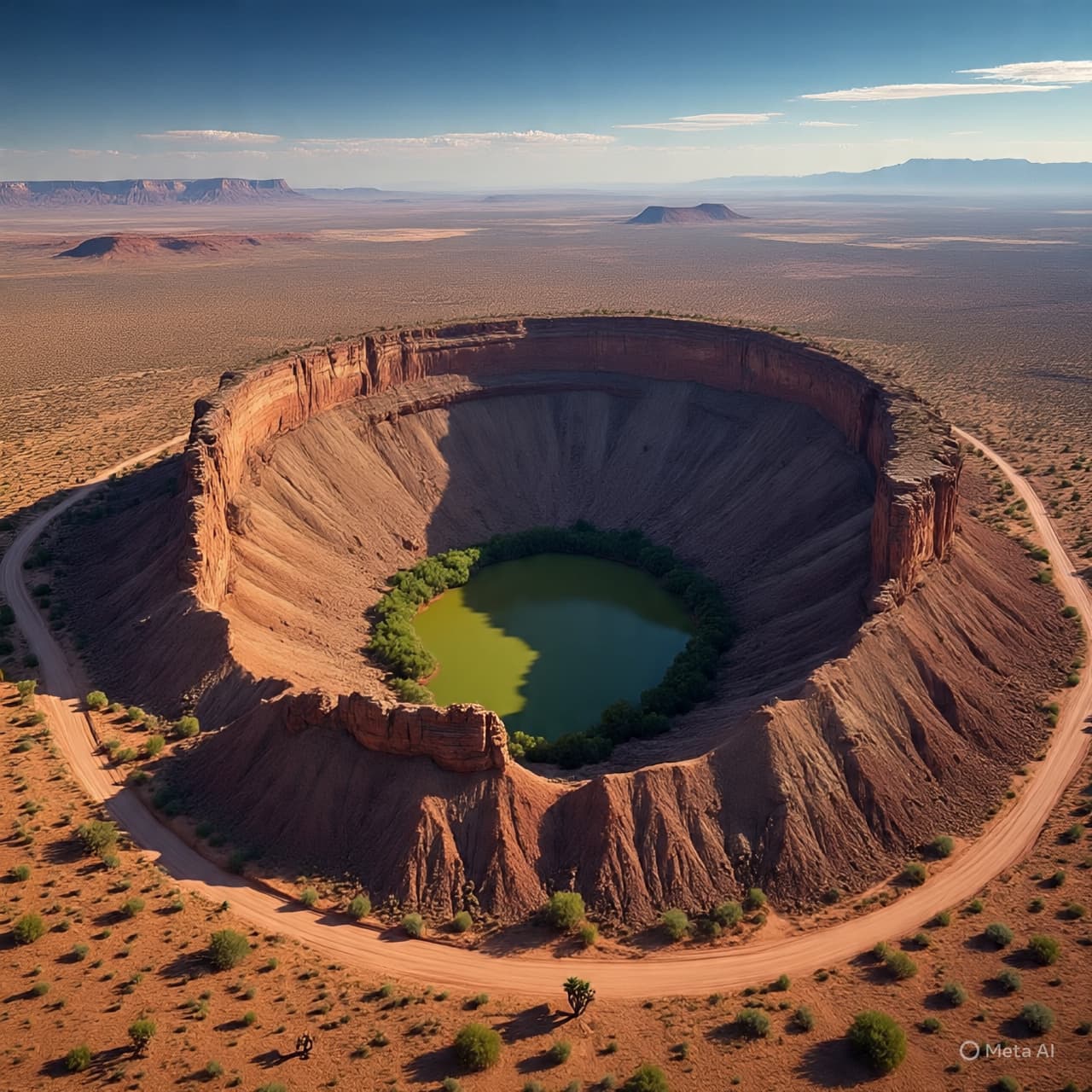
Meteor Crater, located in northern Arizona, is a geological wonder that has captivated scientists and visitors alike for over 50,000 years. Formed by a meteorite impact, this site is one of the best-preserved impact craters on Earth, measuring nearly a mile in diameter and over 500 feet deep. The crater serves as a significant landmark, offering a glimpse into the violent forces that have shaped our planet.
The story of Meteor Crater began with a cataclysmic event that occurred in an instant. A meteor, traveling at incredible speeds, struck the desert floor, creating a massive depression and ejecting debris into the atmosphere. This impact not only altered the landscape but also provided a unique opportunity for scientists to study the effects of such collisions. Researchers have been investigating the crater since the early 1900s, when it was first recognized as an impact site rather than a volcanic formation.
Over the years, Meteor Crater has become a natural laboratory for geologists and planetary scientists. The layers of rock surrounding the crater reveal how the impact altered minerals under extreme conditions. Some of these minerals exhibit structures that can only form during high-energy collisions, providing crucial evidence for identifying other ancient impact sites around the globe. Recent studies have focused on the distribution of debris from the impact, analyzing fragments of rock and impact glass to reconstruct the explosive forces at play during the event.
The meteor that created Meteor Crater is believed to have been an iron-nickel object approximately 50 meters wide. Despite its relatively small size in cosmic terms, the energy released upon impact was equivalent to that of a large nuclear explosion, blasting millions of tons of rock outward and forming the crater we see today. This preservation of the crater's features makes it a rare and valuable site for scientific research, as many older craters have been eroded over time.
Meteor Crater also holds historical significance in the context of space exploration. In the 1960s, NASA astronauts trained at the site in preparation for the Apollo missions. The crater's landscape closely resembles the lunar terrain, making it an ideal location for astronauts to practice geological observation and sample collection. The training conducted at Meteor Crater equipped astronauts with the skills necessary to recognize and interpret impact features on the Moon's surface.
Today, advancements in technology continue to enhance our understanding of Meteor Crater. High-resolution satellite imagery, drone mapping, and sophisticated mineral analysis techniques allow scientists to explore details that were previously unattainable. These modern tools have unveiled subtle patterns in the ejecta field, helping researchers understand the dynamics of shock waves and the impact's influence on the surrounding landscape.
Meteor Crater serves as a poignant reminder of Earth's connection to the cosmos. Throughout history, impacts from asteroids and comets have played a crucial role in shaping our planet's geography and even influencing the course of life. While most celestial objects disintegrate upon entering the atmosphere, Meteor Crater stands as a testament to the dynamic nature of our solar system.
Visitors to Meteor Crater are not merely gazing into a geological formation; they are witnessing a moment frozen in time, a powerful reminder of the forces that have shaped our world. As scientists continue to study this remarkable site, they uncover fragments of a story that began long before humanity arrived to ponder its mysteries. Meteor Crater remains a monument to cosmic chance and a vital scientific resource, inviting exploration and discovery for generations to come.
Published by Banx Network. This article is part of the Banx decentralized media programme, powered by the BXE token on the XRP Ledger.




