

Key Highlights
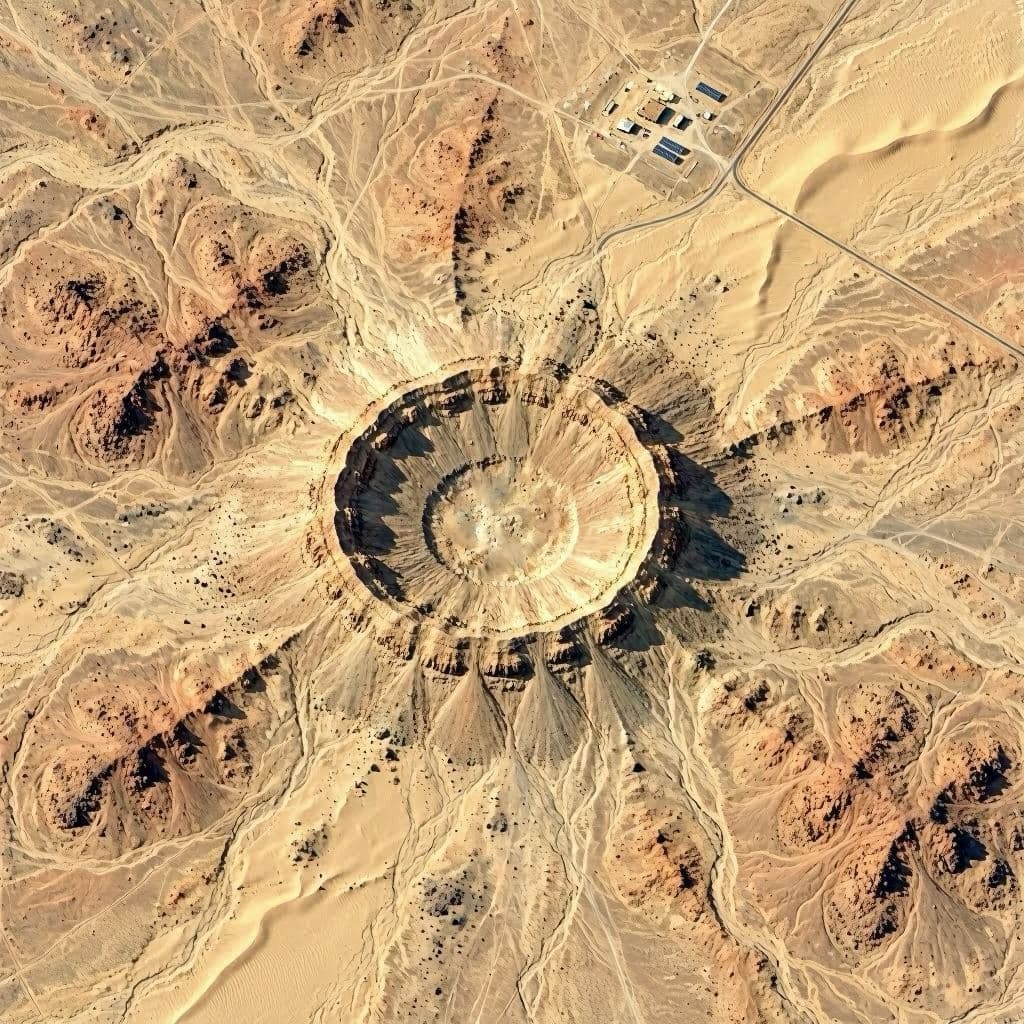
- Discovery:A massive circular depression on Google Earth may be a meteorite impact crater.
- Characteristics:The crater exhibits classic impact morphology, suggesting an extraterrestrial origin.
- Public Engagement:The finding highlights the role of citizen science in geological discoveries.
[Potential Meteorite Impact Crater]
In an age where technology allows us to explore the Earth from the comfort of our homes, a recent discovery on Google Earth has captured the attention of both geologists and amateur enthusiasts. A massive circular depression, located in a remote area, has sparked speculation that it could be the scar of an ancient meteorite impact. This finding not only raises questions about the crater's origins but also emphasizes the role of digital mapping in modern scientific inquiry.
The crater's morphology is strikingly similar to that of known impact sites, featuring a raised rim and a depressed center, along with radial patterns indicative of a high-energy event. While natural geological processes such as volcanic activity or erosion can create similar formations, the symmetry and scale of this crater suggest a more violent origin. Researchers estimate that the impacting body could have been several kilometers in diameter, hinting at a significant event in Earth's history.
To investigate the crater further, scientists are comparing satellite imagery with geological data to identify signs of shock metamorphism—alterations in rock caused by intense pressure and heat during an impact. If confirmed, this crater would join the ranks of verified impact sites on Earth, which are relatively few due to the erasing effects of weathering and tectonic activity over millions of years.
Determining the age of the crater poses a challenge without physical samples for analysis. However, the well-preserved structure suggests it may be geologically recent, possibly only a few million years old. This timeframe is particularly intriguing, as it coincides with an era when early hominids or other prehistoric life forms may have witnessed the meteor's descent.
The discovery of this crater exemplifies the democratization of science, as platforms like Google Earth empower everyday citizens to contribute to scientific exploration. Amateur enthusiasts often spot features that professionals might overlook, fostering a collaborative spirit in the scientific community. This engagement not only enhances public interest in geology and astronomy but also encourages a sense of shared ownership over our planet's history.
If the crater is indeed a result of a meteorite impact, it could provide valuable insights into the frequency of such events on Earth. Understanding the history of large impacts is crucial for assessing future risks and developing strategies for planetary defense. Each new discovery refines our models of near-Earth object populations and their potential trajectories, enhancing our preparedness for similar events in the future.
The mystery surrounding this crater serves as a reminder of Earth's dynamic nature. Our planet is not merely a passive stage for life; it actively participates in the cosmic dance, bearing the marks of encounters with celestial bodies. These scars tell stories of violence and survival, linking our terrestrial existence to the broader solar system.
Whether this feature turns out to be a meteorite impact or a unique geological formation, its discovery highlights the importance of curiosity and observation. As technology continues to expand our ability to explore the world, we may uncover more hidden chapters of Earth's history waiting to be revealed. The crater stands as a silent witness to a moment when the sky fell, inviting us to look closer at the ground beneath our feet.
Published by Banx Network. This article is part of the Banx decentralized media programme, powered by the BXE token on the XRP Ledger.




