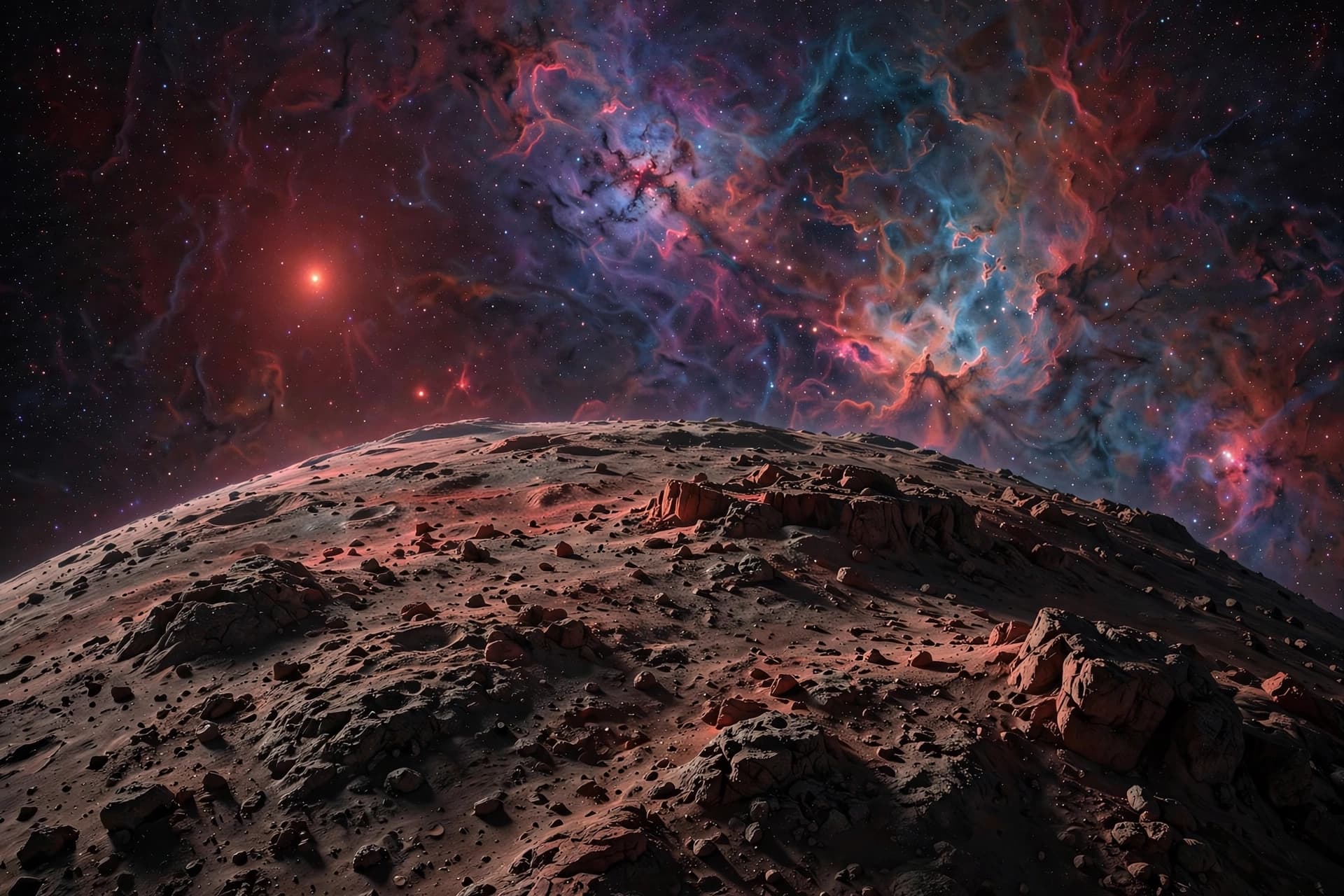
In the vast library of the cosmos, each newly discovered exoplanet adds a unique volume to our understanding of how solar systems come to be. Recently, astronomers identified a rocky world orbiting far from its host star, a configuration that defies conventional wisdom. This discovery, published in Astronomy & Astrophysics, suggests that the rules governing planet formation may be more flexible than previously thought, inviting scientists to rethink the architectural blueprints of planetary systems.
The planet, found orbiting the red dwarf star LHS 1903, is located in the outer regions of its system, well beyond where gas giants typically reside. According to standard models, rocky planets should form close to their stars, where temperatures are high enough for solid materials to condense, while gas giants form farther out, where ices are abundant. Finding a terrestrial world in the cold outer reaches challenges this neat division, suggesting that migration or other dynamic processes may play a larger role in shaping planetary orbits.
The discovery was made using data from high-precision radial velocity instruments, which detect the subtle wobble of a star caused by the gravitational pull of an orbiting planet. The signal indicated a planet with a mass similar to Earth’s, but its distance from the star was surprising. This placement implies that it either formed in situ under unusual conditions or migrated outward from a closer orbit, a process that is difficult to explain with current theories.
Red dwarf stars, which are smaller and cooler than the Sun, are known to host different types of planetary systems. However, the presence of a rocky planet in the outer zone of LHS 1903 adds a new layer of complexity. It suggests that even low-mass stars can produce diverse planetary architectures, potentially harboring worlds in unexpected locations. This finding encourages astronomers to look beyond traditional habitable zones when searching for Earth-like planets.
The implications for planet formation theory are significant. If rocky planets can exist far from their stars, then the distribution of materials in protoplanetary disks may be more mixed than assumed. Turbulence, gravitational interactions, or early stellar activity could redistribute solids, allowing terrestrial worlds to form or settle in distant orbits. This flexibility expands the range of possibilities for where life-supporting planets might be found.
Further observations are needed to determine the planet’s composition and atmosphere, if it has one. Future telescopes, such as the James Webb Space Telescope, may be able to characterize this world in greater detail, providing clues about its origin and evolution. Each piece of data helps refine the models that describe how planets assemble from dust and gas.
For now, this new planet stands as a testament to the unpredictability of the universe. It reminds us that nature often finds ways to surprise us, breaking the molds we create to understand it. As more such anomalies are discovered, our picture of planetary systems will become richer and more nuanced.
The discovery of a rocky planet in the outer orbit of LHS 1903 challenges established theories of planetary formation. It highlights the need for continued exploration and theoretical innovation. As we uncover more of these cosmic outliers, we move closer to a comprehensive understanding of how planetary systems evolve and diversify across the galaxy.
AI Image Disclaimer: The images accompanying this report are AI-generated artistic interpretations intended to illustrate the concept of exoplanet discovery, not actual images of the planet or its star.
Sources: Science Daily, McMaster University, Astronomy & Astrophysics, EarthSky
Published by Banx Network. This article is part of the Banx decentralized media programme, powered by the BXE token on the XRP Ledger.