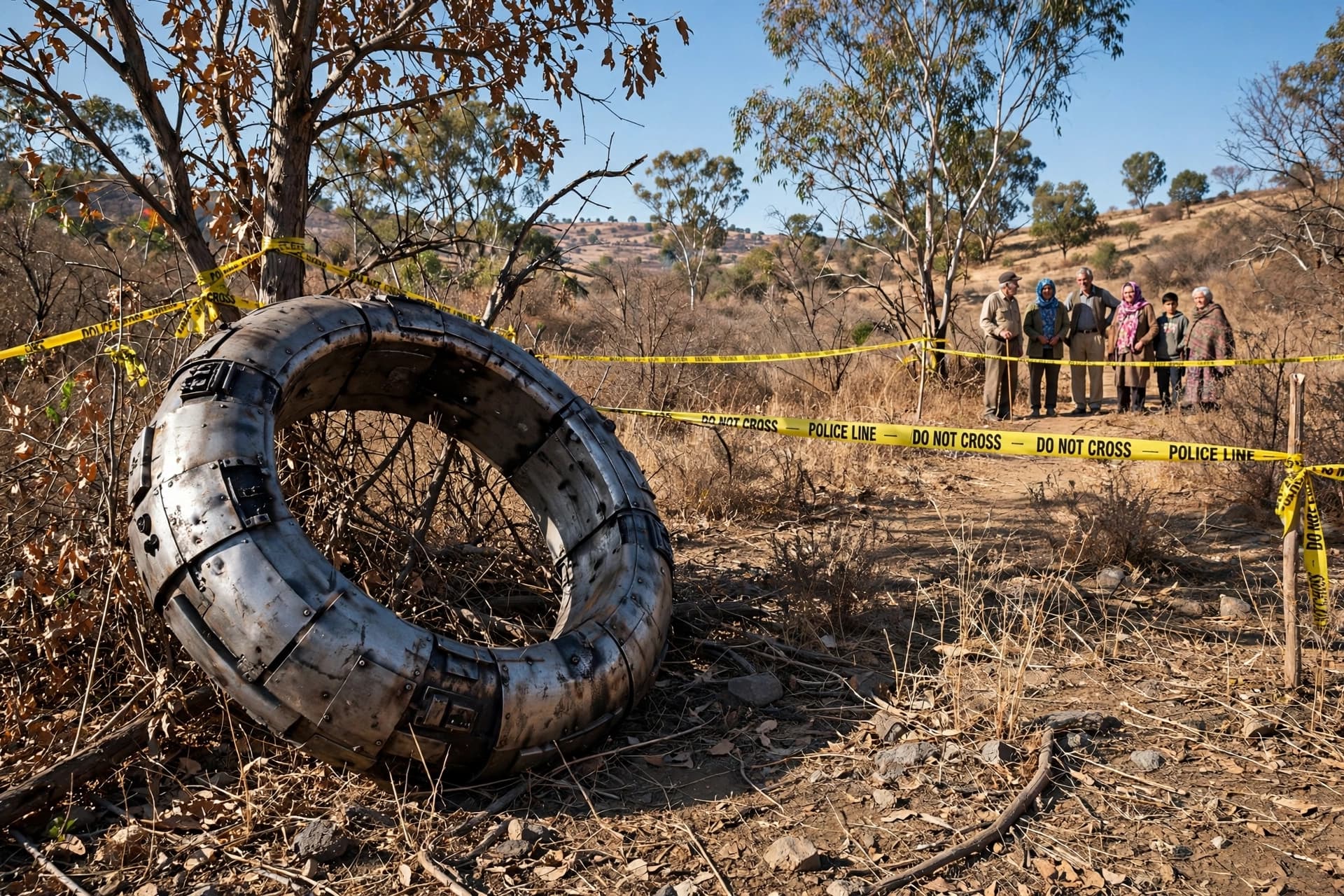
On a quiet afternoon in late December, the residents of Mukuku Village in Makueni County, Kenya, heard a sound they would not soon forget—a deep, percussive bang that some later described as resembling an explosion. When they went to investigate, they found something that belonged less to the soil of eastern Africa than to the cold, silent reaches of low Earth orbit: a metallic ring, still glowing red with the heat of reentry, resting in the brush.
The object, later measured at approximately 2.5 meters in diameter and weighing around 500 kilograms, was identified by the Kenya Space Agency as a separation ring from a launch vehicle—a piece of hardware designed to detach during a rocket’s ascent and, under normal circumstances, either burn up entirely in the atmosphere or fall into an unpopulated expanse of ocean . That it survived the fiery passage through the atmosphere and landed in a village of farmers and families is a reminder of the quiet uncertainties that accompany humanity’s growing presence in space.
The villagers did what communities often do when confronted with the inexplicable: they gathered, kept their distance from the still-hot metal, and waited. Local police cordoned off the area until the ring cooled from its incandescent red to a dull gray . Some stayed through the night, worried that scrap dealers might attempt to haul away the curiosity before authorities arrived . When officials from the Kenya Space Agency reached the site the following day, they took custody of the object and began the methodical work of determining its origin .
Not everyone in the space-tracking community is convinced that the ring came from orbit. Jonathan McDowell, an astrophysicist at the Harvard-Smithsonian Center for Astrophysics, noted that the evidence for reentry heating was “marginal” and suggested the object might not be space debris at all . Other specialists, including Marco Langbroek of Delft Technical University, pointed to nearby material resembling carbon wrap and insulation foil as possible corroboration of a space origin . The Kenya Space Agency, meanwhile, has stood by its preliminary assessment, describing the ring as a separation ring from a launch vehicle and stating that the case is being investigated under international space law .
For the residents of Mukuku, the debate among experts matters less than the tangible consequences of the event. Some reported cracks appearing in the concrete walls of their homes after the impact, though these claims have not been independently verified . Others expressed concern about potential radiation exposure, a fear that the Kenya Nuclear Regulatory Authority sought to allay by confirming that radiation levels, while slightly elevated, remained within safe limits . The more immediate anxiety was simpler: a half-ton object fell from the sky without warning, and no one could say with certainty whose it was.
The ring now sits in the custody of the Kenya Space Agency, awaiting further analysis. Its journey—from a launch pad somewhere on Earth, through the vacuum of space, and finally into the red soil of Makueni County—illustrates both the remarkable reach of modern rocketry and the lingering gaps in the systems meant to track what we send into the heavens.
As the investigation continues, the people of Mukuku Village are left with a story to tell and a quiet question to ponder: what else might fall, and where might it land next?
AI Image Disclaimer: All images associated with this article are artificial intelligence renderings and are not photographs of the actual event. They are intended for illustrative purposes only.
Sources: RNZ, Nairobi News, The Star, Space in Africa, Futurism, Space.com, The Boston Globe
Published by Banx Network. This article is part of the Banx decentralized media programme, powered by the BXE token on the XRP Ledger.

.jpg&w=3840&q=75 "September 2026 Was the Second-Warmest on Record, With Global Temperatures Above 1.5°C for a Second Month")