
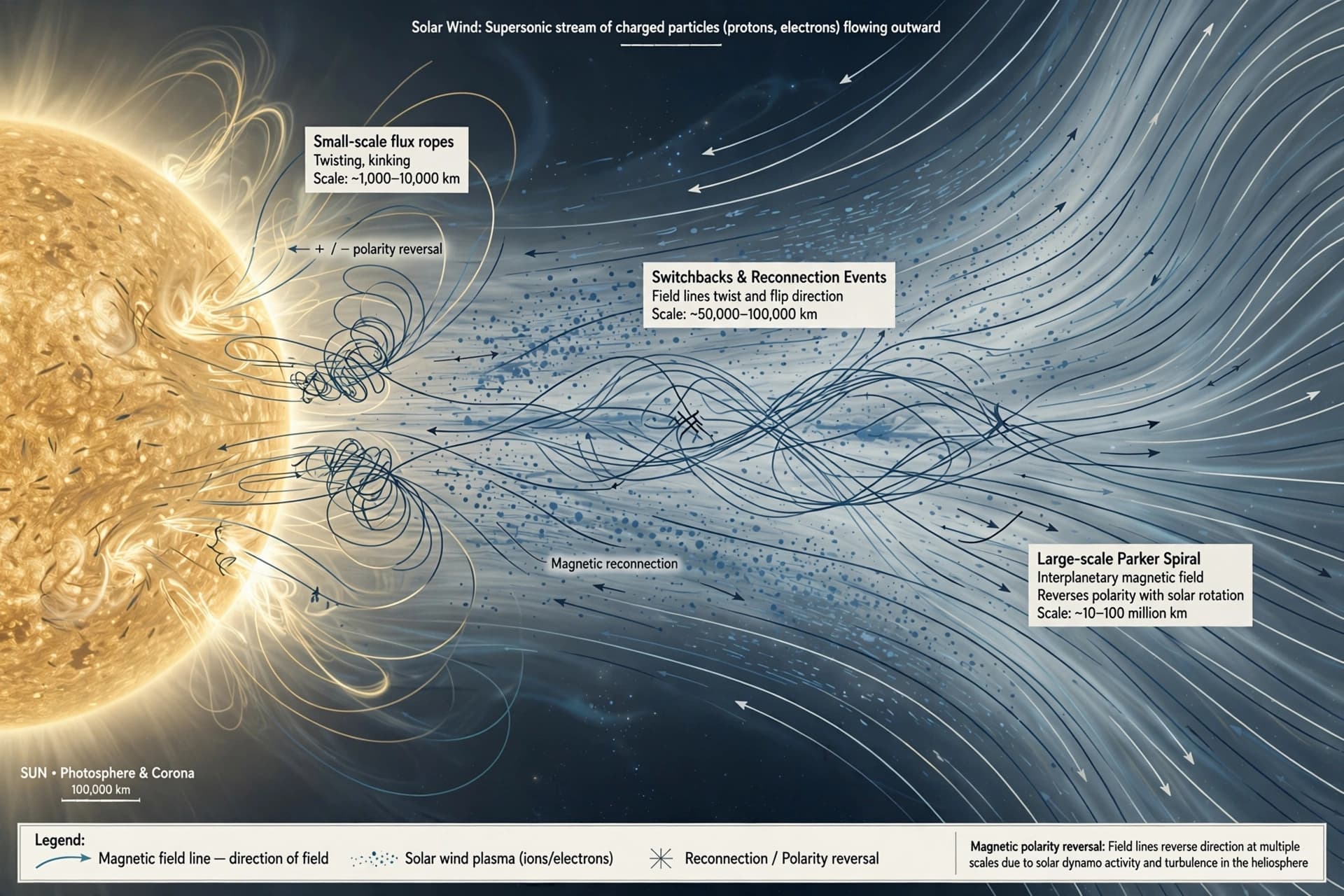
There is a particular elegance in finding order where none should exist—a pattern hidden within the noise, a structure emerging from what appeared to be pure chaos. The solar wind, that ceaseless stream of charged particles flowing outward from the Sun, has long been understood as a turbulent medium, its magnetic fields twisting and churning in ways that seemed fundamentally random. Now, an international team of researchers has discovered something unexpected: within that turbulence, the magnetic field rotates in a consistent direction at large scales, then reverses at smaller ones. The unstructured, it turns out, has a hidden architecture.
The discovery, published in The Astrophysical Journal Letters, was led by researchers at Technische Universität Braunschweig in collaboration with scientists from ten countries . Using high-precision magnetic field and particle data from NASA’s Parker Solar Probe mission, the team demonstrated for the first time a clear reversal of magnetic field rotation sense over a specific wavelength .
At larger length scales, space plasma behaves like a fluid, and turbulence develops through vortices and electromagnetic waves. The magnetic fields preferentially rotate counterclockwise when viewed radially away from the Sun. But at smaller scales, the rotation flips—the fields rotate clockwise . The transition point, researchers found, coincides precisely with the scale where the plasma stops behaving like a fluid and individual particle dynamics take over. This boundary, known as the magnetohydrodynamic–kinetic interface, has received little theoretical attention, making the result a window into a previously unexplored regime .
“We see a clear structure in the spectrum, even though the turbulence represents unstructured motions,” said Dr. Masatomi Iizawa, lead author of the study . The reversal also grows and shifts toward longer wavelengths as one moves radially away from the Sun, suggesting the phenomenon evolves with distance .
The implications extend beyond plasma physics. Turbulence in space plasma influences shock waves and magnetic clouds produced by solar eruptions, making it a critical factor in predicting geomagnetic storms—events that can disrupt power grids and satellite communications while producing spectacular auroras . Understanding how energy distributes across scales in collisionless turbulence, as this research demonstrates, is a fundamental puzzle that affects space weather forecasting and our comprehension of astrophysical systems ranging from accretion disks to the Earth’s magnetosphere.
The findings do not resolve every mystery of solar wind turbulence. But they reveal that within the apparent randomness of space plasma, a coherent pattern exists—a structure written into the very transition between fluid and particle behavior, waiting to be understood.
AI Image Disclaimer: The visuals in this article were created using artificial intelligence for illustrative purposes only and do not depict the actual spacecraft data or observations described.
Sources: Technische Universität Braunschweig, The University of Tokyo, EurekAlert, The Astrophysical Journal Letters, IDW Online
Published by Banx Network. This article is part of the Banx decentralized media programme, powered by the BXE token on the XRP Ledger.



