There are moments in nature that feel less like events and more like unfolding stories—fragile, uncertain, and quietly followed by those who watch from a distance. Along Germany’s northern coastline, one such story has taken shape, centered not on a storm or tide, but on a single whale known, almost affectionately, as Timmy.
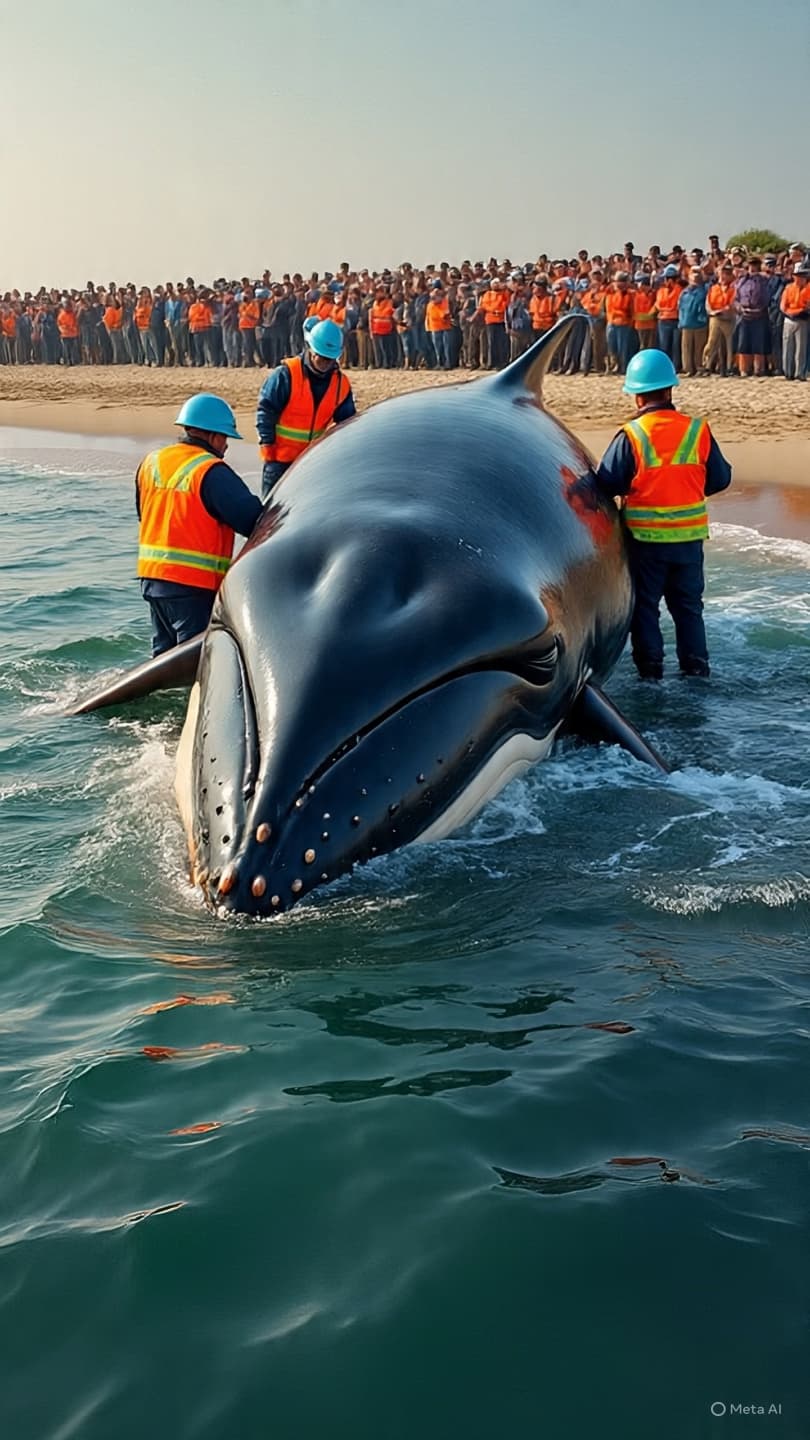
First spotted in the shallow waters near the , the young humpback whale quickly drew attention. Stranding events are not unheard of, yet each carries its own complexity. Tides shift, channels narrow, and for large marine animals, even a small miscalculation can become difficult to reverse.
In Timmy’s case, there was an early moment of cautious relief. After initial concern, the whale managed to free itself, moving back toward deeper water as tides and currents briefly aligned in its favor. For observers—rescue teams, researchers, and local communities—the sight suggested a turning point, a quiet resolution to what might have been a more serious outcome.
But the sea does not always move in straight lines.
Not long after, Timmy was found stranded once again, this time in another shallow stretch along the coast. The repetition has drawn renewed concern from marine experts, who note that such behavior may indicate disorientation, exhaustion, or underlying health issues. Navigating coastal waters can be particularly challenging for humpback whales, especially juveniles, whose migratory instincts may not yet be fully refined.
Efforts to assist remain careful and measured. Unlike some rescue operations, direct intervention with large whales is limited by both safety and practicality. Instead, authorities often rely on monitoring, crowd control, and guidance—ensuring the animal is not further stressed while allowing natural conditions, such as rising tides, to create an opportunity for escape.
There is also a broader context that shapes these incidents. Changes in ocean conditions, shifting prey patterns, and increasing maritime activity all influence how marine animals move through their environment. While no single cause is easily defined, each stranding becomes part of a larger pattern that scientists continue to study.
For now, Timmy’s story remains unfinished. The tides will rise again, and with them, another chance to return to open water. Whether that moment arrives easily or not, it is being watched—quietly, patiently—by those who understand how delicate such journeys can be. AI Image Disclaimer Illustrations were produced with AI and serve as conceptual depictions.
Source Check — Credible Media Presence Reuters BBC The Guardian Associated Press Deutsche Welle
Published by Banx Network. This article is part of the Banx decentralized media programme, powered by the BXE token on the XRP Ledger.