Along the coast of Mozambique, where the Indian Ocean meets the Bazaruto Archipelago, there is a kind of resurrection taking place that no one planned and few had noticed. Forests that once stood on dry land, their roots gripping soil and their canopies catching sunlight, were swallowed by rising seas thousands of years ago. Yet they did not vanish. They waited.
Researchers from the Bazaruto Center for Scientific Studies (BCSS) Ocean Observatory have documented what they call "peat reefs"—submerged platforms of compressed, carbon-rich remains from ancient coastal forests that now teem with marine life in ways that rival neighboring coral reefs . The findings, published in Scientific Reports, represent the first ecological study of tropical peat reefs anywhere in the world .
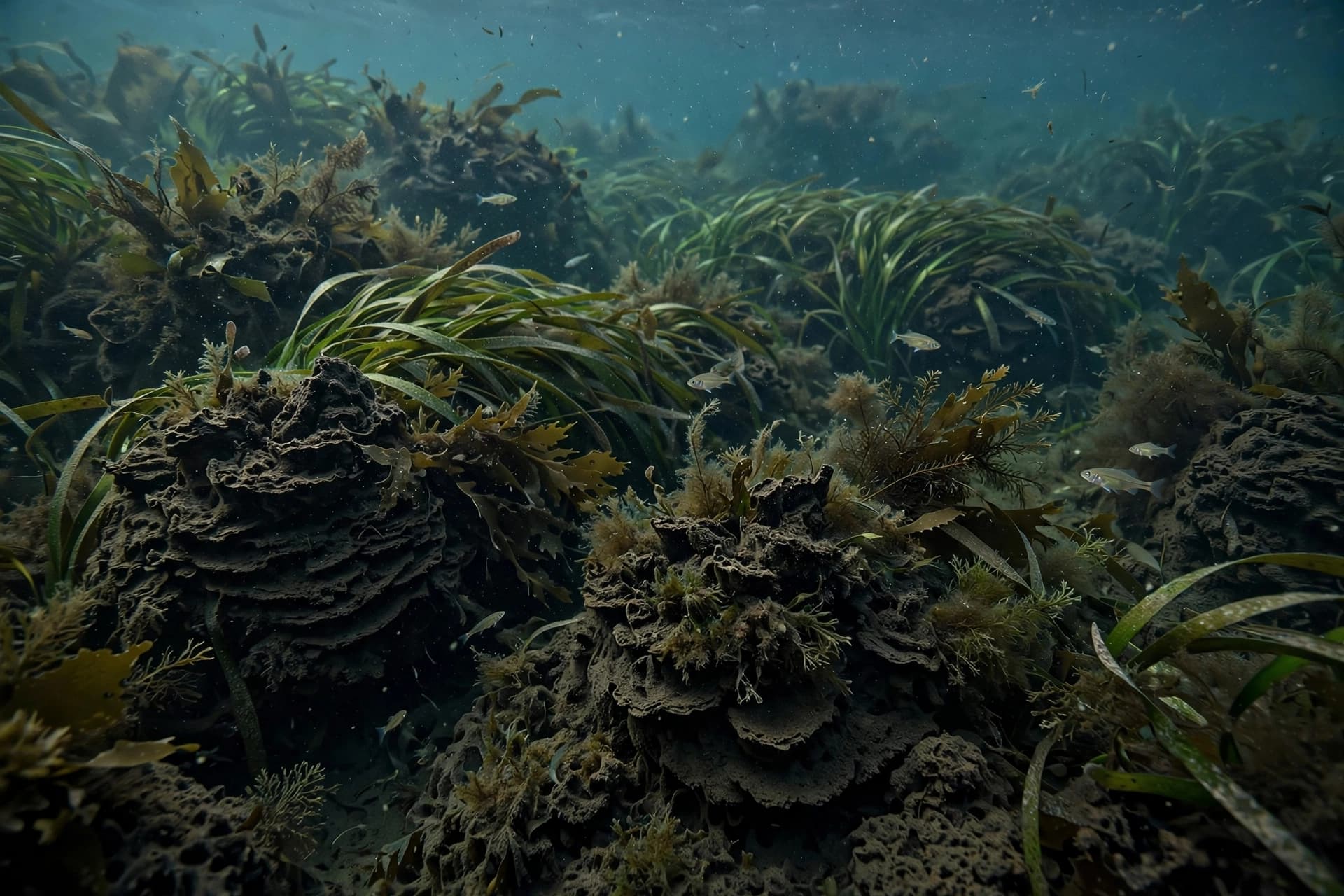
The story begins roughly 5,000 years ago, when sea levels rose and flooded coastal swamps and forests along the Mozambican coast. Over millennia, waves stripped away the sand that covered these drowned landscapes, exposing firm peat platforms on the seabed . These hard surfaces—rare in a region dominated by shifting sand—became places for life to settle, hide, and feed .
What settled there is remarkable. The peat reefs host no living coral, yet they support biodiversity comparable to coral reefs nearby. Each peat reef holds between 26 and 36 species of small fish, with a diversity mix similar to that of the coral reef next door . Seagrass and seaweeds grow directly on the peat. Crevices and ledges shelter spiny lobsters, oysters, barnacles, and juvenile fish, including young snappers and grunts that are usually associated with coral ecosystems .
"We were surprised by how much life these ancient peat deposits support, and how many species move between them and the coral reefs nearby," said Dr. Mario Lebrato, lead author and co-founder of BCSS . The reefs also attract larger animals—sharks, rays, and green turtles—with overlapping species between peat and coral reef types .
The discovery raises questions that extend beyond ecology. Some peat samples contain up to 40 percent organic carbon by dry weight, suggesting these formations could function as significant carbon stores . Peat swamps on land can hold 1,000 to 2,000 tonnes of carbon per hectare below ground, but no one yet knows how much the reefs hold or whether they are storing or releasing carbon today . The authors call for dedicated research to determine their role in blue-carbon storage and their stability in a changing ocean.
For now, the peat reefs stand as a quiet reminder of the Earth's capacity for reinvention. What was once forest floor is now a nursery for reef fish. What was lost to the sea has become something else entirely—not a relic, but a living system, shaped by forces no one directed and sustained by processes still not fully understood.
AI Image Disclaimer: The accompanying visual is AI-generated and does not depict an actual underwater photograph of the peat reefs.
Sources: EurekAlert, Scientific Reports (Nature), BBC Wildlife Magazine, BCSS Ocean Observatory, Globo.com
Published by Banx Network. This article is part of the Banx decentralized media programme, powered by the BXE token on the XRP Ledger.