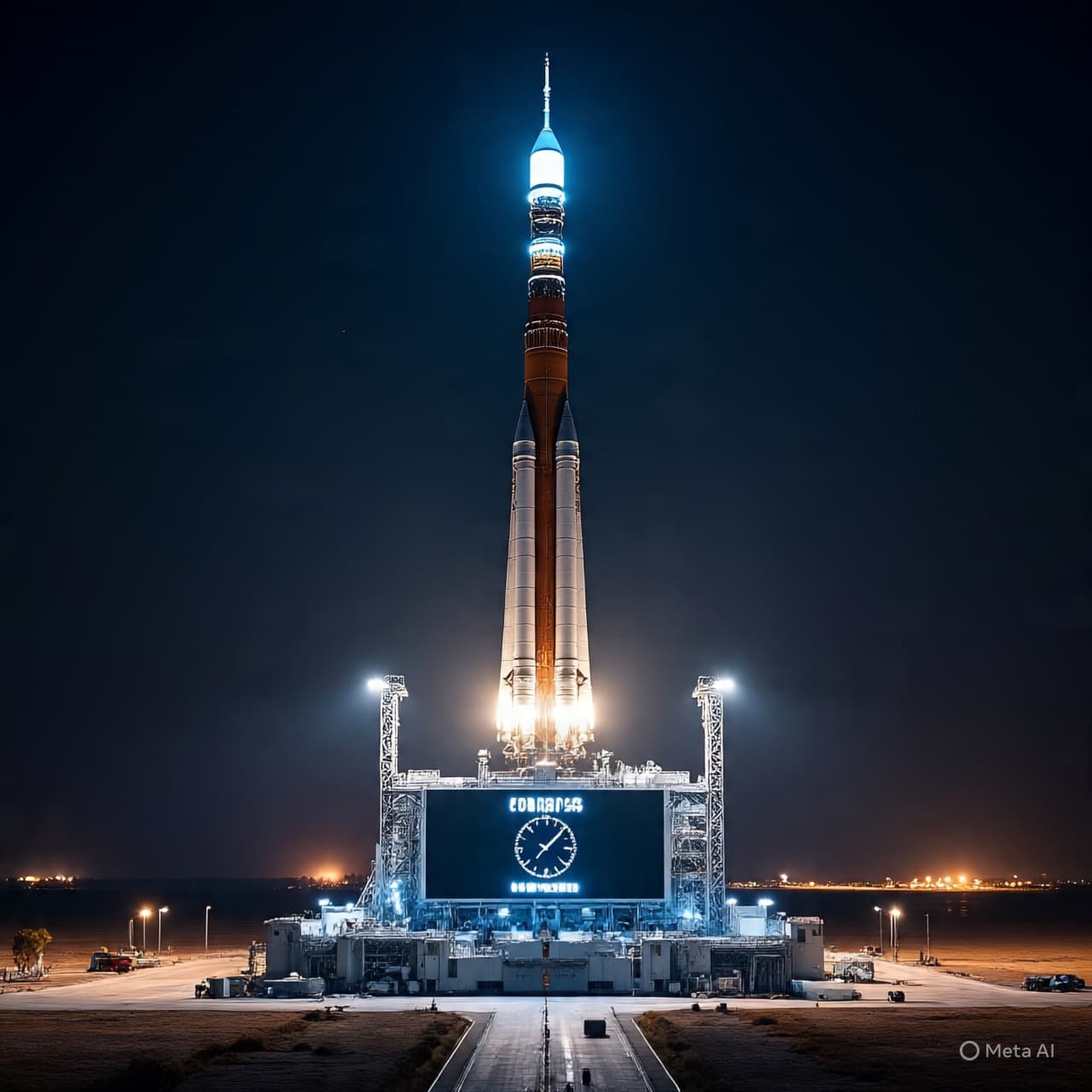
The night sky has always carried a certain patience. It waits above us — steady, distant, unchanged — while generations below look upward and wonder. There are moments in history when that quiet expanse feels closer, when ambition narrows the distance between Earth and its oldest companion. Early March may become one of those moments, as plans gather momentum to send humans once more around the Moon.
According to reporting from Reuters and Associated Press, is targeting early March for the launch of Artemis II, a mission designed to carry astronauts on a journey looping around the Moon and back to Earth. It will mark the first time in more than half a century that humans travel beyond low-Earth orbit, revisiting territory last crossed during the Apollo era.
The Artemis II mission is intended as a crucial step in NASA’s broader lunar ambitions. Unlike the uncrewed Artemis I test flight, this mission will carry four astronauts aboard the Orion spacecraft, propelled by the Space Launch System rocket. Their path will arc thousands of miles beyond the Moon before returning home — a rehearsal not for landing, but for proving that the systems designed to sustain human life in deep space can perform as intended.
Reports from BBC News and CNN describe the upcoming mission as both symbolic and technical. Symbolic, because it reconnects the present generation with an era once defined by lunar exploration. Technical, because Artemis II must validate life-support systems, navigation controls, heat shields, and communication links before any crewed lunar landing attempt can proceed.
Preparation has been unfolding at , where engineers and flight teams continue final tests and evaluations. Space.com notes that the mission timeline depends on readiness reviews and safety checks, each step measured carefully. Spaceflight rarely yields to haste. The margin for error remains as narrow as ever.
In many ways, the mission is less about revisiting history and more about extending it. Artemis represents NASA’s long-term plan to establish a sustained human presence near the Moon, including future landings and potential lunar habitats. The knowledge gathered from these journeys is also intended to inform eventual missions toward Mars. Yet the first step is a return — not to the exact footprints of Apollo, but to the wider path around the Moon’s horizon.
The Moon itself has not changed its orbit. What has changed is the technology, the global collaboration, and the expectations surrounding space exploration. Where Apollo once symbolized geopolitical rivalry, Artemis carries partnerships with international agencies and private industry. The tone has shifted from competition to coordination, from a sprint to a sustained presence.
Still, the emotional resonance remains. To circle the Moon is to step briefly beyond Earth’s immediate grasp. It is to see our planet suspended in darkness, fragile and luminous. That image, once captured by Apollo astronauts, reshaped how humanity viewed itself. Artemis II may offer a similar reminder for a new generation.
NASA has stated that early March remains the target window, pending final assessments and launch readiness reviews. If schedules hold, the mission will last approximately ten days before splashing down in the Pacific Ocean. Further updates are expected as the launch date approaches.
For now, preparations continue. The sky above Florida remains quiet, but anticipation gathers — measured, deliberate, and hopeful.
AI Image Disclaimer: Images in this article are AI-generated illustrations, meant for concept only.
Sources: Reuters Associated Press CNN BBC News Space.com
Published by Banx Network. This article is part of the Banx decentralized media programme, powered by the BXE token on the XRP Ledger.