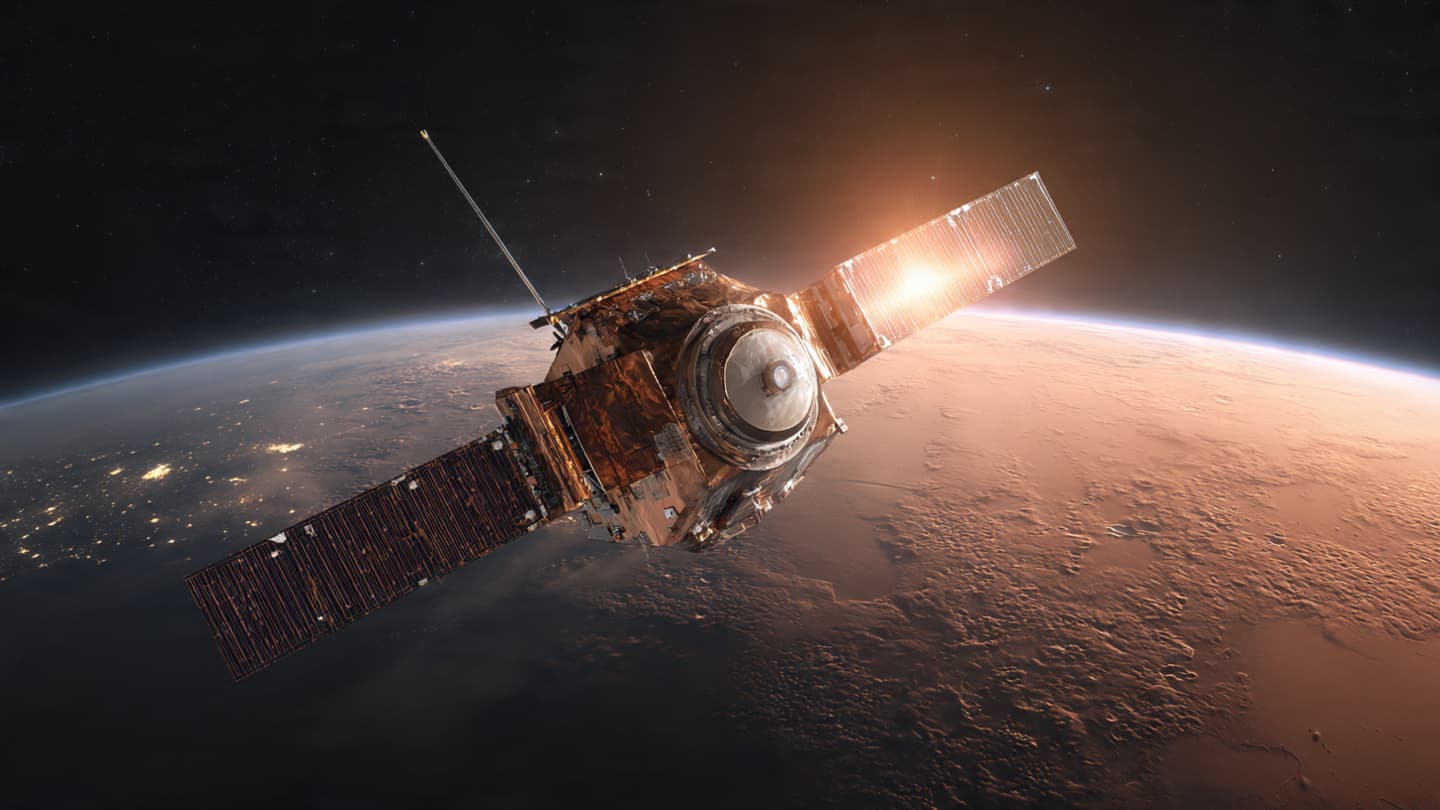
Some space missions conclude with dramatic finales, while others end much as they began—with patience, precision, and quiet persistence. After more than a decade orbiting Mars, NASA’s MAVEN spacecraft has reached the end of a remarkable chapter, leaving behind a legacy built not on spectacle, but on years of careful observation that transformed humanity’s understanding of the Red Planet.
Launched in 2013 and arriving at Mars in 2014, MAVEN—short for Mars Atmosphere and Volatile Evolution—was designed to answer a fundamental question: how did Mars lose much of its atmosphere and become the cold, dry world seen today?
Over eleven years, the spacecraft studied interactions between the Martian atmosphere and the solar wind. Scientists sought to understand how particles from the Sun gradually stripped away atmospheric gases, a process believed to have played a major role in Mars’ climate transformation.
The mission provided evidence that billions of years ago, Mars possessed a thicker atmosphere capable of supporting liquid water on its surface. By measuring atmospheric escape rates and observing solar activity, MAVEN helped researchers reconstruct key stages of the planet’s environmental history.
Its observations revealed that solar storms could dramatically increase atmospheric loss, offering insight into how long-term exposure to solar radiation altered Mars over geological timescales. These findings continue to influence current theories regarding planetary habitability.
Beyond its primary objectives, MAVEN also supported communications for surface missions and contributed to studies of Martian auroras, upper-atmosphere chemistry, and interactions between the planet and space weather.
As spacecraft age, operational challenges naturally increase. Engineers carefully managed MAVEN throughout extended mission phases, maximizing scientific return while adapting to changing technical conditions and mission priorities.
The spacecraft’s final period of operation reflected the same steady approach that characterized its mission. Rather than a sudden ending, its conclusion arrived quietly, marked by the completion of years of valuable scientific work that will continue informing planetary research for decades.
Although MAVEN’s voice has faded, its discoveries remain. The mission leaves behind one of the most comprehensive records ever assembled about the evolution of Mars’ atmosphere and the forces that shaped the planet's past.
AI Image Disclaimer: Images accompanying this article are AI-generated artistic representations inspired by scientific mission data and spacecraft operations.
Sources Verified:
NASA NASA MAVEN Mission Updates Space.com Jet Propulsion Laboratory (JPL) Planetary Science Institute
Published by Banx Network. This article is part of the Banx decentralized media programme, powered by the BXE token on the XRP Ledger.