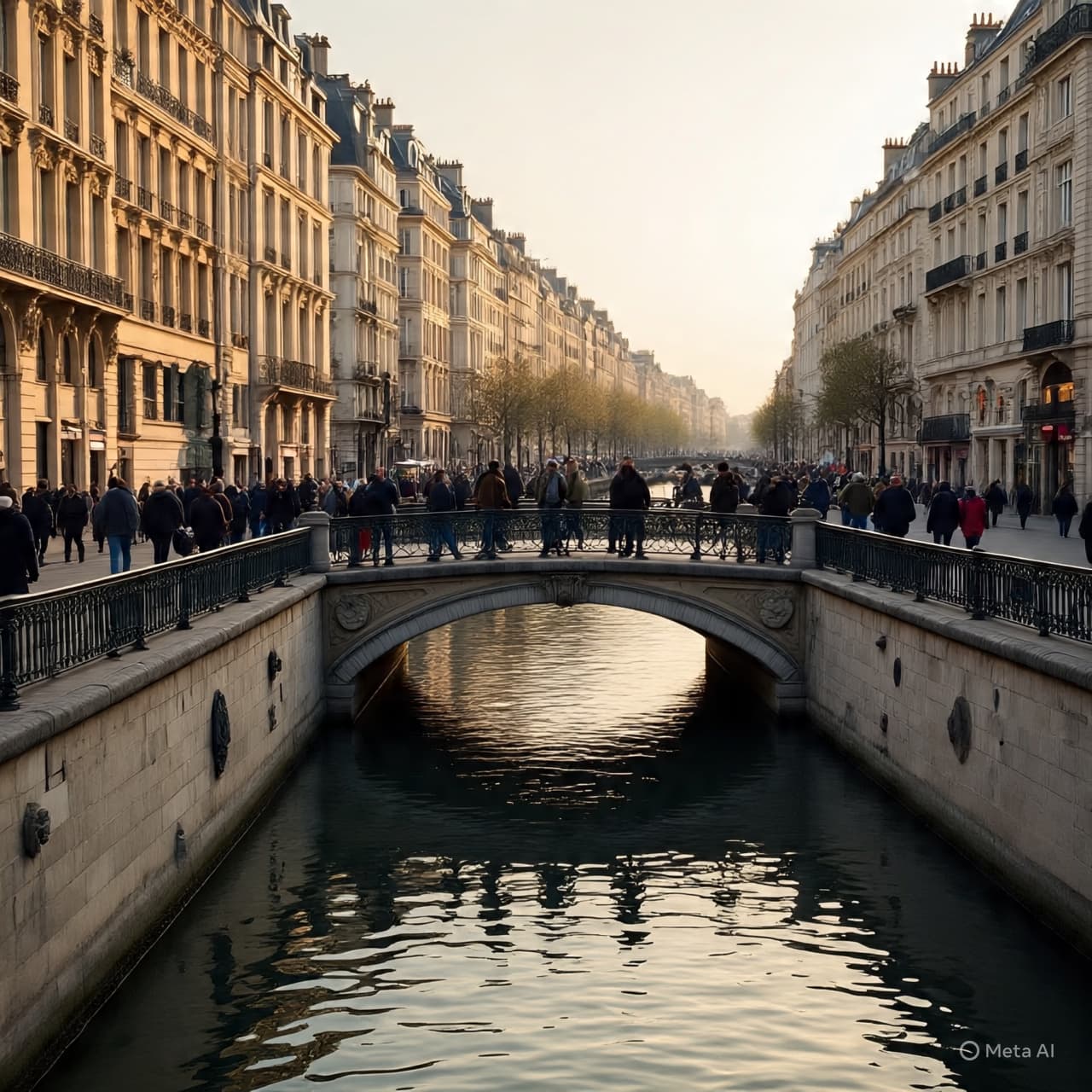
Paris has never rushed its goodbyes. The city prefers gestures that unfold gently, allowing memory to settle into everyday life rather than stand apart from it. In honoring Jane Birkin with the naming of a canal footbridge, the city chose movement over monument, passage over permanence.
Birkin’s relationship with Paris was never ceremonial. Though born in Britain, she became inseparable from the French cultural landscape, not through formality but through presence. Her voice, her style, and her unguarded intimacy with language reshaped how a generation understood chanson, femininity, and freedom. Paris did not adopt her. It absorbed her.
The footbridge spans a canal that carries both reflection and routine. Cyclists pass. Pedestrians linger. Water moves steadily beneath. In this setting, Birkin’s name does not demand attention. It accompanies it. The choice feels deliberate — a tribute meant to be crossed rather than observed from a distance.
City officials described the naming as recognition of Birkin’s artistic legacy and her enduring bond with Paris. But the meaning extends beyond formal acknowledgment. It reflects how Birkin lived within the city: accessible, woven into ordinary streets, never elevated above them.
Birkin’s career defied simple categorization. Actress, singer, muse — each label fits, yet none fully contain her. She embodied contradiction with ease, combining vulnerability with conviction. Her collaborations, especially in music, challenged conventions while remaining deeply personal. Paris, a city that thrives on such tension, understood her instinctively.
Public reaction to the tribute has been quietly warm. There are no grand ceremonies attached to the bridge, no barriers separating tribute from daily life. People encounter her name as they move forward, often unexpectedly. In that moment, memory interrupts routine, briefly and without force.
This form of remembrance aligns with Parisian tradition. The city honors artists not only by preserving their work, but by allowing their names to inhabit shared space. Streets, squares, and bridges become living archives, reminding residents that culture is not confined to museums.
Jane Birkin’s bridge does not mark an ending. It marks continuity. As footsteps pass above flowing water, her presence remains part of the city’s rhythm — not frozen in tribute, but carried forward.
Paris did not choose spectacle. It chose subtlety. And in doing so, it honored Jane Birkin in a way she likely would have recognized: quietly, publicly, and without excess.
Published by Banx Network. This article is part of the Banx decentralized media programme, powered by the BXE token on the XRP Ledger.