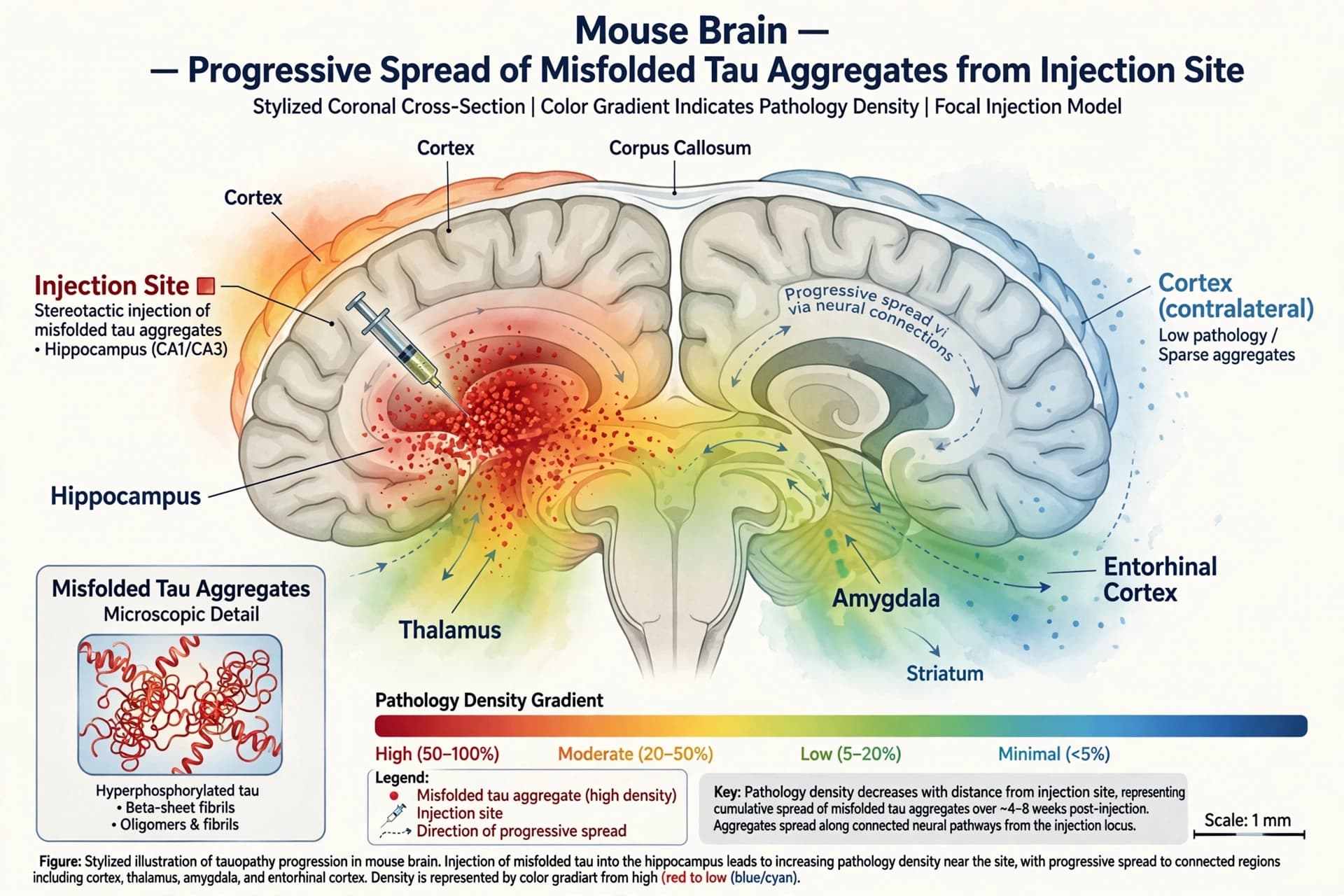
There is a quiet, relentless architecture to the way some diseases move through the brain. They do not arrive as invaders, but as teachers, whispering a wrong shape into proteins that were once healthy, until the error copies itself and travels onward. For years, scientists have wondered whether the tangled tau proteins found in Alzheimer's disease and related conditions spread this way—like prions, the infectious proteins behind mad cow disease. The suspicion was strong, but the proof had a missing piece. No one had yet shown that the new proteins formed inside the brain were truly identical in shape to the ones that started the process.
A collaboration between the MRC Laboratory of Molecular Biology in the United Kingdom and the Tokyo Metropolitan Institute of Medical Science has now supplied that piece. The team, led by Sjors Scheres, Michel Goedert, and Masato Hasegawa, extracted abnormal tau from donated human brains—some from people who had died with Alzheimer's disease, others with corticobasal degeneration, or CBD. They injected these human tau aggregates into the brains of healthy mice. Crucially, these were ordinary wild-type mice, not genetically modified to produce human proteins, which meant any new pathology would have to come from the mouse's own tau. The mice were monitored closely for twelve months .
What the researchers saw was striking. Using antibodies that could distinguish human tau from mouse tau, they found that the injected human proteins disappeared within a week. Yet over the following months, the mice's own tau began to misfold and spread. The pattern differed depending on what had been injected: Alzheimer's tau produced aggregates mostly in neurons, while CBD tau appeared in both neurons and glial cells—mirroring the distinct pathologies seen in human patients .
The decisive evidence came from cryo-electron microscopy. The team extracted the newly formed tau filaments from the mouse brains and resolved their atomic structures. The results were unambiguous. Mice injected with Alzheimer's tau had folded their own tau into precisely the Alzheimer's structure. Mice injected with CBD tau had produced the CBD fold. The original human template was long gone, but its shape had been faithfully copied. The findings were published in Nature .
For Faisal Hossain, a professor of civil and environmental engineering at the University of Washington, the implications reach far beyond this single experiment. The research offers a mechanistic answer to a question that has haunted neurologists for decades: why do neurodegenerative diseases like Alzheimer's worsen progressively over years? If tau spreads by templated misfolding—each new protein taking the shape of the one before it—then the disease is essentially self-propagating, moving from cell to cell as long as healthy tau remains available to be corrupted .
The study also lends weight to an argument that Scheres and Goedert have made before: that tauopathies should be classified by the specific folds of their protein aggregates, not merely by clinical symptoms. Different folds correspond to different patterns of spread and different vulnerabilities in the brain. This molecular taxonomy could reshape how researchers approach diagnosis and, eventually, treatment. The mechanisms controlling how misfolded tau is taken up by cells, how it converts healthy protein, and how it passes to neighbors each offer potential targets for intervention .
There is one detail worth holding onto with care. Despite accumulating abnormal tau, the mice remained outwardly healthy. It is not yet clear whether this reflects the limits of the observation period or whether the mouse brain has some tolerance that the human brain lacks. That question remains open, a quiet reminder of how much is still unknown about the space between a misfolded protein and a failing mind.
AI Image Disclaimer: The visual elements accompanying this report were generated by artificial intelligence and are provided solely for conceptual illustration.
Sources: Nature, MRC Laboratory of Molecular Biology, ScienceAlert, Journal of Biological Chemistry
Published by Banx Network. This article is part of the Banx decentralized media programme, powered by the BXE token on the XRP Ledger.