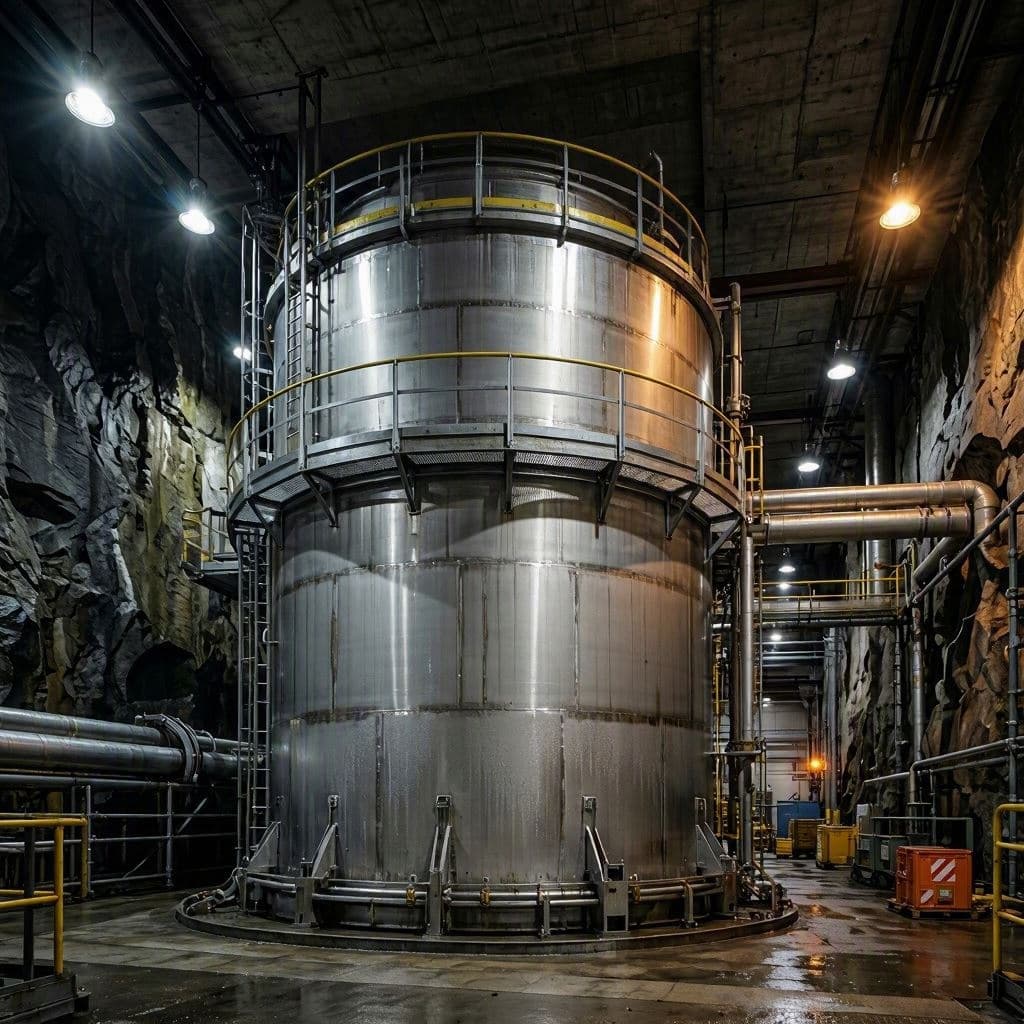
Beneath the rugged surface of the Black Hills in South Dakota, deep within the earth’s protective embrace, scientists are listening for the whisper of the invisible. The Sanford Underground Research Facility, shielded from the cosmic noise above, has long been a sanctuary for the search for dark matter. Recent reports suggest that a potential breakthrough may have occurred within its sensitive detectors. If confirmed, this discovery would illuminate the mysterious substance that makes up most of the universe’s mass, reshaping our understanding of reality itself.
Dark matter, though unseen, exerts a gravitational pull that holds galaxies together. For decades, physicists have hypothesized about its nature, proposing various particles such as WIMPs (Weakly Interacting Massive Particles). The experiments in South Dakota aim to detect the rare interactions between these hypothetical particles and ordinary matter. The depth of the lab is crucial, as it filters out interfering radiation from space, allowing the detectors to focus on the faint signals that might indicate a dark matter collision.
The potential signal detected is subtle, a slight anomaly in the data that deviates from expected background noise. Scientists are approaching this finding with cautious optimism, knowing that extraordinary claims require extraordinary evidence. Rigorous analysis is underway to rule out any terrestrial sources or instrumental errors. The process is meticulous, involving cross-checks with other experiments and theoretical models to ensure the validity of the result.
If this signal proves to be genuine, it would be a monumental achievement in physics. It would provide the first direct evidence of dark matter particles, confirming decades of theoretical work. This would open new avenues for research, helping to explain the structure of the cosmos and the forces that govern it. It would also validate the massive investment in underground laboratories and the collaborative efforts of international scientific teams.
The community of physicists worldwide is watching closely. Peer review and independent verification are essential steps before any announcement can be made. Other facilities, such as those in Italy and China, are comparing their data to see if similar signals have been observed. Consistency across different experiments is key to establishing a discovery, ensuring that the result is not a local artifact but a universal truth.
Beyond the scientific implications, the search for dark matter touches on fundamental questions about existence. What is the universe made of? Why does it hold together? Finding the answer brings us closer to a unified theory of physics, connecting the very small with the very large. It is a quest for knowledge that transcends borders and disciplines, uniting humanity in curiosity.
For now, the labs in South Dakota remain quiet, the detectors humming softly in the dark. The scientists continue their work, driven by the possibility that they are on the verge of seeing the unseen. Whether this specific signal turns out to be the breakthrough or just another step in the journey, the pursuit itself is a testament to human perseverance and the endless desire to understand the cosmos.
A potential dark matter signal detected at the Sanford Underground Research Facility in South Dakota is undergoing rigorous verification, offering hope for a major breakthrough in understanding the universe’s hidden mass.
AI Image Disclaimer: Visuals associated with this article are computer-generated interpretations designed to complement the narrative, not actual photographic evidence.
Sources: Nature Physics Sanford Underground Research Facility Live Science Physics World
Published by Banx Network. This article is part of the Banx decentralized media programme, powered by the BXE token on the XRP Ledger.