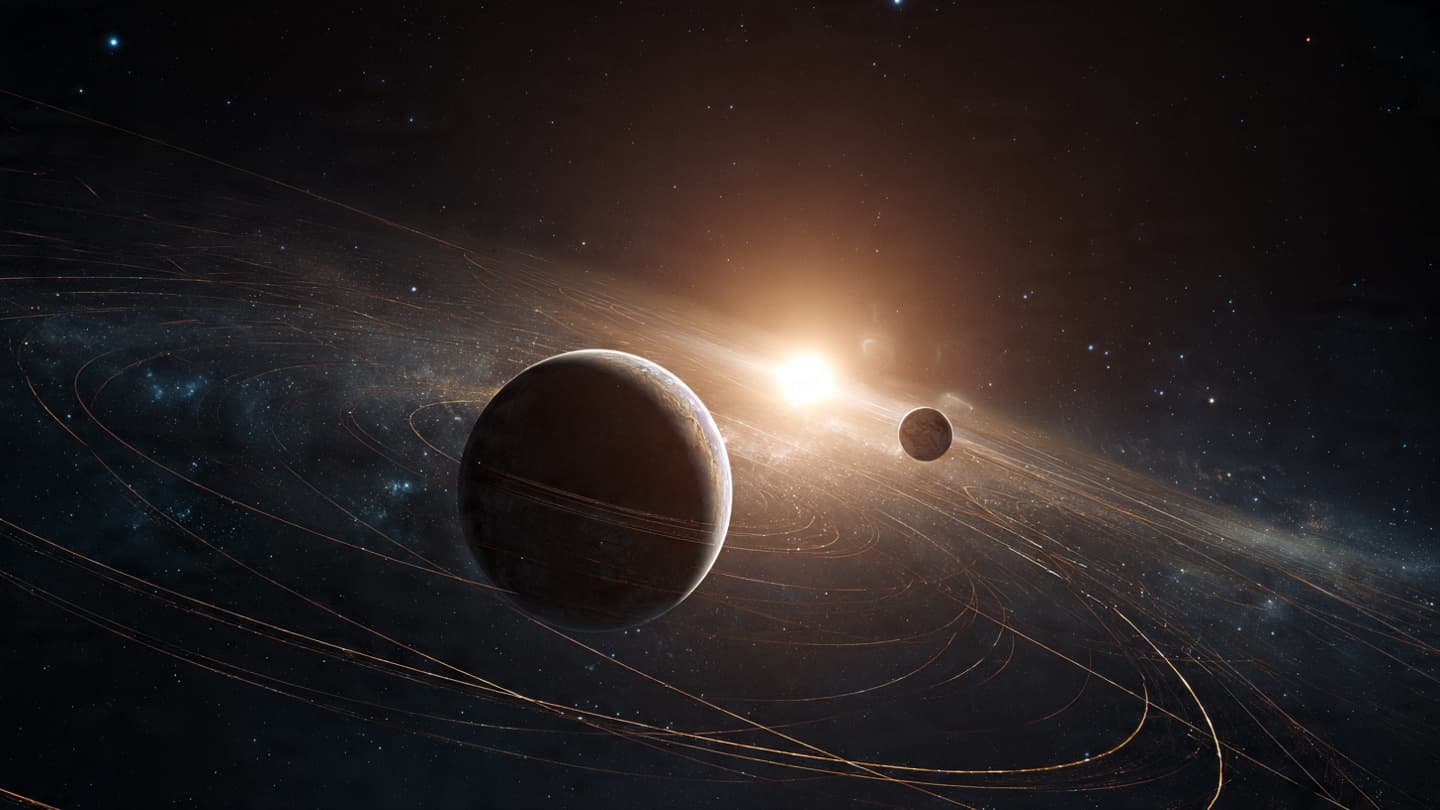
In the vast architecture of the universe, planetary systems often appear stable from a distance, yet beneath that calm structure, gravity constantly shapes slow and invisible motions that can lead to dramatic outcomes.
Body: Astronomers have identified evidence suggesting that two planets in a distant star system may be on intersecting orbital paths, raising the possibility of a future collision. The observation is based on long-term monitoring of orbital shifts and gravitational interactions.
Such potential events are rare but scientifically significant, as they offer insight into how planetary systems evolve and sometimes destabilize over time. Even small gravitational changes can alter orbital trajectories across millions of years.
Researchers studying the system emphasize that these observations are based on probabilistic modeling rather than immediate predictions. The timescales involved are vast, meaning any potential collision would occur far in the future.
The discovery was made using advanced telescopic data combined with computational simulations that map orbital mechanics. These tools allow scientists to reconstruct possible evolutionary paths of distant planetary systems.
Understanding such interactions helps astronomers compare other systems with our own solar system, offering clues about how stable planetary environments form and persist over time.
While the idea of planetary collisions may sound dramatic, it is also a natural part of cosmic evolution, contributing to the formation of new planetary structures and debris fields.
Closing: As observational technology improves, astronomers expect to find more systems with complex orbital interactions. Each discovery adds depth to our understanding of how dynamic and interconnected the universe truly is.
AI Image Disclaimer: This article contains AI-generated conceptual illustrations of astronomical phenomena for editorial visualization purposes only.
Sources: NASA Exoplanet Archive studies, European Southern Observatory reports, Space.com, Astrophysical Journal summaries
Published by Banx Network. This article is part of the Banx decentralized media programme, powered by the BXE token on the XRP Ledger.