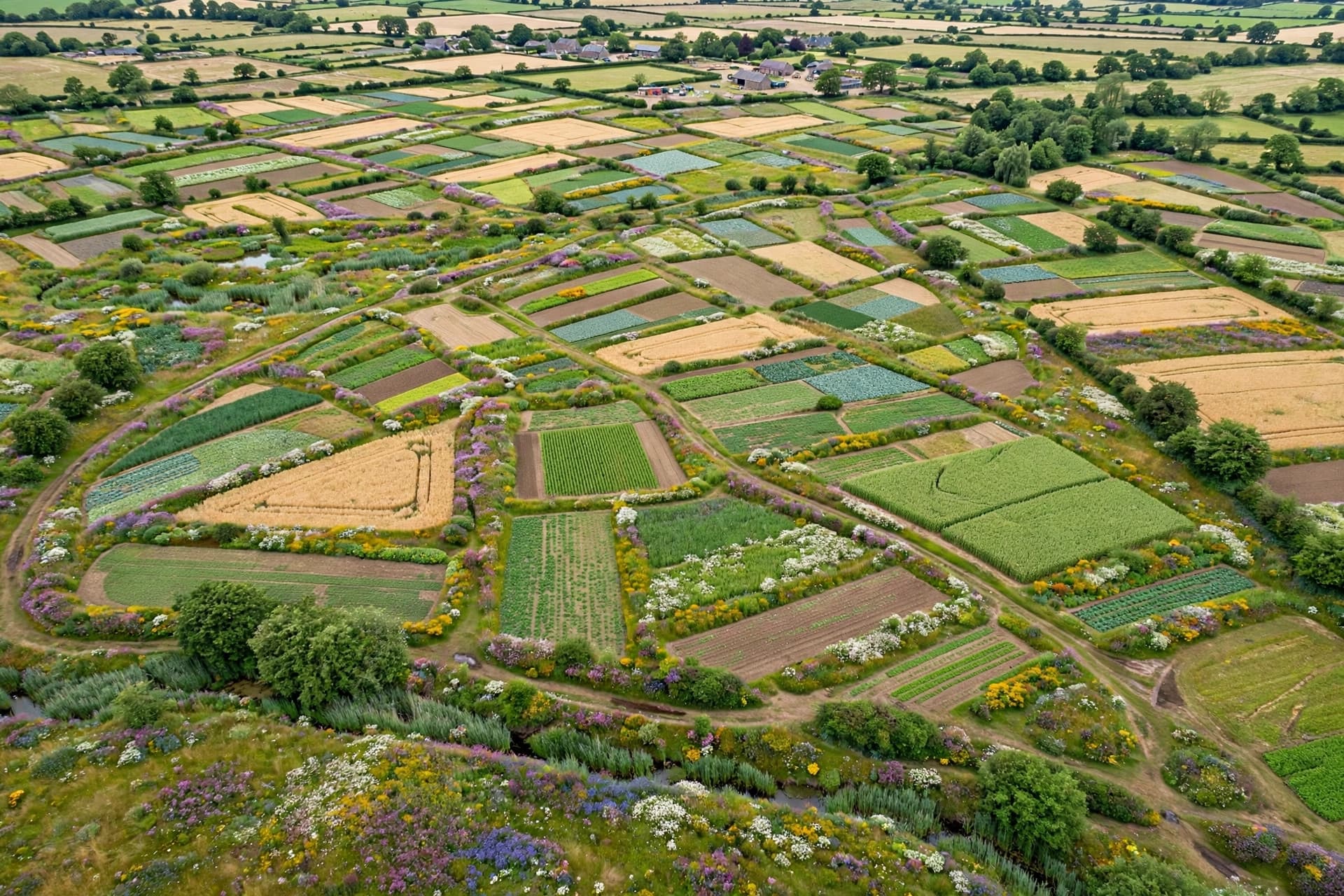
There is a quiet arithmetic to the way birds choose where to live—a calculation of food, shelter, and safety that rarely appears in the spreadsheets of agricultural policy. A new study suggests that the way we arrange our fields, not just what we plant in them, may be one of the most important factors in supporting the birds that share our farmland. The finding offers a practical path toward reconciling food production with biodiversity.
The study, led by the Leibniz Centre for Agricultural Landscape Research (ZALF) in Germany, investigated how growing a variety of crops on small patches within a field affects bird populations. Over three years, researchers compared a diversified experimental field—called patchCROP—with neighboring, conventionally managed large reference fields. The diversified field was visited by birds about 70 percent more often .
The analysis revealed that birds on the diversely managed fields not only appeared more frequently but also behaved differently. They formed small groups and preferred areas characterized by lower pesticide use and greater plant diversity. The Eurasian skylark, a bird that nests in open areas and is often considered the emblem of the agricultural landscape, benefited significantly. Its presence was more frequent in areas with less chemical pesticide use, adjacent flower strips, and more wild plants .
What makes the study unique is its approach of considering the entire mosaic of the landscape rather than individual measures. While other studies often examine only the effect of single wildflower strips, the patchCROP experiment demonstrates how the interplay of small field patches, different crops, and sustainable pest management works together. "If we make the fields smaller, combine different crops, and—wherever it is possible—reduce chemical crop protection or replace it with non-chemical methods, we create habitats that provide birds with food and shelter," explains Jenny Kröcher, a researcher on the ZALF team. "It's like a buffet and a safety net all in one" .
The researchers used a method called Spatial Point Pattern Analysis to draw reliable conclusions from real-world, non-replicated field trials. This approach allowed them to disentangle the effects of multiple interacting factors—pesticide use, soil conditions, and vegetation structure—simultaneously .
The study also found that crop type itself was less important than the spatial combination of crops and their management practices. Structural heterogeneity and reduced management intensity proved to be more important drivers of bird habitat use than the specific crops grown .
For practical application, the researchers acknowledge that increasing crop diversity across many smaller fields is difficult with current large machinery. This could change as autonomous field robots become ready for practical use, as is being tested in the patchCROP experiment. Integrating nature conservation into cultivated land, the authors suggest, offers a promising way to combine food security with species conservation.
AI Image Disclaimer: The accompanying images in this report were created with artificial intelligence and are intended for conceptual representation only.
Sources: Landscape Ecology, Leibniz Centre for Agricultural Landscape Research (ZALF), Research in Germany
Published by Banx Network. This article is part of the Banx decentralized media programme, powered by the BXE token on the XRP Ledger.