For generations, humanity has looked up at the night sky and wondered whether somewhere among the countless stars another world might resemble our own. Astronomers have searched patiently for such places—planets not too hot, not too cold, orbiting their stars in just the right balance where water might remain liquid and life could potentially take hold.
Now researchers believe they may have found one of the most promising candidates yet.
Scientists studying distant planetary systems have identified an Earth-sized exoplanet that appears to orbit its star at a pace remarkably similar to our own planet’s yearly journey around the Sun. The discovery has drawn attention because the planet lies within what astronomers call the —a region where temperatures may allow water to remain stable on a planet’s surface.
The newly studied world circles a star known as , located thousands of light-years away from Earth. What makes the planet intriguing is not only its approximate size—similar to Earth—but also its roughly one-year orbital period, meaning it takes about the same time as Earth to complete a full orbit around its host star.
Planets with such characteristics are rare among the thousands of exoplanets discovered so far. Many known exoplanets orbit extremely close to their stars, producing scorching temperatures, while others circle far away in frozen darkness. Worlds that combine Earth-like size with a moderate orbit remain relatively uncommon.
Detecting planets of this scale is a challenging task. Astronomers typically rely on the transit method, carefully measuring small dips in starlight as a planet passes in front of its star. Observatories such as the have helped identify thousands of such signals, gradually expanding our knowledge of planetary systems across the galaxy.
In this case, researchers used detailed analysis of transit data and orbital patterns to reveal the presence of the planet. Its size suggests it may be a rocky world rather than a gas giant, increasing its potential relevance in the search for life.
However, scientists caution that the planet’s true conditions remain uncertain. Even worlds located within the habitable zone may still be hostile environments. Atmospheric composition, magnetic fields, and geological activity all play critical roles in determining whether a planet could support life.
Future telescopes may provide deeper answers. Instruments capable of analyzing the atmospheres of distant planets could potentially detect chemical signatures such as oxygen, methane, or water vapor—clues that might hint at biological processes.
For now, the discovery represents something both scientific and philosophical: a reminder that planets similar in scale and orbit to Earth may exist across the galaxy.
Somewhere among the stars, another world may circle its sun with the quiet rhythm of a familiar year.
And with each new discovery, the possibility grows that one of those distant planets might not be entirely alone.
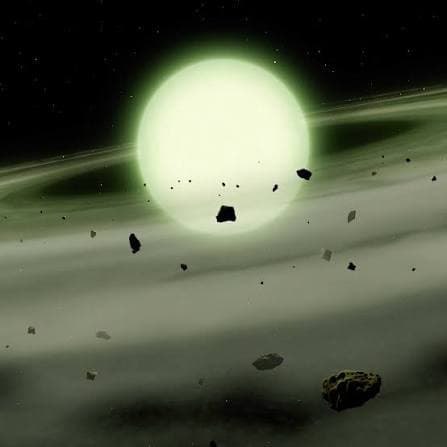
AI Image Disclaimer Illustrations were produced with AI and serve as conceptual depictions.
Source Check Credible sources covering the topic “Earth-size exoplanet with a one-year orbit is the best candidate for life astronomers have found to date”:
Nature Astronomy Scientific American Space.com New Scientist BBC Science
Published by Banx Network. This article is part of the Banx decentralized media programme, powered by the BXE token on the XRP Ledger.