
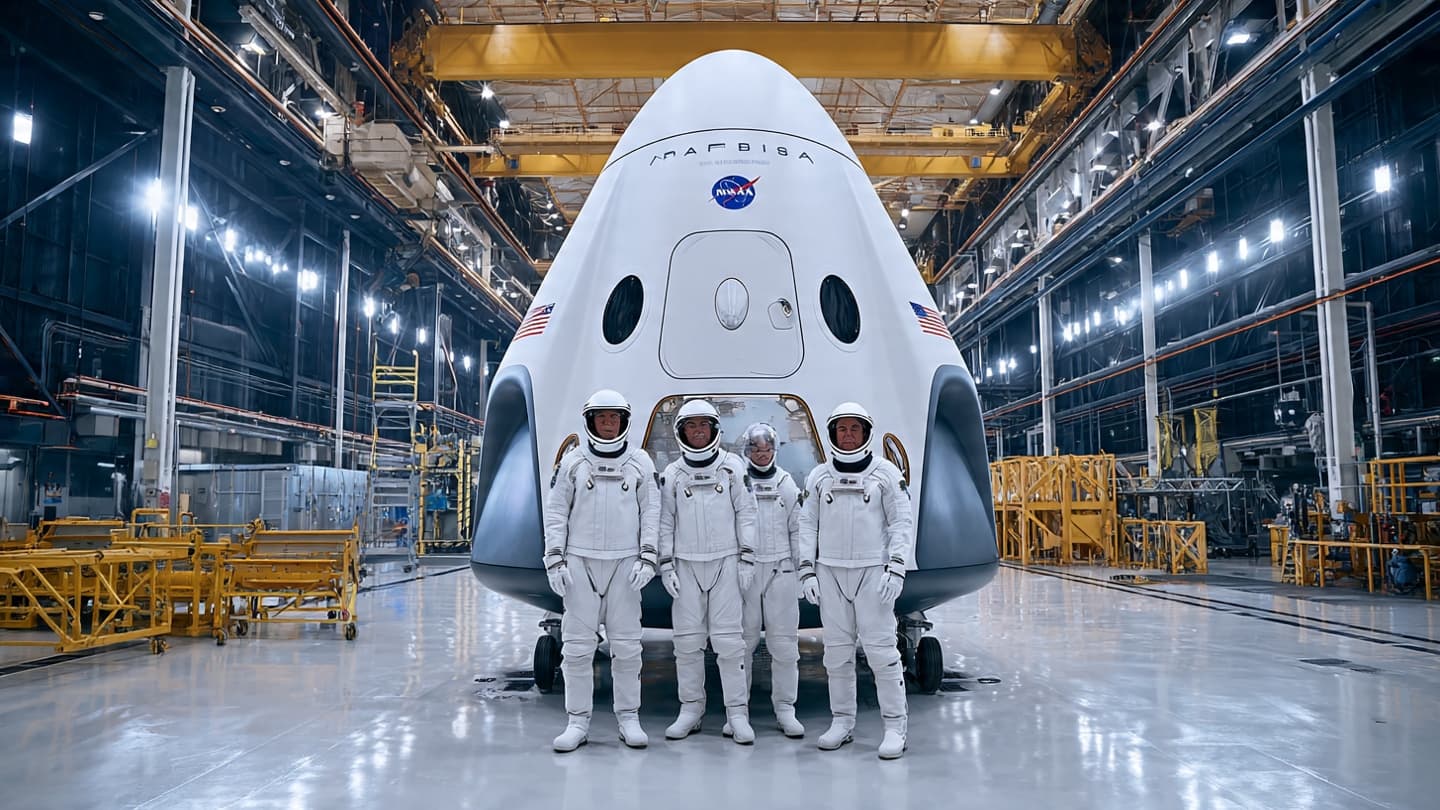
The story of exploration has always begun with a horizon. For centuries, that horizon rested upon oceans, deserts, and distant mountain ranges. Today, it stretches far beyond Earth's atmosphere, reaching toward the Moon once again. With the announcement of the Artemis III crew, NASA has unveiled the individuals who will help carry humanity into the next chapter of lunar exploration.
The Artemis program represents one of the most ambitious space initiatives of the modern era. Building upon decades of scientific achievement, the mission seeks not only to revisit the Moon but also to establish the foundation for future exploration deeper into the solar system.
NASA introduced four astronauts selected for the mission, each bringing extensive experience in aviation, engineering, science, and spaceflight operations. Their preparation reflects years of training designed to meet the unique challenges of deep-space travel.
Unlike the Apollo missions of the twentieth century, Artemis III is expected to operate within a broader framework of international cooperation and advanced technology. The mission will incorporate new spacecraft systems, modern communication capabilities, and next-generation lunar exploration tools.
One of the mission's most anticipated objectives involves returning astronauts to the lunar surface, particularly in regions near the Moon's south pole. Scientists view this area as especially valuable due to evidence suggesting the presence of water ice in permanently shadowed locations.
Water resources on the Moon could play an important role in future exploration efforts. Beyond supporting human activities, water can potentially be converted into oxygen and hydrogen, resources useful for sustaining long-duration missions.
The announcement of the crew has generated excitement across the scientific community. Universities, research institutions, and space agencies worldwide continue to follow developments closely, recognizing the mission's significance for both science and international collaboration.
NASA officials emphasize that Artemis is intended to be more than a single mission. The broader program aims to create a sustainable human presence near the Moon while helping prepare for future journeys to Mars.
As the selected astronauts continue their training, the world watches with anticipation. The Artemis III mission represents not only a return to a familiar celestial neighbor but also a reminder that exploration remains one of humanity's most enduring pursuits.
AI Image Disclaimer: The image accompanying this article is AI-generated and intended solely as a visual interpretation of the topic.
Sources (Verified): NASA, Reuters, Associated Press, Space.com, Scientific American
Published by Banx Network. This article is part of the Banx decentralized media programme, powered by the BXE token on the XRP Ledger.



