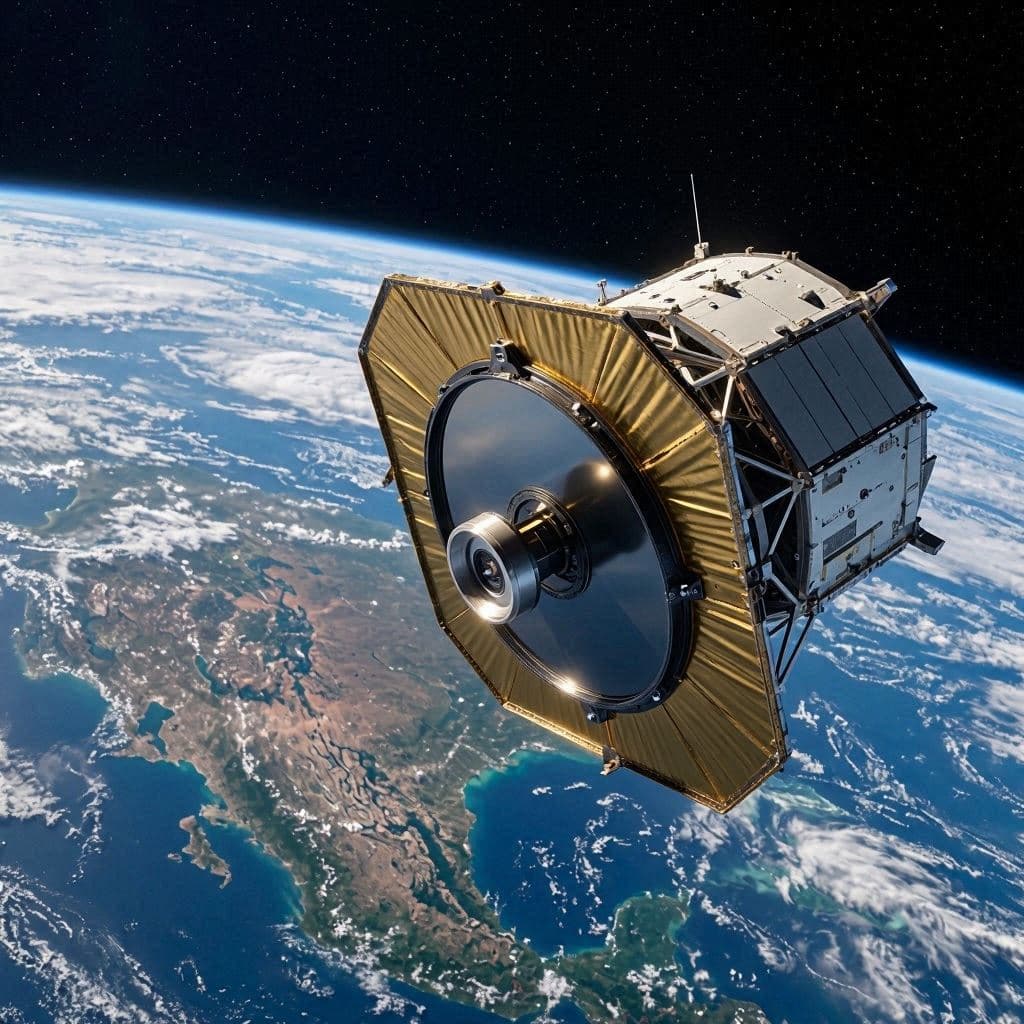
The night sky has always been a canvas for human curiosity, inviting us to ask questions about our origins and our place in the cosmos. Soon, a new eye will open to the heavens: NASA’s Nancy Grace Roman Space Telescope. Designed to survey the sky with unprecedented breadth and precision, this mission aims to address some of the most profound puzzles in astronomy, from the nature of dark energy to the prevalence of exoplanets. This endeavor is not merely a technological achievement; it is a testament to humanity’s enduring desire to understand the universe. It invites reflection on the scale of cosmic time, the invisible forces that shape reality, and the collaborative spirit of scientific exploration.
Body: The Roman Space Telescope differs from its predecessor, the Hubble, in its approach. While Hubble provides deep, detailed views of small patches of sky, Roman will capture wide-field images with similar resolution. This capability allows it to map vast areas of the universe, collecting data on billions of galaxies and stars. It is like switching from a microscope to a panoramic lens, revealing the large-scale structure of the cosmos in ways previously impossible.
One of its primary goals is to investigate dark energy, the mysterious force driving the accelerated expansion of the universe. By observing how galaxies cluster and how light bends around massive objects (gravitational lensing), Roman will help scientists determine if dark energy changes over time. This research could fundamentally alter our understanding of gravity and the ultimate fate of the universe. It seeks to illuminate the invisible scaffolding of reality.
Another key objective is the search for exoplanets, worlds orbiting other stars. Using a technique called microlensing, Roman can detect planets that are difficult to find with other methods, including those far from their host stars or floating freely in space. This census of planetary systems will help answer whether our solar system is typical or unique. It brings us closer to understanding the potential for life elsewhere.
The telescope is also equipped with a coronagraph, a device that blocks the bright light of stars to reveal fainter objects nearby. This technology serves as a precursor to future missions that may directly image Earth-like planets. By refining these techniques, Roman paves the way for the next generation of discovery. It is a bridge to the future of astronomy.
International and academic collaboration is central to the mission. Data from Roman will be made publicly available, allowing researchers worldwide to analyze the findings. This open-access model accelerates discovery and ensures that the benefits of the mission are shared broadly. It reflects the global nature of scientific inquiry, where knowledge transcends borders.
Public engagement is also a priority. Images and discoveries from Roman will inspire students and enthusiasts, fostering a new generation of scientists. The sheer beauty of the cosmos, captured in high definition, has the power to unite people in awe. It reminds us of our shared heritage as stargazers.
As the launch date approaches, anticipation builds within the scientific community. The potential for unexpected discoveries is high, as history shows that new instruments often reveal phenomena we did not know to look for. Roman may uncover surprises that rewrite textbooks. It is a venture into the unknown.
Closing: In the end, the Roman Space Telescope represents a significant leap forward in our quest to understand the universe. It promises to shed light on the darkest mysteries and the most distant worlds. As we prepare to receive its first images, the hope is that it will deepen our appreciation for the cosmos and our place within it.
AI Image Disclaimer: The visual representations associated with this article are AI-generated artistic interpretations designed to illustrate the themes of space exploration and astronomical discovery.
Sources: NASA Space.com The Astrophysical Journal
Published by Banx Network. This article is part of the Banx decentralized media programme, powered by the BXE token on the XRP Ledger.