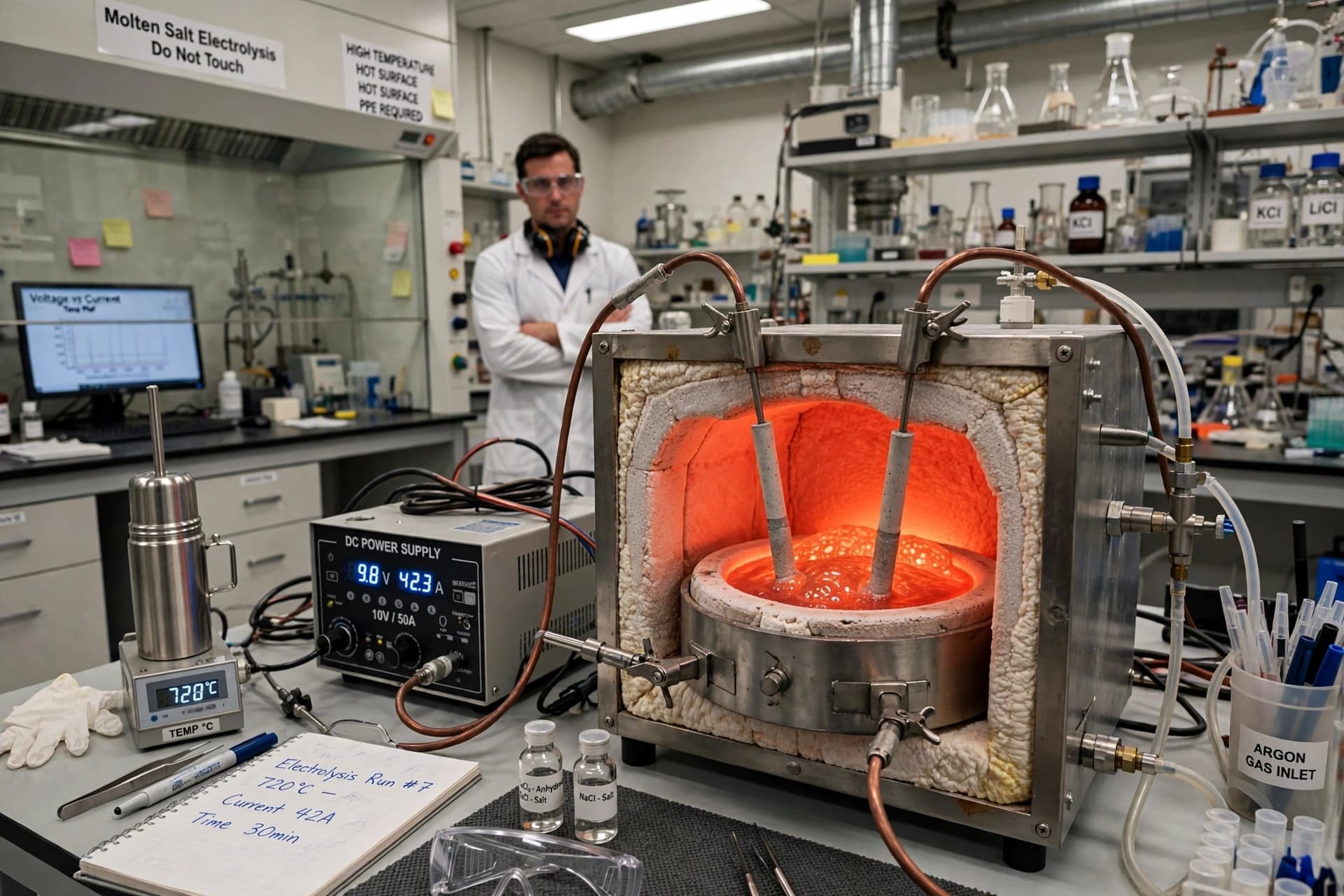
There is a quiet revolution taking place in the search for cleaner energy, one that unfolds not in fields or factories but in the microscopic architecture of materials. At the heart of this revolution is a simple question: how do we split water into hydrogen and oxygen without relying on rare and expensive metals like platinum? The answer, according to researchers in China, may lie in hollow nanoparticles that combine five or more elements with rare-earth atoms in a single, elegant structure.
A team led by Wen Ma at the Inner Mongolia University of Technology has achieved the first synthesis of hollow nanostructured high-entropy carbides containing rare-earth elements. Using a direct electroreduction process in molten salt, they created nanoparticles of (HfNbTaTiZr)C, (HfNbTaTiZrRE)C, and (HfNbTaTiZrCeY)C . The work, published in the Journal of Advanced Ceramics, represents a significant advance in the design of non-noble-metal catalysts for the hydrogen evolution reaction.
High-entropy carbides have attracted attention because their electronic structure resembles that of platinum, and they conduct electricity well. But existing HEC nanocrystals have been limited to dense, solid structures, and incorporating rare-earth elements has proven difficult due to the atomic size mismatch between rare earths and transition metals . The new approach solves both problems at once.
The key innovation is the use of molten-salt electrolysis, a mild, low-temperature method that converts inexpensive oxide precursors directly into nanomaterials in a single step. By selecting different carbon sources, the researchers found they could tailor the microstructure from solid to hollow particles—without using templates . Hollow structures offer high surface-to-volume ratios and abundant interior voids, translating into more exposed active sites and lower mass-transport resistance.
When tested as catalysts in alkaline electrolyte, the hollow rare-earth-containing HECs significantly outperformed their solid counterparts. The best performer, (HfNbTaTiZrCeY)C, achieved an overpotential of just 167 millivolts at 10 mA·cm⁻², with a Tafel slope of 58.8 mV·dec⁻¹ and a charge-transfer resistance of only 2.7 Ω . Notably, the dual-rare-earth composition outperformed single-rare-earth analogues, suggesting a synergistic effect.
"This work not only establishes a facile method for synthesizing various hollow rare-earth-containing high-entropy carbide nanoparticles," the authors wrote, "but also provides a novel strategy for the design of high-performance non-noble metal-based catalysts" . For an energy transition that depends on affordable, scalable hydrogen production, the hollow nanoparticles offer something rare: a path that is both scientifically elegant and practically promising.
AI Image Disclaimer: This article's image is AI-generated and does not depict the actual nanoparticles or laboratory procedures.
Sources: EurekAlert!, Journal of Advanced Ceramics, SciOpen
Published by Banx Network. This article is part of the Banx decentralized media programme, powered by the BXE token on the XRP Ledger.