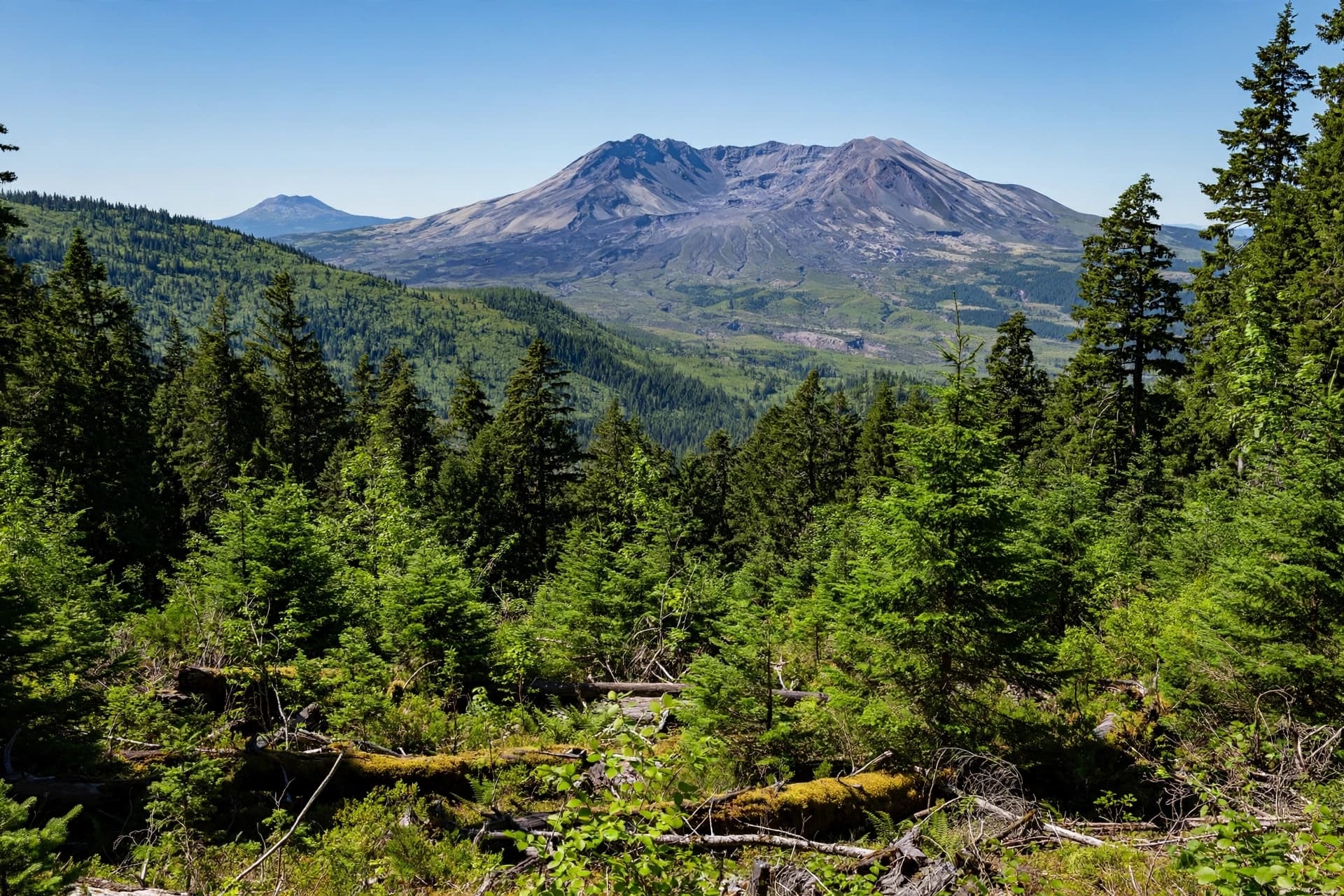
There is a particular kind of faith that belongs to those who study destruction—the belief that even in a landscape that appears utterly dead, something is waiting. On May 18, 1980, Mount St. Helens erupted with a force that leveled 230 square miles of forest, buried the land under tens of meters of ash and rock, and sterilized the surface with heat and noxious gas . Fifty-seven people died. Elk herds vanished. The streams were emptied of fish. To the first scientists who helicoptered into the blast zone, the mountain looked like a moonscape, uniformly gray and, from initial appearances, sterile .
But the appearance was deceiving. What ecologists found, and what they have spent four decades documenting, is that life does not always need to arrive from elsewhere. Sometimes it survives in place, hidden beneath the debris, and waits for the conditions to allow it to rise again.
The key to the recovery lay in what University of Washington scientist Jerry Franklin called "biological legacies"—the remnants of the old ecosystem that persisted through the blast . Seeds, spores, root balls, even whole plants protected by snowbanks survived beneath the ash. Gophers and fungi stirred the soil in pockets where life had not been extinguished. These survivors became the launching points for the forest that would follow .
The recovery was not a single process but a mosaic of them. In some areas, plants sprouted from roots that had survived underground. In others, wind-borne seeds landed on exposed soil and took hold. The Forest Service eventually planted nearly 10 million trees across 14,000 acres, but much of the regrowth happened on its own, driven by the resilience of species that had evolved in a volcanic landscape . By 1984, just four years after the eruption, 600 elk had returned to the area, and the streams held ten times as many steelhead trout as before the blast .
Scientists have used the eruption as an unprecedented natural laboratory. Landsat satellites, which had been observing the region since 1972, provided a continuous record of the recovery, allowing researchers to calculate tree cover year by year and watch the forest reassemble itself . What they found complicated older theories of ecological succession. The recovery was not orderly or predictable; it depended on chance, on the location of surviving seeds, on the whims of wind and weather . The forest that emerged was not the same forest that had been destroyed, but it was a forest nonetheless.
Forty years after the eruption, the landscape around Mount St. Helens is green again. Mosses and grasses gave way to shrubs, and shrubs to trees. Some stands have already been commercially thinned. The elk and the fish and the tourists have returned . The mountain itself remains active, a reminder that the forces that destroyed the forest are still present beneath the surface.
What Mount St. Helens teaches is not that destruction is reversible—the lives lost and the forest that was cannot be recovered. It teaches something more modest and more durable: that life, given time, water, and sunlight, will find a way to begin again. The forest came back not because it was restored, but because it was resilient. And in that distinction lies a lesson for a world facing its own disruptions, both natural and human-made.
AI Image Disclaimer: The visuals in this report were produced using artificial intelligence and serve an illustrative purpose only.
Sources: NASA Earth Observatory, NASA Scientific Visualization Studio, Wiley (Environmental Science textbook), EurekAlert (University of Washington)
Published by Banx Network. This article is part of the Banx decentralized media programme, powered by the BXE token on the XRP Ledger.