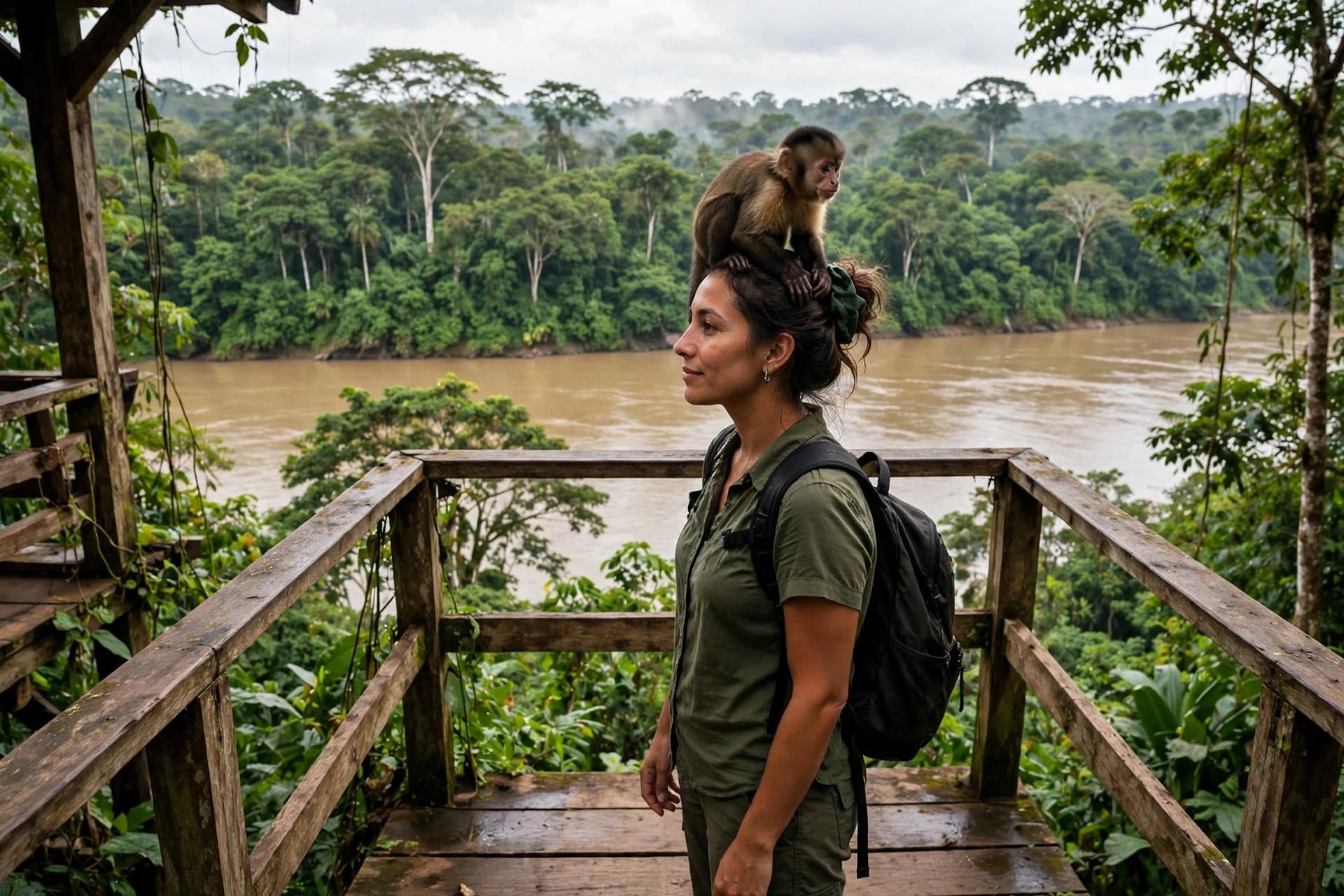
The Amazon has a way of rearranging one's expectations. Vicky Maskell had climbed a wooden platform in Puerto Nariño, a jungle town on a bend of the river, hoping for a view. What she received instead was a lesson in how quickly the wild can decide to help—and how little warning it offers before doing so.
The wasps arrived without announcement. One sting, then another, then a swarm, each puncture landing before she could call out . She was, in her own words, being swarmed. What happened next belongs to a capuchin monkey that had been watching from a nearby tree, assessing the scene with the quiet attention of a creature accustomed to making quick judgments about risk and reward.
The monkey jumped onto her head. It was, Maskell recalled, about the size of a pet cat, its face set like a mask on a darker body. It began to work—thin fingers reaching into her hair, grasping a wasp, removing it, flicking it to the ground. One by one. Then another. The precision was deliberate, almost methodical, as if the animal had done this before or had reasoned its way to the solution in the seconds available .
Only when Maskell yelped did her companions below realize something was happening. "Wasps! I've been stung, but this monkey is getting them off me," she called down. The reply came back incredulous: "Really?!" By then the capuchin had finished its work, or decided it was finished, and leapt back to its lookout in the tree. The guide, examining her head afterward, offered a verdict that carried more weight than any official report: "I really think that monkey saved you" .
Capuchins are known for their intelligence and their opportunistic relationships with the humans who pass through their territories. They are also known to raid wasp nests for the larvae inside, a high-risk foraging strategy that researchers have documented across Amazonian species . Whether the monkey on the platform was acting from instinct, curiosity, or something closer to intent is a question science cannot fully answer. What is known is that it intervened, and that its intervention was effective.
Maskell described the moment as overwhelming—the suddenness of the attack, the strangeness of the rescue, the way a creature of the forest had crossed a boundary she had not known existed. "That day, the capuchin monkey broke that barrier, purposefully protecting me from harm," she wrote. "I certainly won't forget that in a hurry" .
The jungle, it seems, keeps its own account of who helped whom. On a platform above the Amazon, a woman and a monkey shared a few seconds that neither will remember in the same way, and one of them will carry the story forward.
The images accompanying this article are AI-generated and are not photographs of the individuals or events described.
Sources: BBC Wildlife Magazine, Discover Wildlife, Hartpury University
Published by Banx Network. This article is part of the Banx decentralized media programme, powered by the BXE token on the XRP Ledger.