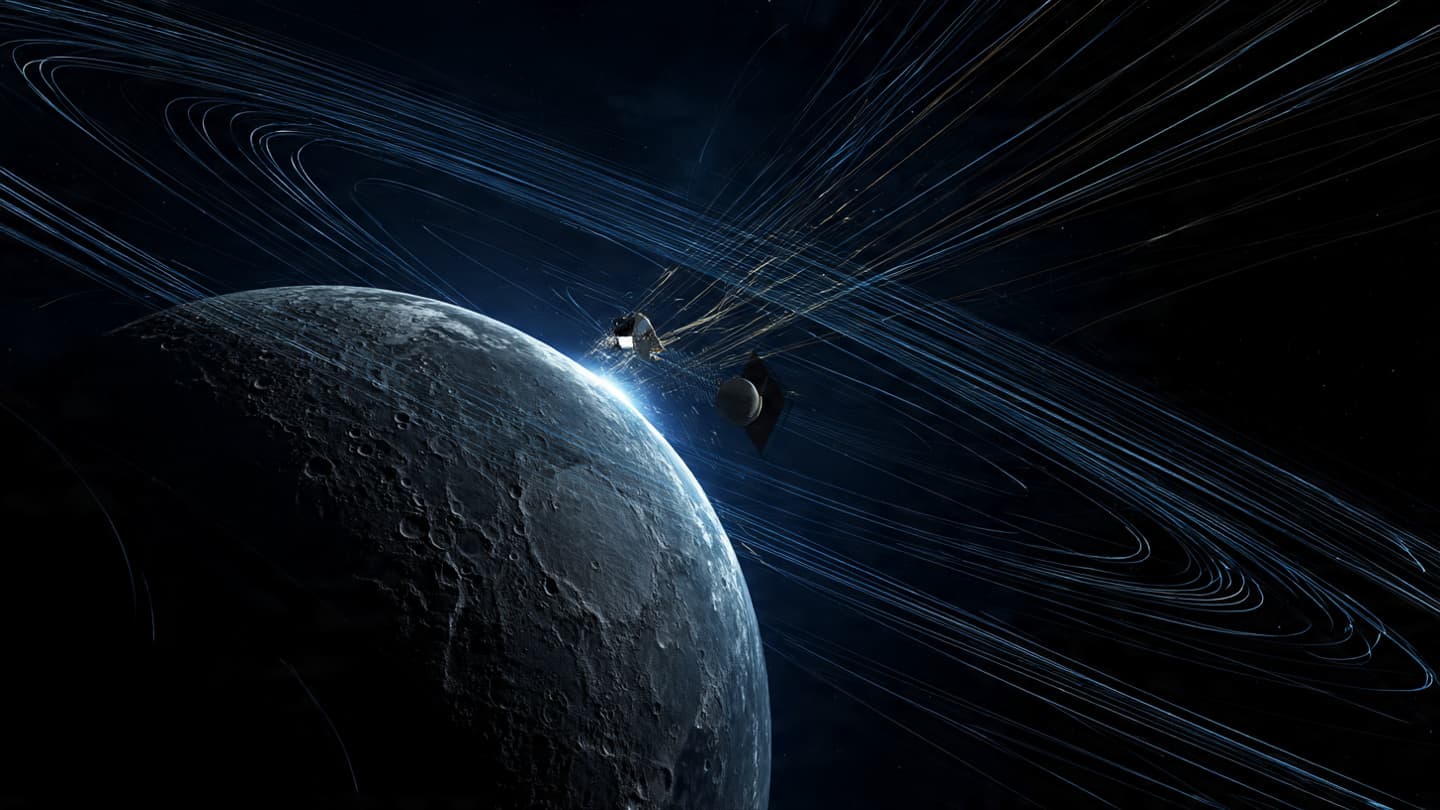
Space travel is often imagined as a straight line stretching from one world to another, a clean arc drawn across darkness. Yet the reality of orbital mechanics resembles something far more intricate, shaped by invisible gravitational currents flowing between planets, moons, and stars. In a recent study, researchers explored millions of possible pathways to the Moon and identified an alternative route that could reduce fuel demands while maintaining continuous communication with Earth.
The research focused on a region of space known as the Earth-Moon L1 Lagrange point. Lagrange points are positions where gravitational forces between two large bodies create areas of relative balance, allowing spacecraft to maneuver efficiently with reduced energy requirements.
Using advanced computer simulations, scientists analyzed roughly 30 million possible lunar trajectories. Their goal was to identify routes that balanced fuel efficiency, communication stability, and navigational practicality. The results suggested that certain detours through the L1 region could offer meaningful operational advantages compared with more direct flight paths.
One of the key benefits involves communication. Traditional lunar missions can experience periods where spacecraft temporarily lose direct contact with Earth, particularly when traveling around the far side of the Moon. The newly studied pathways appear capable of maintaining more stable communication links throughout much of the journey.
Fuel efficiency is another important factor in modern space exploration. Every kilogram launched into space carries significant cost and engineering consequences. By using gravitational dynamics more effectively, spacecraft may conserve propellant, allowing either smaller launch systems or greater payload flexibility for future missions.
Researchers explain that the trajectories rely on carefully timed gravitational interactions rather than simple straight-line travel. In some respects, the process resembles navigating ocean currents instead of forcing a vessel directly through open water. Space agencies increasingly explore such methods as missions become more ambitious and resource-conscious.
The findings may prove valuable for planned lunar infrastructure projects, including orbiting stations, robotic landers, and long-duration crewed missions. Reliable communication and reduced fuel consumption are especially important for sustained operations involving multiple spacecraft traveling between Earth and the Moon.
The work also demonstrates the growing influence of computational modeling in modern astronomy and aerospace engineering. Simulating millions of orbital possibilities would once have been nearly impossible. Today, powerful computing systems allow researchers to map complex gravitational environments with extraordinary precision.
Although practical implementation will require further testing and mission planning, scientists view the research as part of a broader effort to make deep-space travel more sustainable and adaptable. As humanity prepares for a renewed era of lunar exploration, even small improvements in efficiency may shape how future missions are designed and operated.
AI-generated image notice: Some accompanying visuals may contain AI-generated representations created to illustrate orbital routes and spacecraft navigation concepts.
Sources: NASA, European Space Agency, Space.com
Published by Banx Network. This article is part of the Banx decentralized media programme, powered by the BXE token on the XRP Ledger.