Airports are often places of quiet anticipation, where journeys begin not with motion but with waiting—lines that move slowly, screens that flicker with destinations, and the soft hum of travelers measuring time in glances and footsteps. Yet there are moments when that rhythm shifts, when waiting becomes something heavier, stretching beyond expectation and pressing gently, but persistently, against the edges of patience. At George Bush Intercontinental Airport, that shift has begun to take shape.
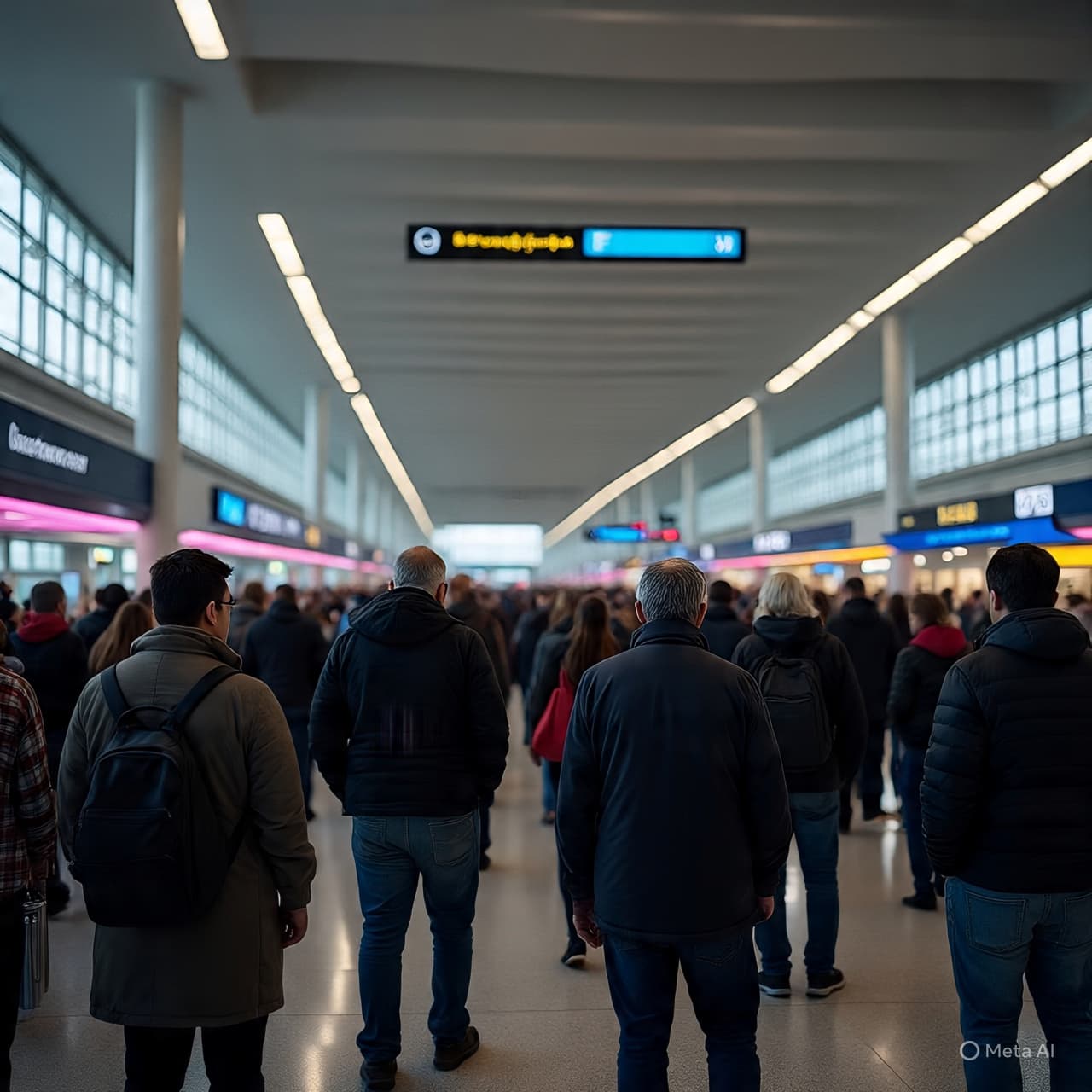
What was once a routine passage through security has, for many travelers, turned into an extended pause. Reports indicate that only two Transportation Security Administration checkpoints were operational during peak hours, creating lines that extended far beyond their usual bounds. Wait times, in some cases, stretched to four hours or more—long enough to transform a simple departure into a test of timing and endurance.
The situation has prompted airport officials to issue alerts, gently but clearly warning of the possibility that some passengers may miss their flights. It is not a dramatic declaration, but rather a careful acknowledgment of how small disruptions—fewer checkpoints, increased travel volume—can ripple outward. In the delicate choreography of air travel, even minor imbalances can lengthen the entire sequence.
For travelers, the experience unfolds in layers. There is the initial surprise of encountering an unusually long line, followed by the quiet recalculation of time—boarding schedules, gate distances, the ticking clock displayed on a phone screen. Conversations become hushed and practical, strangers exchanging updates, staff offering guidance where they can. The atmosphere is not chaotic, but it carries a certain weight, as if time itself has slowed in response to the crowd.
Operationally, such delays often emerge from a convergence of factors. Staffing limitations, heightened travel demand, and procedural requirements all play their part. None alone may seem overwhelming, yet together they create a narrowing passage through which thousands must pass. The result is not a sudden breakdown, but a gradual constriction—an hour added here, another there—until the delay becomes impossible to ignore.
There is also a broader reflection in moments like these. Airports are designed for flow, for movement that feels almost seamless. When that flow is interrupted, it reveals how much coordination lies beneath the surface. Every checkpoint, every officer, every lane contributes to a balance that, when altered, shifts the experience for everyone passing through.
Still, responses have begun to take shape. Travelers are being encouraged to arrive earlier than usual, allowing for the extended time now required to navigate security. Airport authorities continue to monitor conditions, adjusting operations where possible. These measures, while modest, reflect an ongoing effort to restore a sense of steadiness to the process.
As the day unfolds, flights continue to depart, though not always with every passenger aboard. The alert remains in place, not as a warning of crisis, but as a reminder of the present conditions. At Bush Airport, the journey still begins with waiting—only now, the waiting asks for a little more time, a little more patience, and a quiet understanding of how even the most routine systems can, at times, slow under their own weight.
AI Image Disclaimer Illustrations were produced with AI and serve as conceptual depictions.
Source Check (Credible Media Outlets): Reuters Associated Press CNN The Washington Post USA Today
Published by Banx Network. This article is part of the Banx decentralized media programme, powered by the BXE token on the XRP Ledger.