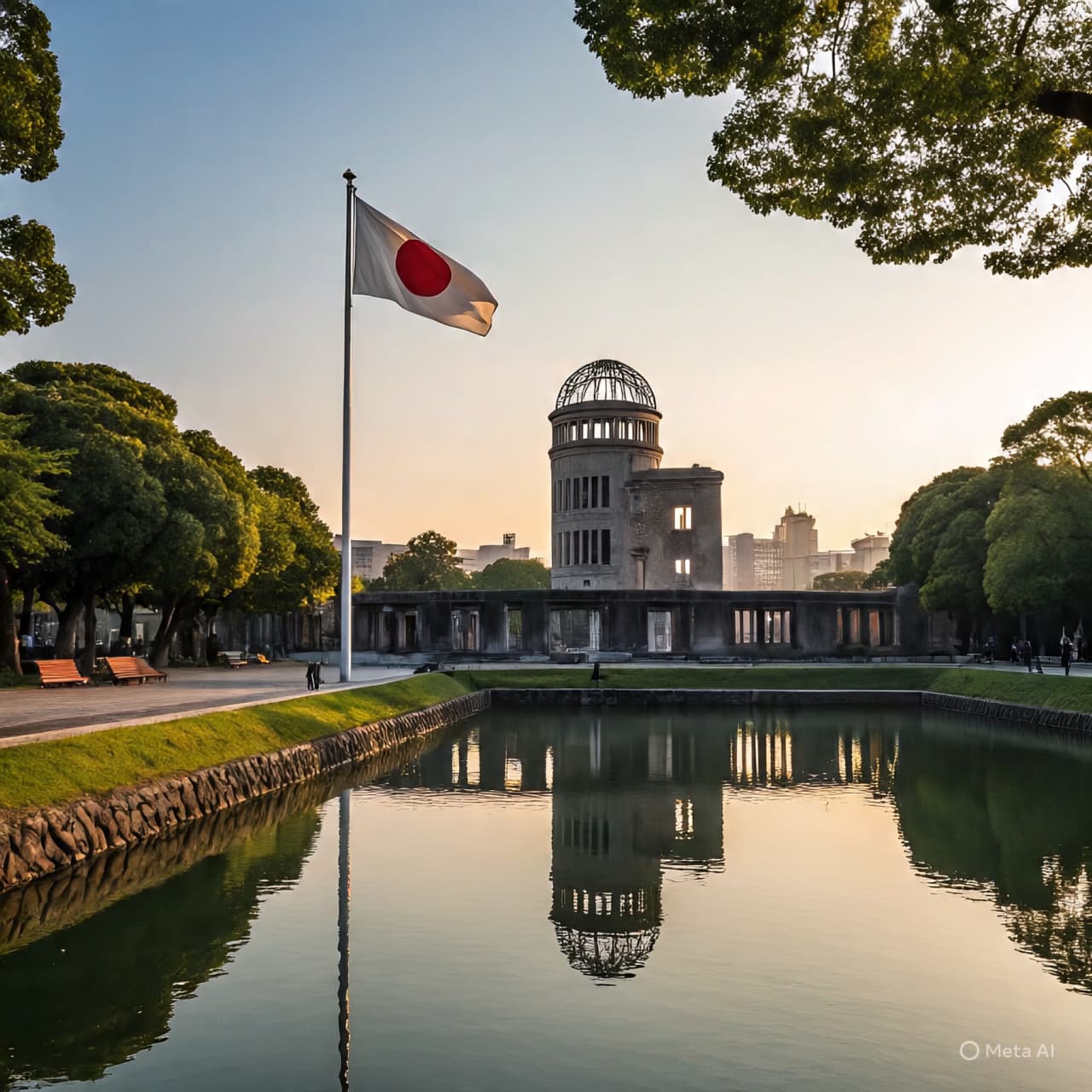
Japan’s nuclear stance has always been defined as much by memory as by policy. It is a position shaped not by abstraction, but by lived history—etched into cities, institutions, and national identity. That is why even a fleeting suggestion can trigger an immediate and forceful response.
This week, Tokyo moved quickly to reaffirm its long-standing commitment to remain non-nuclear after a senior official publicly floated the idea of Japan reconsidering its position on nuclear weapons. The comment, brief and speculative, was enough to ignite domestic unease and regional attention. The government’s reaction was equally swift: Japan, it said, will not pursue nuclear arms.
At the center of the reaffirmation are Japan’s Three Non-Nuclear Principles: not possessing, not producing, and not permitting the introduction of nuclear weapons. Adopted during the Cold War and repeatedly endorsed by successive governments, the principles function less like a policy option and more like a moral boundary. Crossing it—even rhetorically—carries consequences.
Officials were careful to frame the remark as a personal view, not government policy. Senior leaders emphasized continuity, stressing that Japan’s security remains anchored in its alliance with the United States and its reliance on extended deterrence rather than independent nuclear capability. There would be no shift, they said, no recalibration, no quiet debate moving behind closed doors.
Yet the episode revealed an underlying tension that Japan has struggled to fully resolve.
The regional security environment has deteriorated. North Korea continues to advance its nuclear and missile programs. China’s military expansion has altered strategic calculations across East Asia. Russia’s nuclear signaling has grown more overt. In that context, questions that once seemed settled are being revisited—if not officially, then at least conversationally.
For Japan, however, conversation itself is the danger.
Public opinion remains deeply resistant to nuclear weapons, not merely as tools of war but as symbols of a past the country refuses to normalize. Hiroshima and Nagasaki are not distant history; they are living reference points in political discourse. Any suggestion that Japan might someday join the nuclear club risks undermining its credibility as a global advocate for disarmament.
That advocacy has been central to Japan’s diplomatic identity. It has positioned itself as a bridge between nuclear and non-nuclear states, urging restraint while relying on alliances for protection. Maintaining that balance requires consistency—and, when necessary, rapid correction.
The government’s reaffirmation was designed to close the door before speculation widened. It was also a signal outward, particularly to neighboring countries, that Japan’s strategic posture remains unchanged. In a region where signals are often read louder than statements, clarity matters.
Still, moments like this suggest that Japan’s nuclear debate is not disappearing; it is being contained.
The pledge was restated, the line redrawn, the reassurance delivered. Japan remains committed to its non-nuclear path—not because it lacks alternatives, but because the cost of abandoning that identity is higher than the uncertainty of maintaining it.
Published by Banx Network. This article is part of the Banx decentralized media programme, powered by the BXE token on the XRP Ledger.