In the quiet training grounds scattered across North Korea, the morning air often carries the smell of damp earth and distant pine forests. These are landscapes where military exercises unfold far from crowded cities—open fields bordered by mountains, where vehicles line up along dusty roads and soldiers wait for the signal that begins the day’s drills.
On one such occasion, the scene included not only officers and technicians but a familiar figure often seen beside the country’s leader. According to state media reports, Kim Jong Un observed the testing of multiple rocket launch systems during a military exercise, accompanied by his daughter, who has appeared alongside him at several high-profile defense events in recent years.
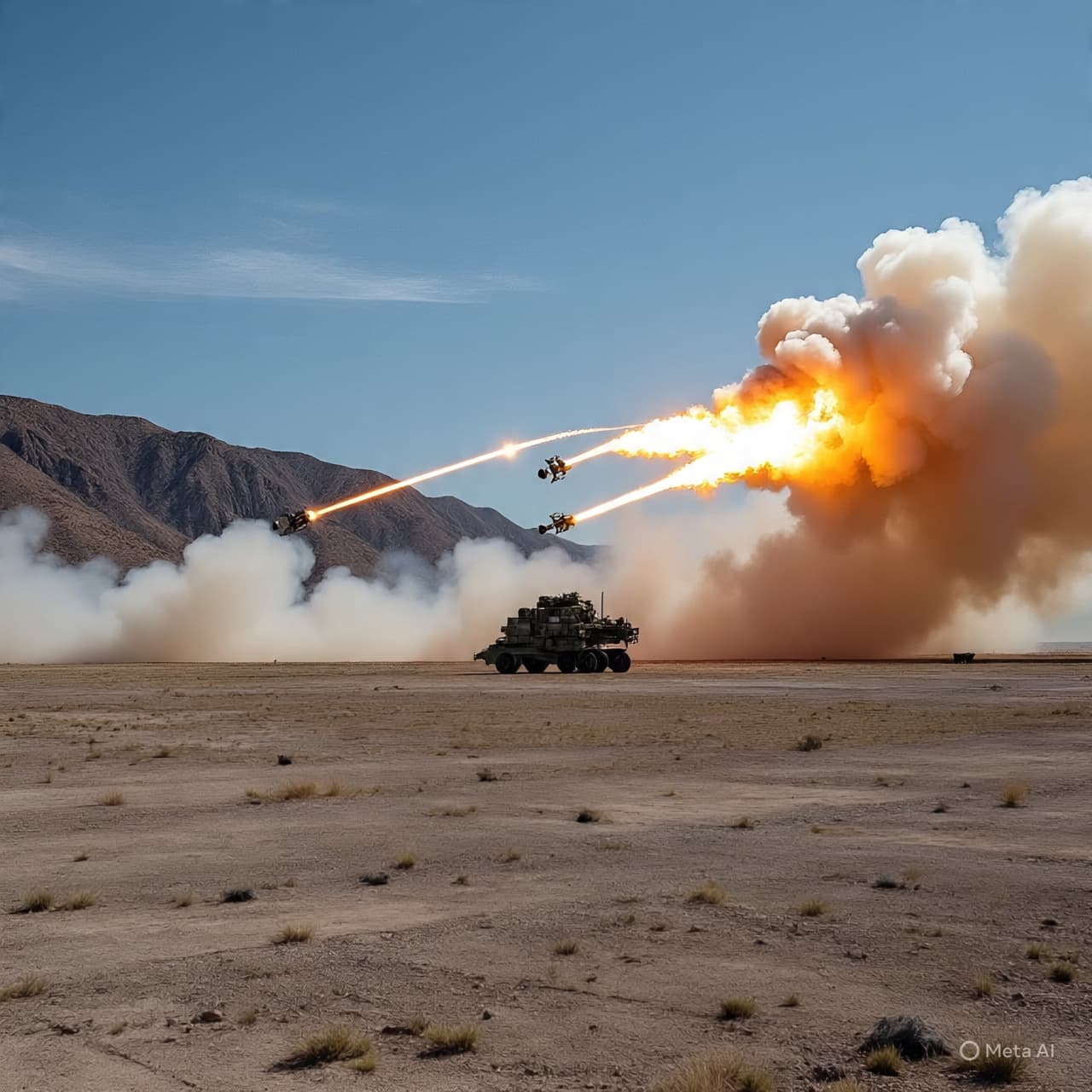
Images released by the Korean Central News Agency showed launch vehicles positioned across a broad testing field while rockets lifted into the sky, leaving brief trails of smoke against the pale horizon. Military officials were seen reviewing the results as the launchers fired in coordinated sequences.
Multiple rocket launch systems are designed to deliver rapid volleys of rockets across wide areas, often used in battlefield scenarios where speed and volume of fire are key. In modern military strategy, such systems can be paired with precision-guided technologies or conventional munitions to strike targets at varying ranges.
For North Korea, weapons demonstrations often serve several purposes simultaneously. Domestically, they reinforce images of technological capability and military readiness. Internationally, they function as signals within the broader strategic landscape of Northeast Asia.
The presence of Kim’s daughter at these events has also drawn attention among regional observers. Her appearances alongside the leader at missile tests, military parades, and training exercises have gradually become more frequent, prompting speculation about how leadership symbolism and family imagery are being incorporated into the country’s political narrative.
Across the Korean Peninsula, such moments are closely watched by neighboring governments and defense analysts. The region remains shaped by the unresolved legacy of the Korean War, which ended with an armistice rather than a permanent peace agreement.
Within that context, each new weapons test becomes part of a familiar cycle: launches are detected, statements follow from regional governments, and diplomatic conversations about deterrence and stability return to the forefront of international discussion.
Yet the landscapes where these demonstrations take place remain largely unchanged. Mountains continue to frame the testing grounds, winds move across empty fields, and the sky briefly fills with the echo of rockets before returning to silence.
In the hours after a test concludes, equipment is packed away and vehicles depart along narrow roads that disappear into forested valleys. The quiet that follows is almost immediate.
But beyond those valleys, the images and reports released from the exercise continue their journey across the world—another entry in the ongoing story of strategy, symbolism, and uncertainty that shapes the Korean Peninsula.
AI Image Disclaimer Images were generated using AI and are intended for illustrative purposes only.
Sources Reuters Associated Press BBC News Korean Central News Agency Yonhap News Agency
Published by Banx Network. This article is part of the Banx decentralized media programme, powered by the BXE token on the XRP Ledger.