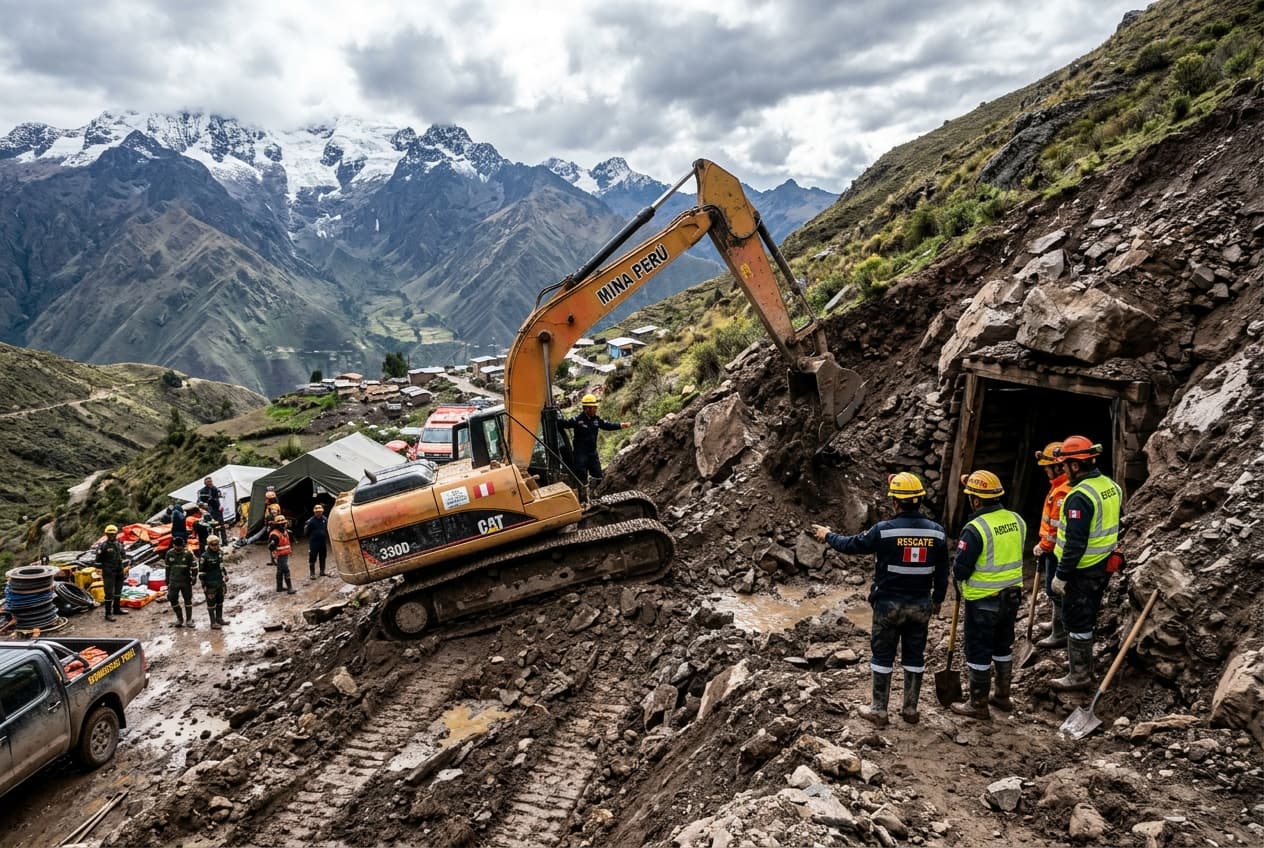
Cajamarca, Peru— A hillside collapsed onto a small-scale mine in northern Peru early Thursday, killing three workers and trapping 12 others underground behind a wall of mud and rock.
The slide hit at around 4:30 a.m. local time in a remote sector of the Cajamarca region, where artisanal mines cut into steep, rain-soaked slopes. Local police said the entrance was completely buried under an estimated 500 tons of earth. Three bodies were recovered near the mouth of the shaft. Voices were heard from inside.
Relatives arrived before heavy machinery did. They stood at the edge of the pit with flashlights, shouting names. By 10 a.m., a regional civil defense team brought in a single excavator and two pumps. "The terrain is unstable, the soil is saturated," a civil defense coordinator said on site. "We can't send people in blindly. One more slide and we lose the rescue team."
The mine is one of hundreds operating in the area, many with informal permits and minimal engineering support. Officials said the gallery was about 60 meters long with timber shoring, not steel. That structure was never built to take a lateral load from a slope failure. Inspectors had flagged the area for risk last month after unusually heavy rains.
Communication with the trapped miners came and went. Rescuers said they managed to pass a plastic tube through a small gap around noon and heard tapping back. No verbal contact was confirmed. Oxygen is the immediate concern. The mine's ventilation pipe was sheared off by the slide.
The regional governor requested support from Lima, including specialized mine rescue units and geotechnical engineers. The national mining agency, INGEMMET, said it was sending a team to assess slope stability and whether blasting would be required to reopen the portal safely. The army said it was preparing to airlift equipment if weather allowed.
This part of northern Peru has seen a surge in small mine activity as gold prices rose. That growth has outpaced oversight. Municipal officials admitted they lack staff to inspect every cut. Workers take the risk because the pay, when a vein hits, is triple what farm work pays.
Families were moved back from the lip at 3 p.m. after cracks appeared above the rescue trench. Work continued with ropes and hand tools. A second excavator was still hours away, stuck on a dirt road washed out by the same rain system that loosened the hill.
The crew inside had now been buried for more than twelve hours. The tube remained the only link.
Published by Banx Network. This article is part of the Banx decentralized media programme, powered by the BXE token on the XRP Ledger.