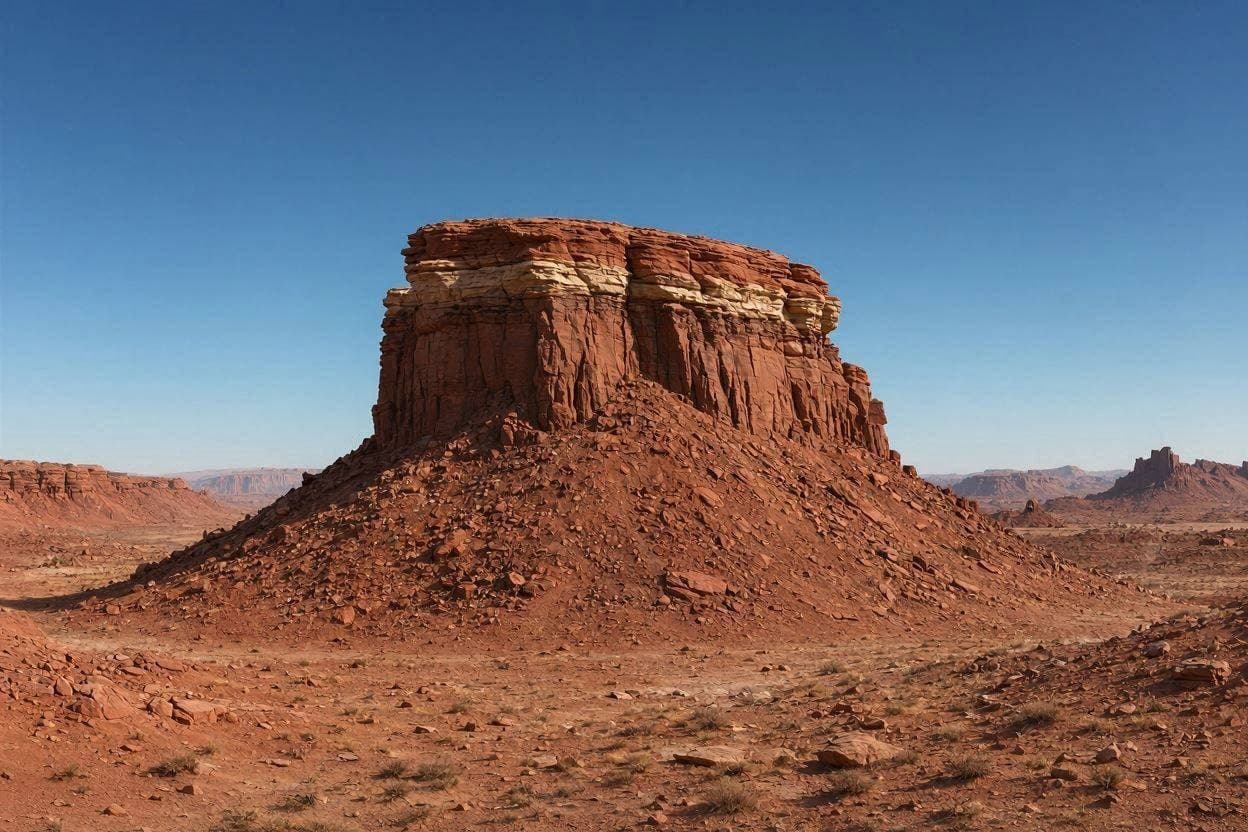
On the red plains of Mars, every rock tells a story of wind, water, and time. The Curiosity rover, our steadfast explorer on the Martian surface, has recently turned its gaze toward a striking geological feature: a sand-capped butte. This unusual formation, with its protective layer of sandstone resting atop softer material, offers a window into the planet’s complex climatic history and the enduring power of erosion.
The butte, located in the Gale Crater, stands as a testament to the varying environmental conditions that have shaped Mars over billions of years. The caprock, composed of harder, more resistant sandstone, has protected the underlying layers from being worn away by the relentless Martian winds. This differential erosion creates the distinctive mushroom-like shape, a common feature in arid environments on both Earth and Mars.
Curiosity’s cameras captured high-resolution images of the butte, revealing intricate textures and stratification in the rock layers. These details provide clues about the sedimentary processes that formed the structure, suggesting periods of flowing water followed by long stretches of dryness. By studying these layers, scientists can reconstruct the timeline of wet and dry cycles in Gale Crater’s past.
The presence of sand on top of the butte indicates recent aeolian activity, where wind has transported and deposited fine particles. This ongoing process highlights that Mars is not a dead world but one that is still dynamically changing, albeit at a much slower pace than Earth. Understanding these modern processes helps contextualize the ancient geological record.
Scientists are particularly interested in the chemical composition of the caprock. Spectrometers on Curiosity analyze the minerals present, looking for signs of past habitability. If the sandstone contains clay or other hydrated minerals, it could indicate that water played a role in its formation, further supporting the theory that Mars once had a more hospitable environment.
The observation of this butte is part of Curiosity’s broader mission to assess the potential for microbial life in Gale Crater. Each rock formation adds a piece to the puzzle, helping researchers determine if the necessary ingredients for life were present and if they persisted long enough for life to emerge. The butte’s preservation suggests that some areas may have retained evidence of past conditions better than others.
As Curiosity continues its journey up Mount Sharp, it encounters a variety of geological features, each with its own story. The sand-capped butte is just one chapter in the extensive narrative being written by the rover’s instruments. Its study contributes to a growing body of knowledge that informs future missions, including those aimed at returning samples to Earth.
The view of the sand-capped butte by Curiosity is a reminder of the patience and precision required in planetary science. As we decode the rocks of Mars, we gain a deeper understanding of our neighbor’s history and our own place in the solar system.
AI Image Disclaimer: The images associated with this article are AI-generated illustrations designed to represent the themes of Martian geology and robotic exploration.
Sources: NASA JPL, Malin Space Science Systems, Space.com, Scientific American
Published by Banx Network. This article is part of the Banx decentralized media programme, powered by the BXE token on the XRP Ledger.