When a stone from the depths of space decides to visit Earth, it does not simply fall; it undergoes a violent and transformative baptism by fire. For centuries, meteorites have been viewed as random gifts from the cosmos, their arrival marked by streaks of light and occasional thunderous booms. Yet, beneath the spectacle lies a complex physical narrative. Recent research has mapped this descent into seven distinct stages, offering a clearer understanding of how these celestial travelers survive the hostile embrace of our atmosphere to reach the ground below.
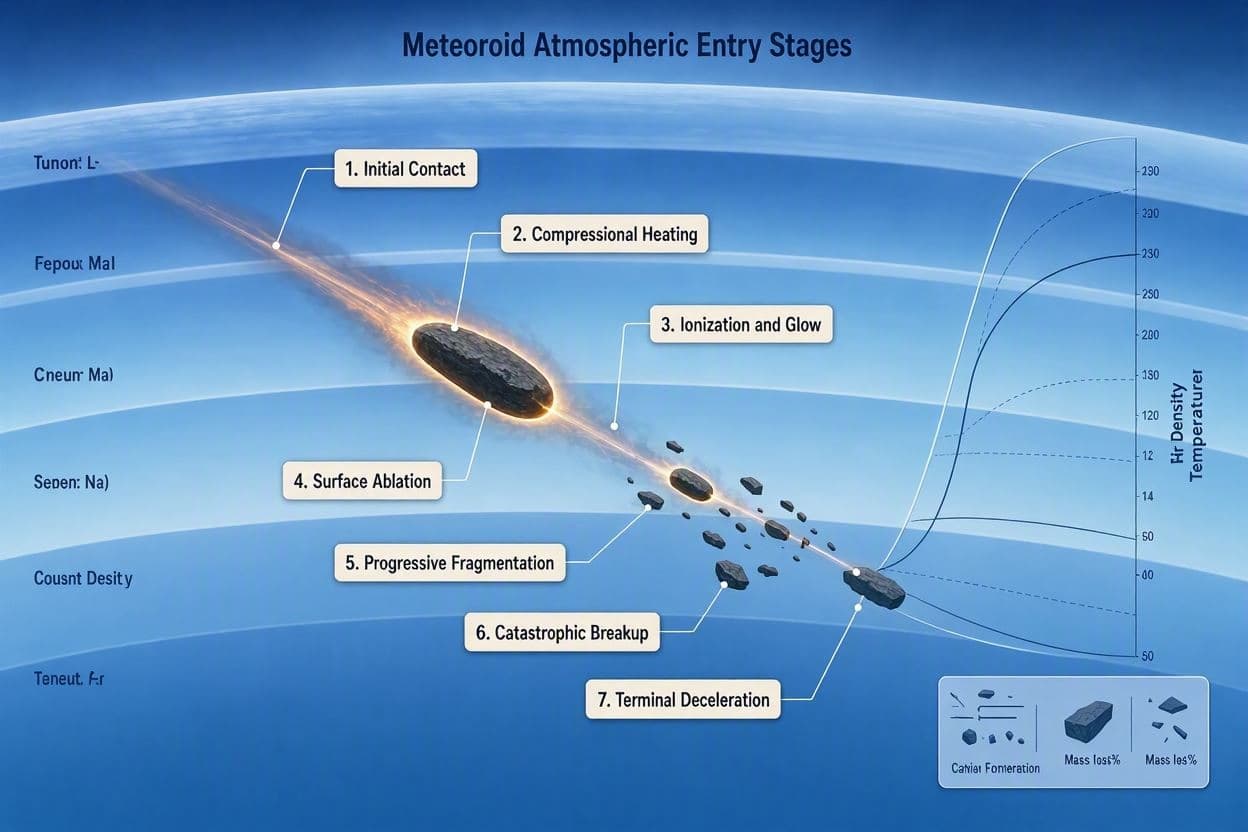
The journey begins long before the rock enters the sky, originating in the cold vacuum of the asteroid belt or beyond. As it approaches Earth, gravity pulls it into an ever-tightening spiral, accelerating it to speeds that defy everyday comprehension. The first stage of its atmospheric encounter is defined by compression, where the air ahead of the rock becomes so dense it acts almost like a solid wall, generating intense heat through shock waves rather than simple friction.
As the meteoroid plunges deeper, it enters a phase of ablation, where the outer layers begin to melt and vaporize. This process, often visible as the glowing tail of a meteor, serves as a protective shield. By shedding mass, the rock dissipates energy and protects its core from immediate disintegration. It is a sacrificial dance, where the exterior gives way to preserve the interior, allowing the heart of the stone to remain intact despite the extreme temperatures.
The third and fourth stages involve fragmentation and deceleration. The immense pressure can cause the rock to break apart, creating a shower of smaller pieces rather than a single impactor. This breakup changes the aerodynamics of the fall, slowing the fragments down more effectively than a single large body would be slowed. It is during these moments that the trajectory shifts from a straight line to a more scattered pattern, distributing the kinetic energy over a wider area.
As the fragments lose speed, they enter a dark flight phase, where they no longer glow but continue to fall under gravity. This stage is critical for recovery, as the rocks cool and stabilize. Understanding this phase helps scientists predict where meteorites will land, turning what was once a game of chance into a calculated search. The final stages involve the gentle settling of the stones onto the surface, completing their journey from the stars to the soil.
This seven-stage model provides a framework for interpreting meteorite falls with greater precision. It allows researchers to reconstruct the original size and composition of the incoming object based on the debris field found on the ground. Such insights are invaluable for planetary science, helping us understand the materials that built our solar system and the risks posed by near-Earth objects.
Moreover, this knowledge enhances our ability to protect our planet. By understanding how asteroids break up and slow down in the atmosphere, we can better assess the potential impact of larger bodies. It transforms fear into understanding, replacing the mystery of the unknown with the clarity of physics. The sky is no longer just a source of wonder but a laboratory for studying the dynamics of entry and survival.
Each meteorite that reaches the ground is a testament to resilience. It has survived the vacuum of space, the pull of gravity, and the fiery gauntlet of the atmosphere. By mapping its journey, we not only learn about the rock itself but also about the protective qualities of our own planet’s atmospheric shield.
The delineation of the seven-stage journey of falling space rocks offers a refined perspective on meteorite impacts. It highlights the intricate balance of forces that allow extraterrestrial material to reach Earth’s surface. This understanding aids both scientific discovery and planetary defense, reminding us that even in chaos, there is a predictable order to the universe.
AI Image Disclaimer: The accompanying illustrations are AI-generated visualizations intended to depict the dramatic stages of a meteoroid’s entry into Earth’s atmosphere.
Sources: Nature Astronomy Meteoritics & Planetary Science Scientific American
Published by Banx Network. This article is part of the Banx decentralized media programme, powered by the BXE token on the XRP Ledger.