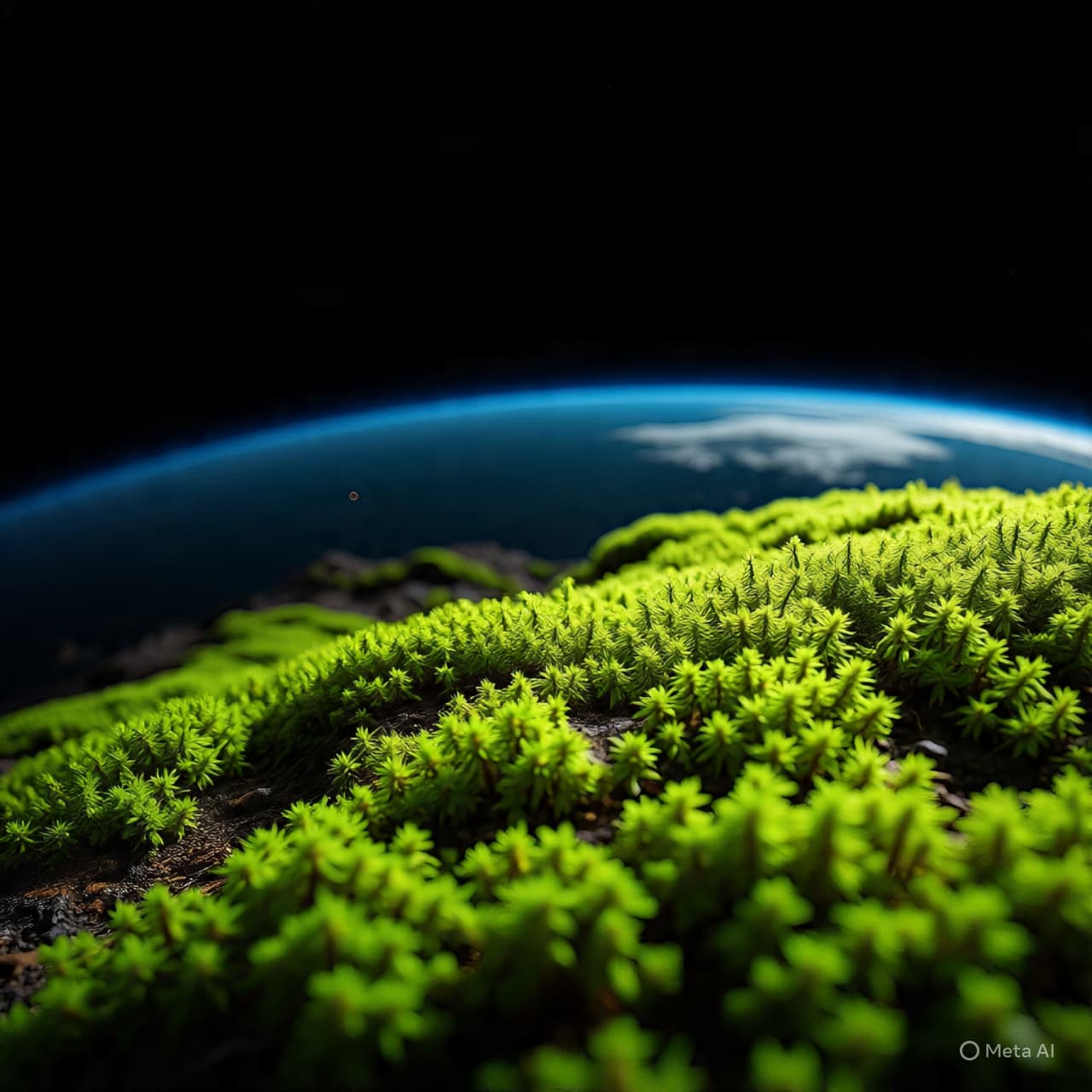
In the vast stillness above our atmosphere, where silence feels older than time and sunlight arrives unfiltered, a small and unlikely traveler endured what few living things can. A simple moss — delicate, earthly, almost forgettable on a forest stone — remained alive after spending nine unprotected months in the vacuum of space. Its survival is a reminder that life, even in its humblest forms, sometimes carries a quiet resilience that outshines our expectations.
Researchers sent samples of bryophyte moss to the exterior of a low-Earth-orbit platform to test how it would fare under conditions that mimic early planetary environments: intense radiation, violent temperature swings, and the crushing absence of air. When the moss returned home, scientists expected a brittle memory of green. Instead, they found something stirring. After hydration and controlled regrowth, many of the samples revived — their cells repairing damage that would have destroyed more complex organisms.
Part of the explanation lies in moss’s ancient lineage. Its survival strategies were shaped long before flowering plants dominated the surface of Earth. Mosses can enter a desiccated state that resembles suspended animation, allowing them to tolerate long periods without water. This adaptation appears to act like a biological shield, helping cells recover once conditions improve.
The implications reach beyond botanical curiosity. If moss can survive exposure to vacuum and cosmic radiation, it strengthens the case that simple life could endure interplanetary transfer under the right circumstances. It also hints at future applications for human missions — from biomaterials capable of tolerating extreme environments to potential experiments in biological resilience on the Moon or Mars.
Still, survival is not the same as thriving. The moss endured severe cellular stress, and only part of the population recovered. Space remains as unforgiving as ever: a place where most life perishes quickly, with no second chances. But this outcome — modest, quiet, and almost poetic — widens the boundaries of what we assume biology can withstand.
In the end, the experiment leaves a lingering thought. If a patch of moss can outlast months in a realm with no air, no water, and no shelter, perhaps the story of life — on Earth and elsewhere — is both more fragile and more stubborn than we imagine.
Published by Banx Network. This article is part of the Banx decentralized media programme, powered by the BXE token on the XRP Ledger.