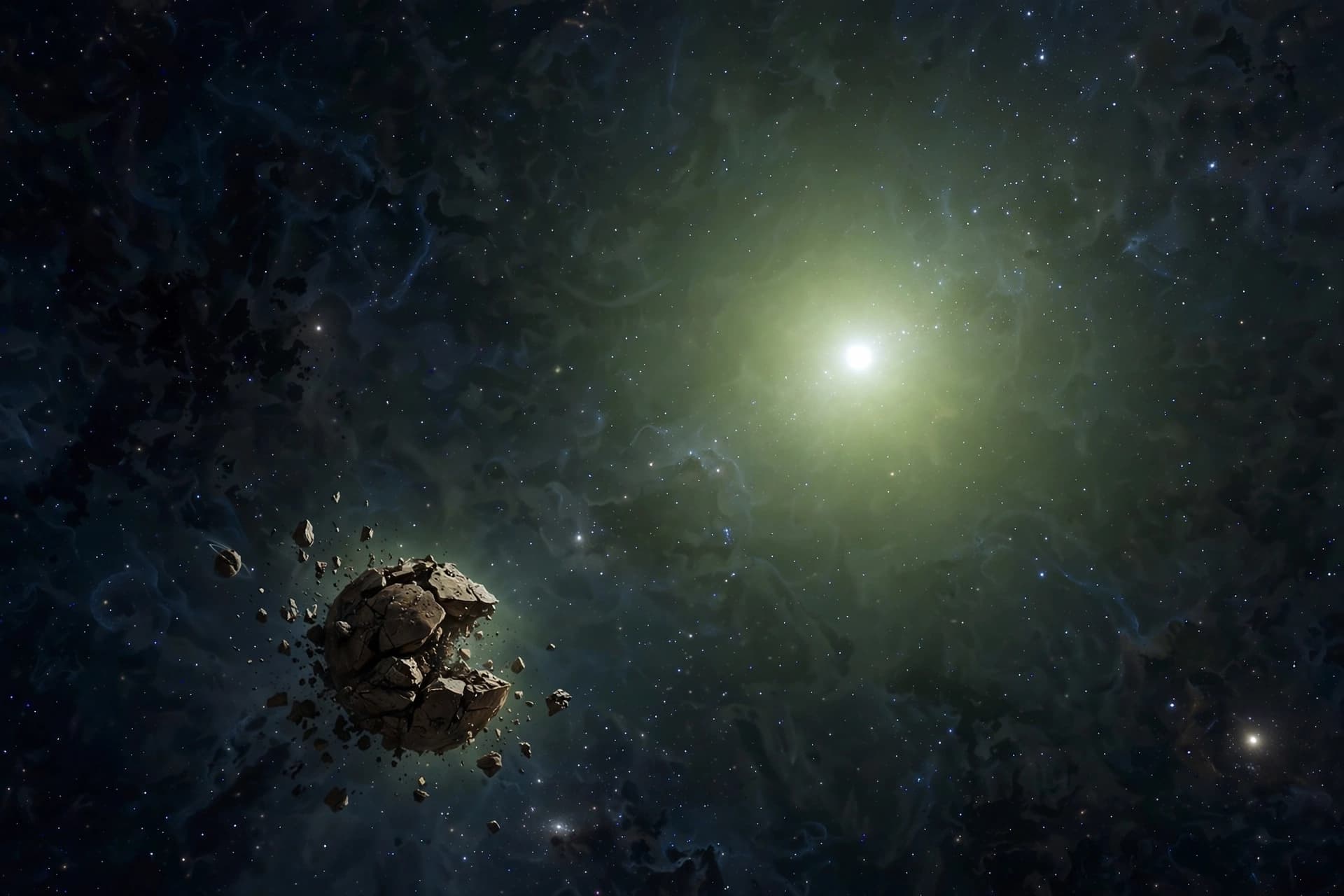
There are travelers in the cosmos who arrive without ceremony and depart without promise of return. They drift through familiar neighborhoods of planets and sunlight, pause just long enough to be noticed, and then continue onward into the dark. In recent weeks, such a visitor has drawn the quiet attention of astronomers: , a faint emerald-tinged wanderer that has briefly brightened as it passed near , before beginning what scientists believe will be its final journey out of the solar system.
As the comet approached the inner solar system, solar warmth awakened the frozen materials locked within its nucleus. Gases such as diatomic carbon began to glow as sunlight broke them apart, producing the soft green hue that gives the comet its name. This temporary brightening made C/2024 E1 a subject of renewed observation, even as it remained beyond naked-eye visibility for most observers on Earth.
Astronomers tracking the comet’s path noted that its trajectory is unusually steep and elongated. Unlike short-period comets that loop around the Sun again and again, C/2024 E1 follows a path suggesting it originated far beyond the planetary region, perhaps from the distant Oort Cloud. Calculations now indicate that gravitational interactions during its passage — influenced by the Sun and subtly by planetary alignments — have altered its orbit just enough to prevent a return.
The moment of visual interest came as the comet passed near Mars from Earth’s perspective. While not a close encounter in physical terms, the alignment offered a striking celestial pairing: the steady red glow of Mars contrasted with the diffuse green coma of a comet already loosening its grip on the Sun. For planetary scientists and skywatchers alike, it was a reminder of how layered the solar system can appear when geometry briefly aligns distant worlds.
From a scientific standpoint, such comets are valuable precisely because they are fleeting. Long-period and potentially interstellar-bound comets preserve chemical records from the earliest days of planetary formation. By observing how they brighten, shed material, and fade, researchers gain insight into the primordial ingredients that once shaped planets — including Earth itself.
Yet the tone surrounding C/2024 E1 remains measured. While its green glow and dramatic orbit capture imagination, it poses no threat to planets and offers no spectacle beyond telescopic reach. Its significance lies instead in its narrative: a natural object completing a single, unrepeatable passage through the Sun’s domain.
As the comet now dims and recedes, instruments will continue to track it for as long as possible, refining orbital models that increasingly suggest a permanent departure. Once it slips beyond the Sun’s gravitational influence, it will join countless other icy bodies drifting between the stars — silent, cold, and largely unseen.
In the end, Green Comet C/2024 E1 leaves behind no disruption, only data and a momentary glow against the darkness. Its passage near Mars and its likely exit from the solar system serve as a quiet illustration of celestial impermanence, reminding us that even within our well-mapped cosmic neighborhood, some visitors come only once.
AI Image Disclaimer Illustrations were produced with AI and serve as conceptual depictions.
Sources Space.com NASA BBC News Reuters Sky & Telescope
Published by Banx Network. This article is part of the Banx decentralized media programme, powered by the BXE token on the XRP Ledger.