There is a prejudice embedded in much of physics, a quiet assumption that the environment surrounding a system is forgetful. When a particle moves through water, the thinking goes, the water does not remember where it has been. Its past is erased with each molecular collision, and whatever information the particle sheds is lost for good. This assumption has served thermodynamics well for over a century. But it is not always true, and in the gap between what we assume and what actually happens, a team of physicists has found something useful.
The work centers on a concept familiar to anyone who has encountered Maxwell's demon—the thought experiment in which a tiny being sorts fast molecules from slow ones, seemingly violating the second law of thermodynamics. Modern physics resolved this paradox by recognizing that information itself has a thermodynamic cost. But that resolution opened a door: if information can be converted into work, then perhaps the information a system leaves behind in its environment can be reclaimed.
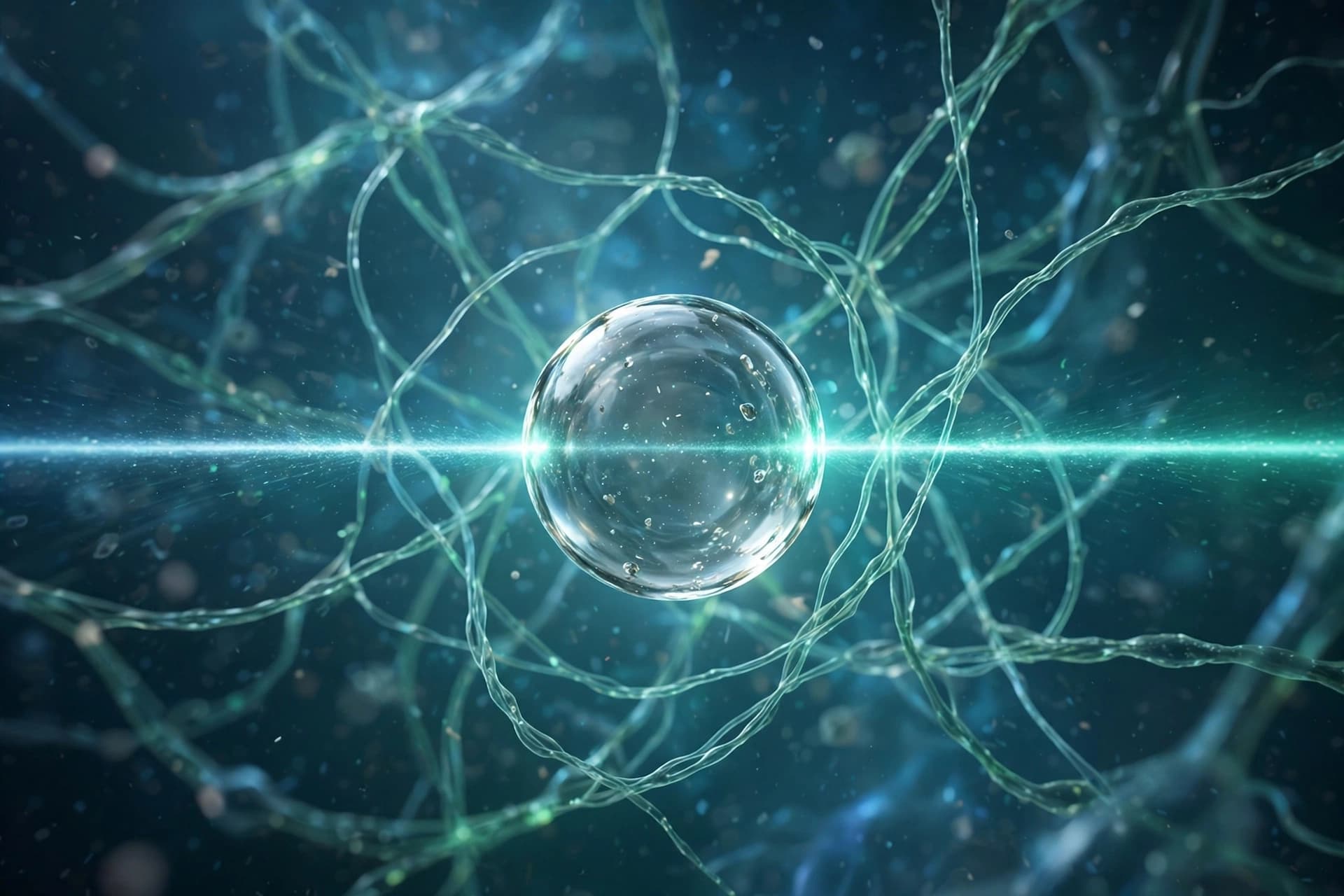
Researchers at the University of Konstanz, led by Clemens Bechinger, set out to test this idea. They trapped a microscopic glass bead in a laser beam and suspended it not in ordinary water but in a viscoelastic fluid filled with micelles—long, spaghetti-like molecular chains that form an invisible network . When the bead jiggled under the relentless bombardment of surrounding molecules, that network deformed. And crucially, it did not forget. The micelles retained traces of the bead's past movements, a kind of physical memory that influenced how the bead would move next.
The challenge was that this memory was hidden. The researchers could see the bead, but not the network. So they devised a workaround: they measured the bead's position twice, with a carefully chosen delay between observations. If the interval was too short, the measurements revealed little about the network's dynamics. If it was too long, the fluid had already forgotten. At around one second, they found the sweet spot .
Armed with this partial knowledge of the hidden memory, they shifted the laser trap at strategically chosen moments, converting the bead's random jostling into mechanical work. Under certain conditions, they extracted up to three times more work than the theoretical limit for a system without memory . The results, published in Nature Physics, establish what the authors call "environmental memory as an experimentally accessible thermodynamic resource" .
It is worth being precise about what this means and what it does not. The threefold figure is not a claim about the efficiency of some future engine. It applies to a specific measurement sequence and a specific comparison. In other measurement sequences, the absolute work extracted was higher, but the ratio to the memoryless limit was different. What matters is the principle: information that was once considered irrecoverably lost can, under the right conditions, be recovered and put to use.
The practical implications remain distant but conceivable. Microscopic devices operating in complex fluids—inside living organisms, perhaps, or in industrial environments where the surrounding medium is anything but simple—might one day exploit these hidden memories rather than treating them as noise . For now, the research is a demonstration, a proof that the assumption of a forgetful environment is not merely imprecise but unnecessarily limiting.
The water, it turns out, remembers. And in that memory, there is work to be done.
Image note: The visuals accompanying this article are AI-generated and are intended for illustration only.
Sources: University of Konstanz, Nature Physics, ScienceAlert, Scinexx
Published by Banx Network. This article is part of the Banx decentralized media programme, powered by the BXE token on the XRP Ledger.