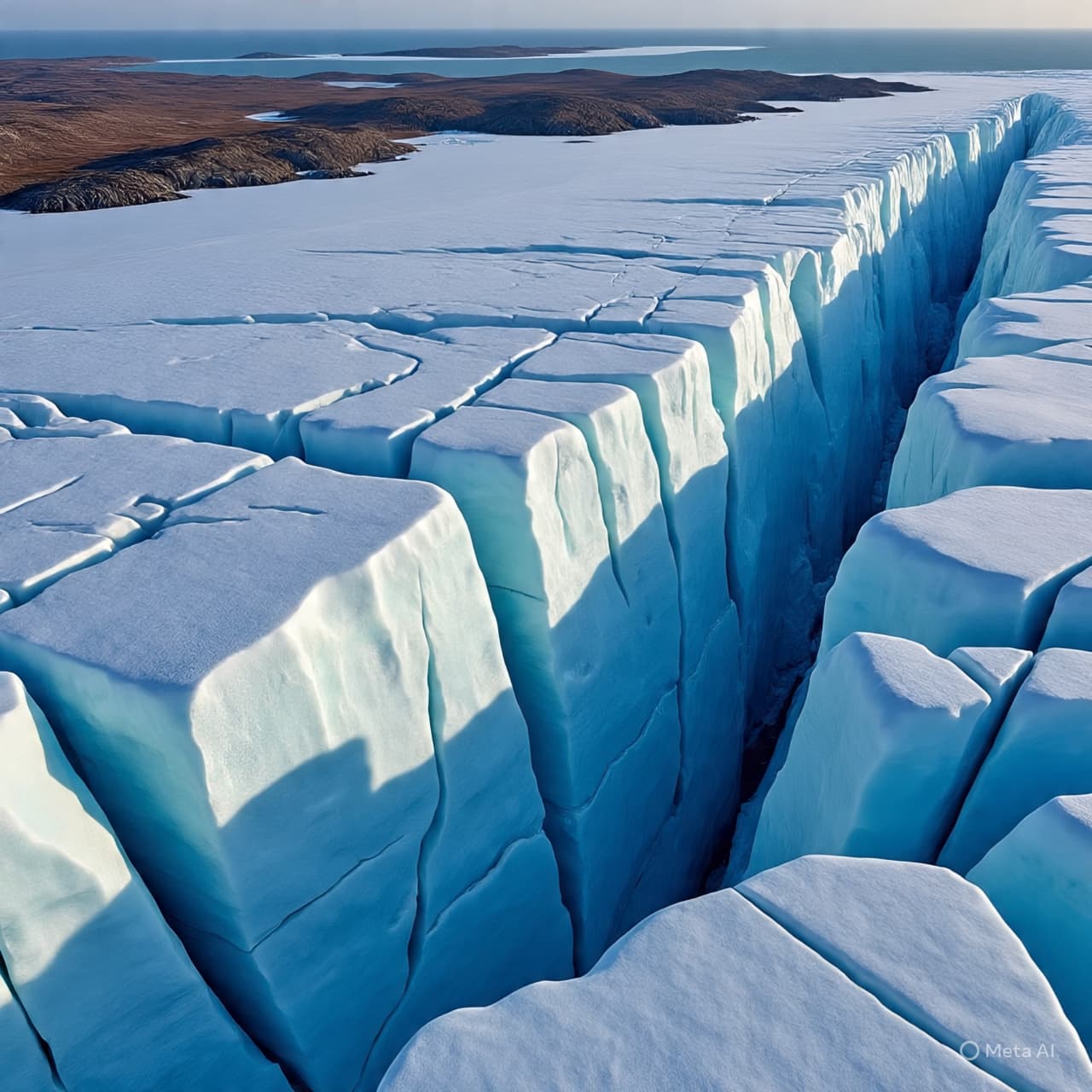
Antarctica is often imagined as stillness itself — a continent frozen not only in ice, but in time. Its vast glaciers appear immovable, their silence reinforcing the illusion of permanence. But beneath one of the world’s most closely watched ice masses, that silence has been breaking.
Scientists report alarm and uncertainty after detecting hundreds of earthquakes beneath the Thwaites Glacier, often referred to as the “Doomsday Glacier.” The seismic activity, recorded deep below the ice, has drawn renewed attention to a region already considered one of the most vulnerable points in Earth’s climate system.
The earthquakes were not large enough to be felt by humans, nor did they signal an immediate collapse. Yet their sheer number and location matter. They occurred in zones where ice meets bedrock — a critical interface that governs how quickly a glacier can slide toward the sea. Movement there, even subtle, can reshape the glacier’s future.
Researchers believe the tremors may be linked to the shifting of the glacier as it responds to warming ocean water and internal stress. As the ice thins and accelerates, friction against the underlying rock changes. That friction, in turn, can release energy in small seismic bursts — the ice effectively cracking and adjusting as it moves.
What unsettles scientists is not just the activity itself, but how little precedent exists. Glacial earthquakes have been observed before, but rarely in such concentration beneath a single, already unstable glacier. Thwaites alone holds enough ice to raise global sea levels by more than half a meter if it were to collapse completely.
The uncertainty lies in interpretation. Some researchers caution that these earthquakes may be part of a natural adjustment process, not a sign of imminent failure. Others argue they could indicate accelerating instability, where feedback loops — warming water, faster flow, increased cracking — begin reinforcing one another.
Complicating matters is the environment itself. Antarctica remains one of the most difficult places on Earth to monitor. Instruments are sparse, data arrives slowly, and every new signal raises as many questions as it answers. Each tremor is a data point, but not yet a conclusion.
What is clear is that the glacier is not static. The seismic signals confirm that Thwaites is active, responsive, and changing — not silently, but audibly, if scientists know how to listen.
For now, researchers are focused on understanding rather than predicting. Models are being refined. Monitoring is expanding. And the glacier continues its slow interaction with forces both ancient and newly intensified by a warming world.
In Antarctica, change rarely announces itself loudly. But when the ice begins to shake, even quietly, it has a way of commanding attention.
Published by Banx Network. This article is part of the Banx decentralized media programme, powered by the BXE token on the XRP Ledger.