The open ocean can make even a routine voyage feel wonderfully small. For four sailors aboard the Australian-flagged yacht Tai Tam, that feeling became very real when a sperm whale struck their vessel in the remote South Pacific, turning an ordinary passage into an overnight survival ordeal and triggering an international rescue effort.
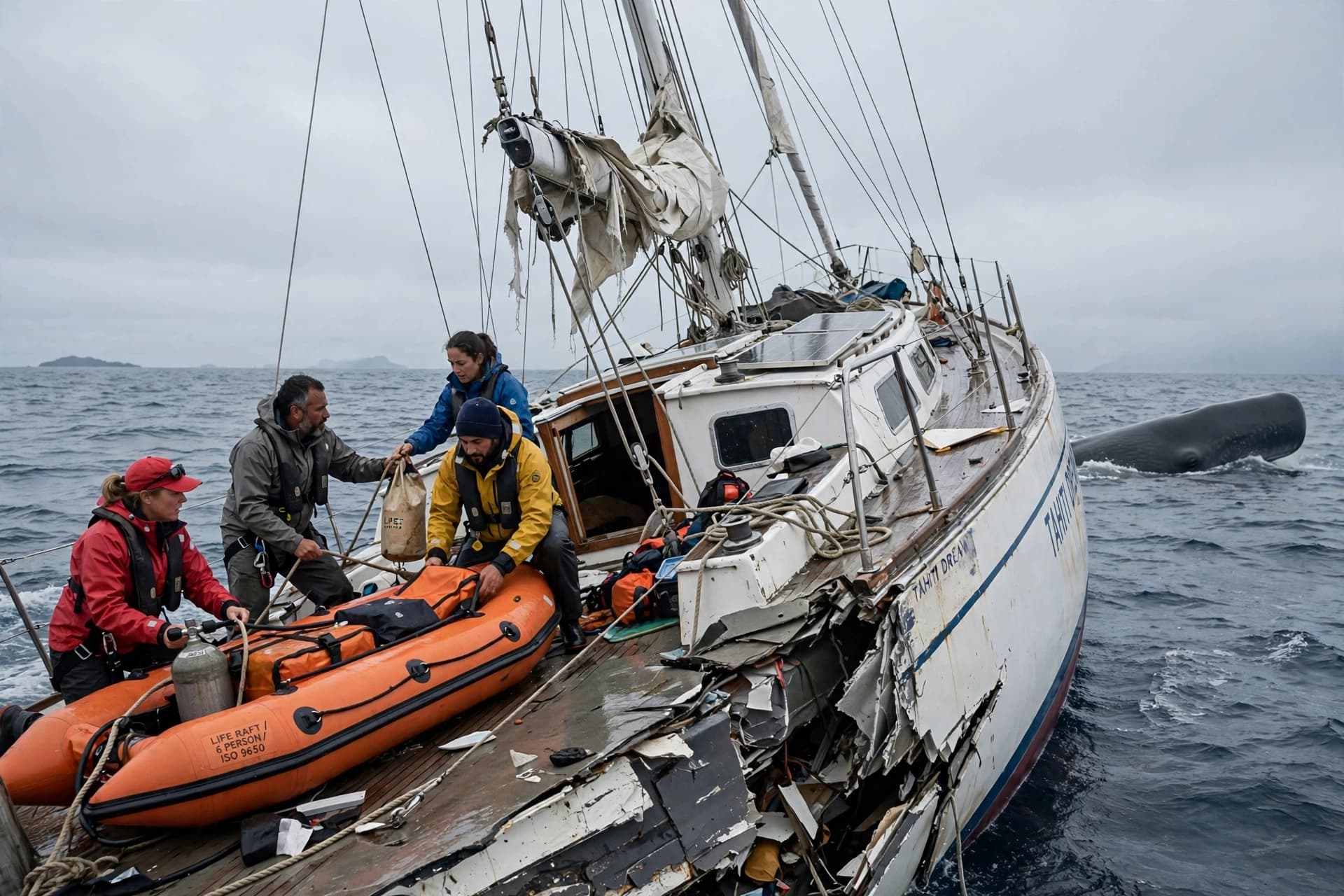
The incident occurred about 250 nautical miles north of Norfolk Island on September 26. The 51-foot yacht was traveling in an area where the crew encountered a pod of sperm whales when a sudden impact damaged the vessel. The crew initially did not know what had happened, but quickly realized that the hull had been seriously compromised and water was entering the boat.
The impact damaged the yacht's steering equipment and cracked its hull. The four sailors attempted to control the flooding and keep the vessel operational, but the situation deteriorated. They eventually activated an emergency position-indicating radio beacon, known as an EPIRB, which alerted Maritime New Zealand's Rescue Coordination Centre to their emergency.
A Royal New Zealand Air Force P-8A Poseidon surveillance aircraft was sent to the area to help locate the crew and establish communications. The aircraft was able to communicate with the sailors and with vessels nearby, helping coordinate the response in a remote stretch of ocean where conventional rescue resources were limited.
As the yacht continued taking on water, the sailors abandoned ship and moved into a life raft. They remained at sea for several hours while rescue coordination continued. The yacht eventually disappeared beneath the water, leaving the crew dependent on their raft and the assistance of vessels being directed toward their position.
The rescue vessel that reached them was the 143-meter cargo ship Sofrana Surville. Its crew took the four sailors aboard at approximately 6 a.m. the following morning, after they had spent many hours in the life raft. The rescued sailors included two Australians, one New Zealander and one French national, and authorities reported that all four survived.
Maritime New Zealand praised the coordination between the New Zealand Defence Force, Australian and New Caledonian rescue authorities, the cargo ship and other vessels that assisted. Officials also emphasized the importance of the yacht's early EPIRB activation, which helped rescuers establish the location of the stricken crew in a vast area of ocean.
The incident is a reminder of the particular risks of long-distance sailing, where the distance between danger and assistance can be measured in hours rather than minutes. In this case, preparation, an emergency beacon, military surveillance and the presence of a nearby commercial vessel combined to bring four people safely through an unexpected encounter with one of the ocean's largest animals.
AI Image Disclaimer: This article's accompanying visual is AI-generated and is intended only as a neutral illustration of the reported event.
Sources: New Zealand Defence Force, Maritime New Zealand, AFP, Associated Press, CBS News, Euronews
Published by Banx Network. This article is part of the Banx decentralized media programme, powered by the BXE token on the XRP Ledger.