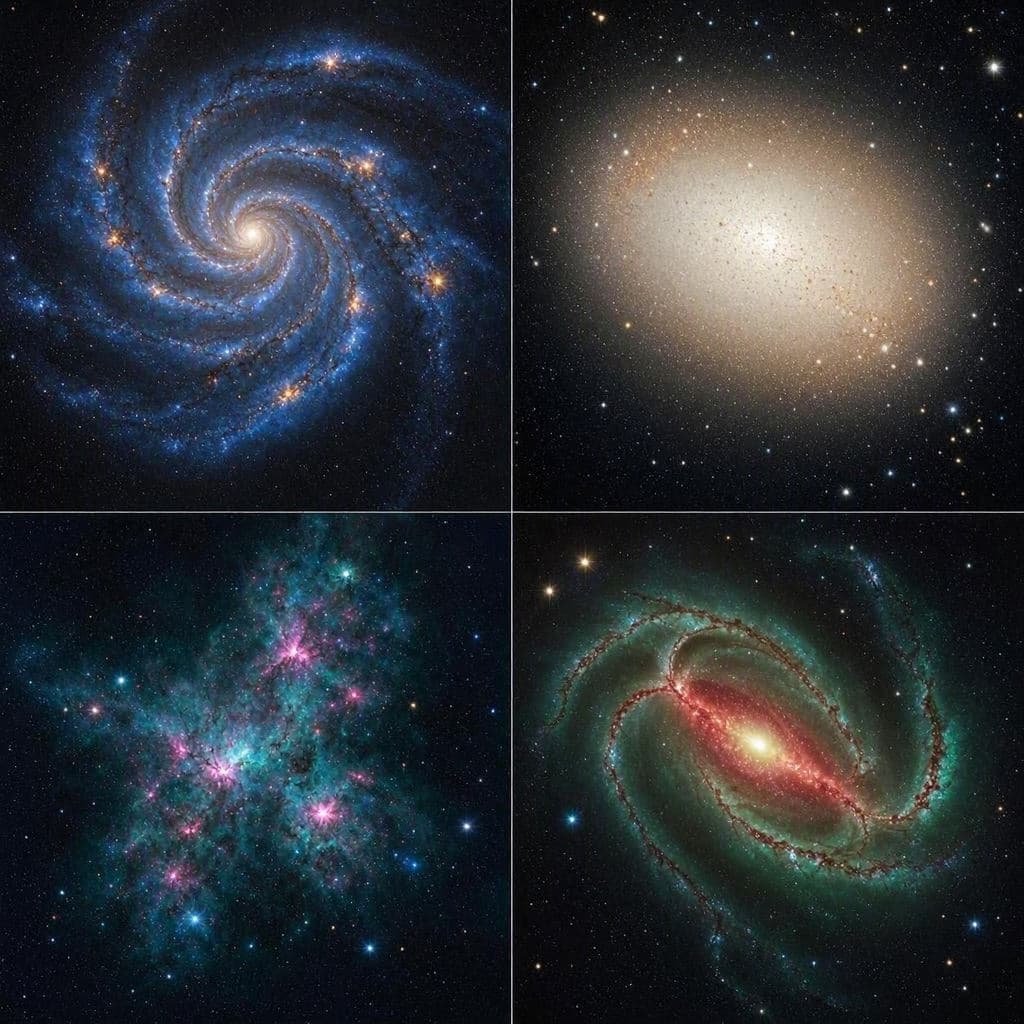
In the vast expanse of the universe, galaxies are the fundamental building blocks of cosmic structure, each with its own unique story written in starlight. Recently, astronomers have curated a stunning gallery of 16 "Cosmic Gems," showcasing the breathtaking diversity of galactic forms. From spirals that swirl like celestial pinwheels to ellipticals that glow like ancient embers, this collection invites us to appreciate the artistic variety inherent in the laws of physics.
Each image in the gallery is more than just a photograph; it is a window into different stages of galactic evolution. Some gems display vibrant blue hues, indicating regions of active star formation where new suns are being born. Others shine with a warm, reddish glow, suggesting older populations of stars that have burned for billions of years. Together, they paint a comprehensive picture of the life cycles of these massive systems.
The selection highlights the influence of gravity and interaction on galactic shape. Some galaxies appear distorted or stretched, likely due to gravitational tugs from neighboring giants. These tidal forces can pull streams of stars and gas across millions of light-years, creating bridges and tails that defy simple geometric classification. It is a reminder that galaxies are not isolated islands but part of a dynamic, interacting community.
High-resolution imaging from telescopes like Hubble and James Webb has made this gallery possible. The clarity of these instruments allows astronomers to resolve individual star clusters and dust lanes, revealing details that were previously blurred into obscurity. This technological leap has transformed our understanding of galaxy morphology, moving beyond broad categories to appreciate nuanced structures.
For the public, the gallery serves as an educational tool, demystifying the complexity of the cosmos. By presenting these objects as "gems," astronomers emphasize their value and beauty, encouraging a sense of wonder and stewardship for scientific discovery. It bridges the gap between technical data and human appreciation, making the abstract concepts of astrophysics tangible and visually engaging.
The diversity shown in these 16 examples also challenges simplistic models of galaxy formation. It suggests that the path a galaxy takes is influenced by a myriad of factors, including initial conditions, mergers, and environmental pressures. Studying these variations helps scientists refine simulations and theories about how the universe evolved from the Big Bang to its current state.
As we look at these cosmic gems, we are also looking back in time. The light from some of these distant galaxies has traveled for eons to reach our eyes, carrying information from the early universe. They are fossils of light, preserving the history of cosmic growth and change. Their beauty is matched only by the scientific insights they provide.
The gallery of 16 Cosmic Gems offers a vivid illustration of galactic diversity, highlighting the complex processes that shape the universe. Through these images, astronomers continue to unravel the mysteries of cosmic evolution, inviting everyone to marvel at the splendor of the heavens.
AI Image Disclaimer: Images used to depict this astronomical collection are AI-generated for illustrative purposes.
Sources: NASA/ESA Hubble Space Telescope European Space Agency The Astrophysical Journal
Published by Banx Network. This article is part of the Banx decentralized media programme, powered by the BXE token on the XRP Ledger.