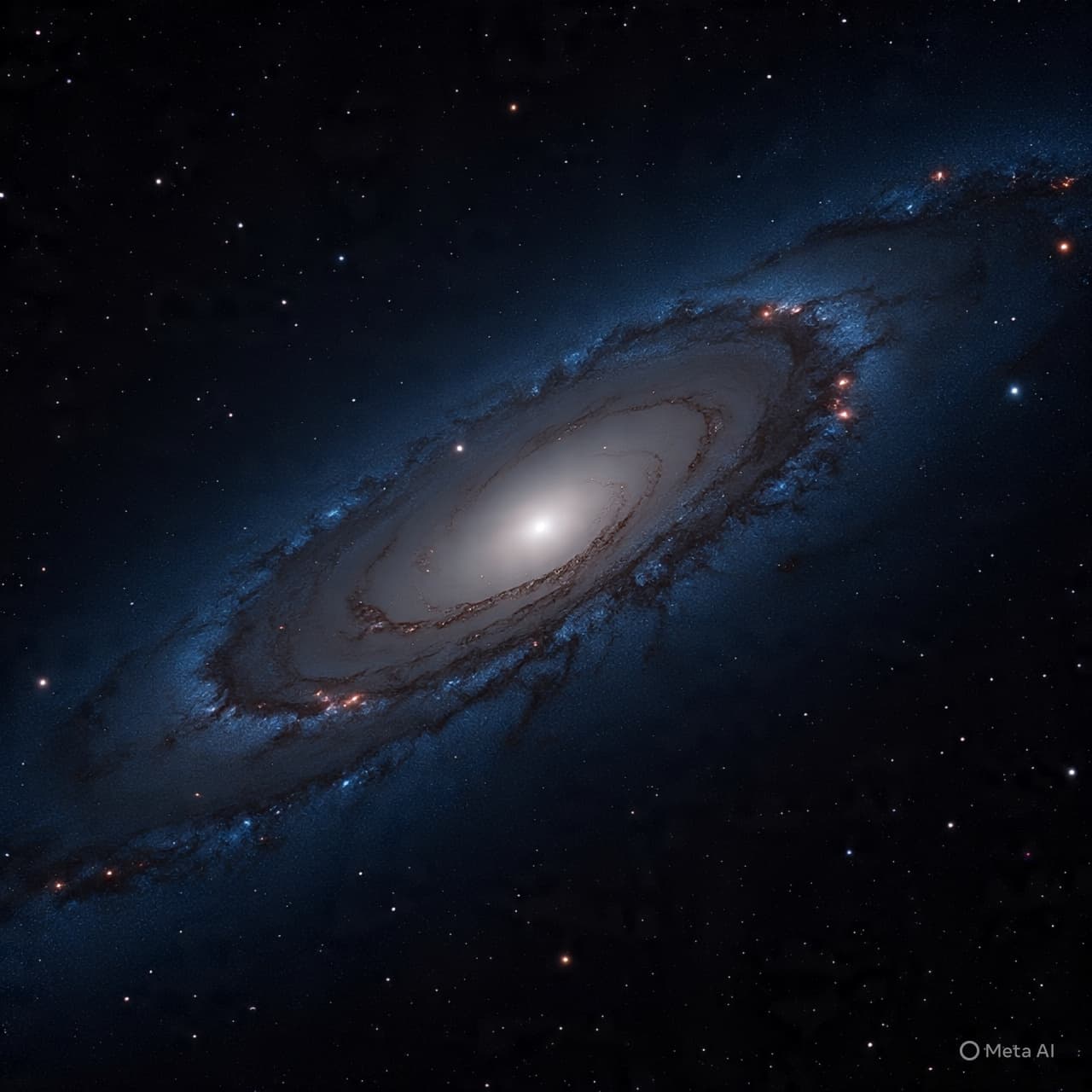
In the vast theater of the cosmos, where stars and nebulae often take center stage, there are whispers of invisible actors that move just out of sight — shadows shaped not by light but by gravity. For generations, scientists have sensed these unseen presences, teasing out hints of a substance that holds galaxies together while remaining stubbornly elusive to telescopes. Like listening for footsteps in a room full of echoes, astronomers have followed subtle clues across space and time, seeking evidence of the dark matter that dominates the mass of the universe. Now, a rare and extraordinary discovery has brought that pursuit into sharper focus, illuminating a galaxy that almost defies conventional presence by shining so faintly it almost fades from view.
Peering into the Perseus galaxy cluster, a team of researchers used some of the world’s most powerful instruments — the Hubble Space Telescope, the Euclid space observatory, and Japan’s Subaru telescope — to reveal the existence of a virtually invisible galaxy whose substance is almost entirely dark matter. For years, scientists had observed tight groupings of ancient star clusters in this region, but only through careful synthesis of multi‑telescope data did the full gravity of the discovery come into view.
Body: The galaxy, tentatively named CDG‑2 (Candidate Dark Galaxy‑2), lies some 300 million light‑years away and barely glimmers with the light of its sparse stellar population. Unlike typical galaxies — dazzling assemblies of billions of stars — CDG‑2 emits the faint glow equivalent to only about six million Suns. Much of that faint light arises from four globular star clusters, ancient and compact groupings of stars that acted like cosmic beacons, guiding astronomers to the galaxy’s hidden core.
What makes CDG‑2 remarkable is not just its faintness, but its composition. Based on gravitational modeling and the distribution of visible matter, researchers estimate that approximately 99.9 % of its mass is dark matter — the invisible substance that neither emits nor reflects light but exerts a profound gravitational pull on everything around it. This stands in stark contrast to ordinary galaxies, where visible matter — stars and gas — contributes significantly more to overall brightness, even if dark matter still outweighs it.
Astronomers have long suspected the existence of “dark galaxies” — vast collections of matter with few or no stars — but confirming one has been a formidable challenge. These ghostly systems are nearly invisible to traditional detection methods because they do not radiate light. In the case of CDG‑2, the discovery hinged on observing the gravitational signature left by its globular clusters, then uncovering the faint, diffuse glow that revealed the hidden galaxy behind them.
Researchers suggest that tidal interactions — gravitational forces from nearby galaxies in the crowded cluster environment — may have stripped CDG‑2 of much of its gas long ago, suppressing star formation and leaving behind a dense dark matter halo with only the hardiest clusters of stars surviving at its edges. This process could explain why the galaxy is so dim yet so massive.
The discovery of CDG‑2 offers a unique laboratory for studying dark matter’s role in galaxy formation and evolution. Because the galaxy’s visible components are few, it provides an unusually clear view of how dark matter shapes and holds together large structures, offering empirical tests for cosmological models that otherwise depend on indirect measures.
Closing: Astronomers have confirmed the existence of a galaxy, named CDG‑2, whose mass is almost entirely composed of dark matter, with only a tiny fraction of visible starlight from a few globular clusters. This discovery, made using combined data from the Hubble Space Telescope, Euclid, and the Subaru telescope, marks one of the most dark matter‑dominated systems ever observed. Researchers say this rare find provides new opportunities to study the nature of dark matter and its influence on galaxy formation, though scientists caution that further observations will be needed to fully understand the galaxy’s structure and history.
AI Image Disclaimer “Visuals are created with AI tools and are not real photographs.”
Sources WIRED, ScienceDaily, Space.com, NASA/ESA Hubble Mission Team, Colombian science news reports.
Published by Banx Network. This article is part of the Banx decentralized media programme, powered by the BXE token on the XRP Ledger.