
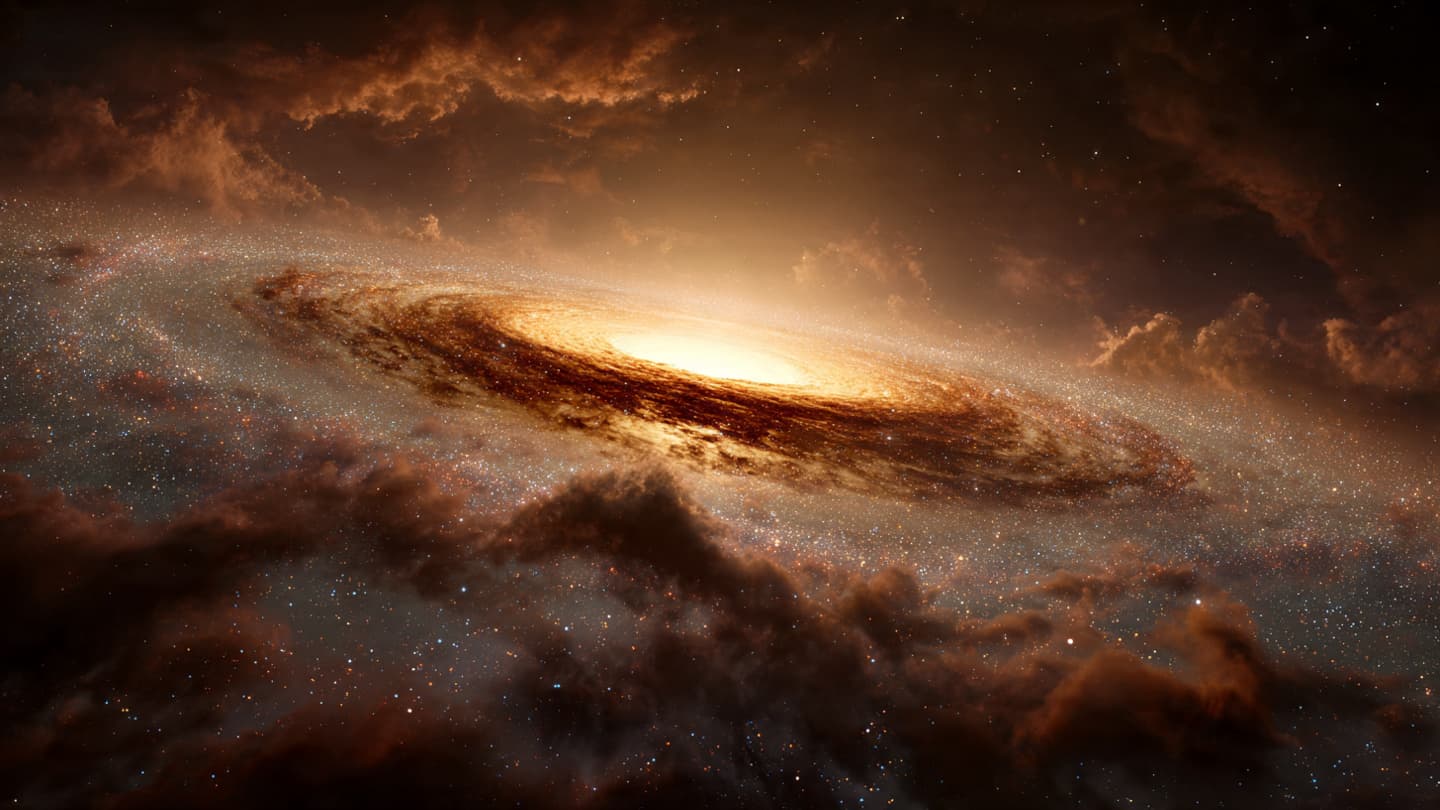
At the center of the Milky Way lies an object both familiar and mysterious. Known as Sagittarius A*, the supermassive black hole anchoring our galaxy has fascinated scientists for decades. Like a distant lighthouse hidden behind fog, it has offered clues while withholding complete explanations. New research may now be clearing part of that uncertainty.
Body:
Astronomers report that a longstanding mystery involving the Milky Way's central black hole may finally have an explanation. The findings address questions that have challenged researchers for more than half a century.
The mystery centered on unusual activity observed around Sagittarius A*. Over the years, astronomers detected behavior that did not fully align with existing expectations regarding the environment surrounding a supermassive black hole.
Using advanced observational techniques and improved computer simulations, researchers analyzed data collected from multiple observatories. The study combined theoretical modeling with observational evidence to investigate the phenomenon in greater detail.
Scientists concluded that interactions involving magnetic fields, hot gas, and energetic particles likely played a more significant role than previously recognized. These interactions appear capable of producing the unusual signals that puzzled researchers for decades.
Understanding the behavior of Sagittarius A* is important because it provides a nearby laboratory for studying black holes throughout the universe. Although many galaxies contain similar objects, the Milky Way's central black hole can be observed with greater precision.
The research demonstrates how scientific mysteries are often solved gradually rather than suddenly. Years of observations, technological improvements, and collaboration between institutions contributed to the latest breakthrough.
Astronomers emphasize that the new explanation resolves one specific question rather than every mystery surrounding black holes. Many aspects of these extraordinary objects remain active areas of investigation.
Even so, the study represents a significant achievement in astrophysics. By clarifying a longstanding puzzle, researchers have added another piece to humanity's understanding of the galaxy we call home.
Closing:
The findings offer fresh insight into the complex environment surrounding the Milky Way's central black hole. As observations continue, scientists hope to uncover even deeper details about one of the most fascinating regions in our galaxy.
AI Image Disclaimer: Images associated with this article are AI-generated interpretations based on astronomical concepts and are intended for editorial illustration only.
Sources (Verified): Scientific American, Nature, NASA, European Southern Observatory (ESO)
Published by Banx Network. This article is part of the Banx decentralized media programme, powered by the BXE token on the XRP Ledger.



