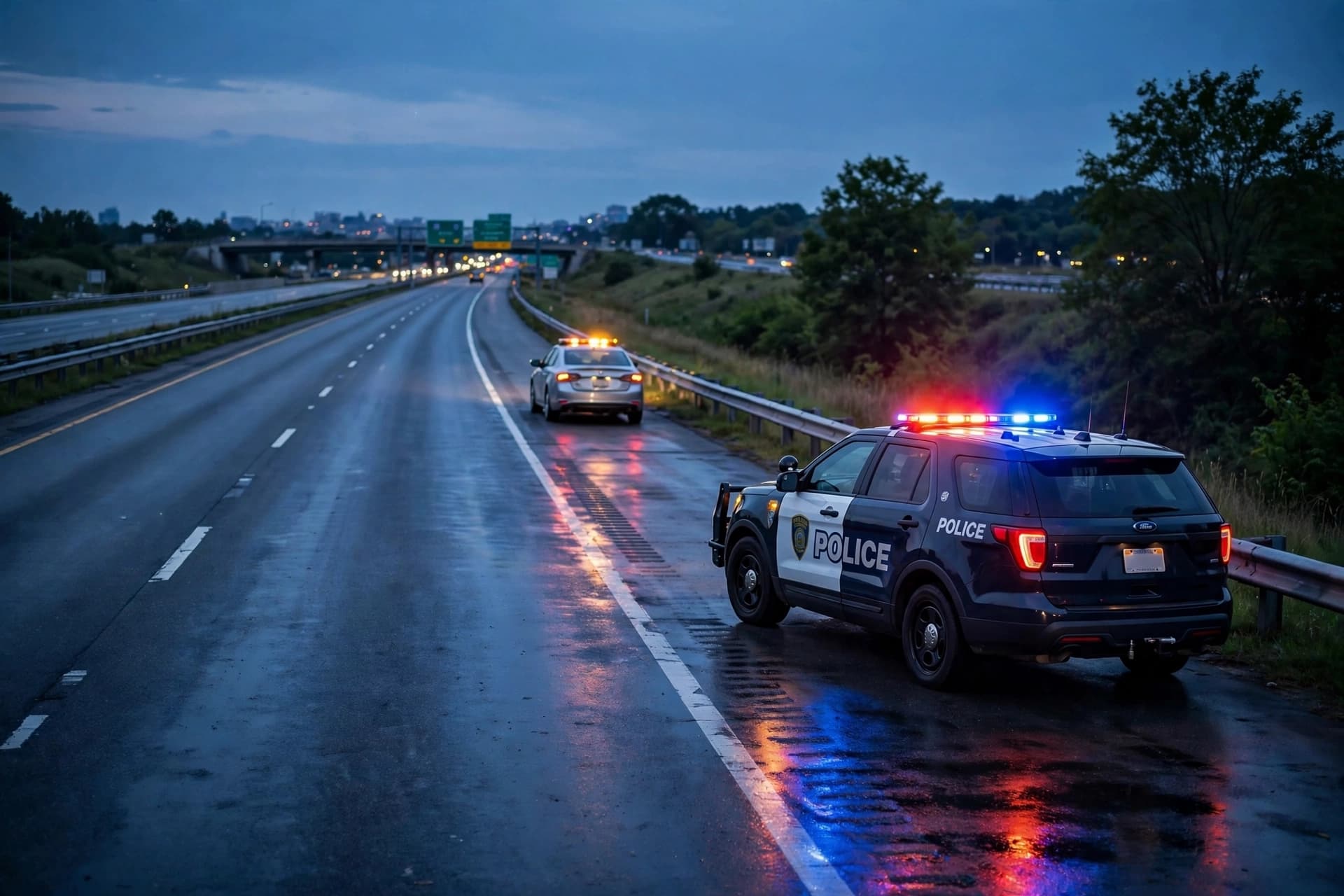
There is a particular kind of stillness that follows a speeding car when it is finally pulled over—the engine ticking as it cools, the officer's flashlight sweeping across the dashboard, the slow realization that the world is not, in fact, a video game. On Thursday evening, shortly after eight o'clock, an Ontario Provincial Police officer on Highway 417 in Ottawa clocked a vehicle traveling at 171 kilometers per hour in a 110-kilometer zone. The driver was a G2 licence holder. The car belonged to his mother.
The consequences arrived with the quiet efficiency of Ontario's stunt driving laws. His licence was suspended for thirty days. The vehicle was impounded for fourteen days. He faces a minimum fine of two thousand dollars, six demerit points, and a one-year driving prohibition upon conviction. For a driver in the graduated licensing system—still learning, still accumulating the experience that makes judgment possible—the arithmetic of that evening is stark. A moment of acceleration has become a year without driving.
Stunt driving charges in Ontario have become increasingly common in recent years, a fact that speaks to something beyond individual recklessness. The province's highways are long and straight. The speed limits are posted. The temptation to press the accelerator, to feel the car respond, is not new. What is new is the severity of the response, a legislative choice that treats excessive speed not as a minor infraction but as a precursor to catastrophe. At 171 kilometers per hour, the physics of a collision become almost abstract in their violence.
The detail that the car belonged to the driver's mother adds a domestic texture to what might otherwise be a routine traffic report. It suggests a young person entrusted with something borrowed, a vehicle that represents not just transportation but the trust of a parent. That trust, like the car, was impounded—the vehicle for fourteen days, the trust for considerably longer. The driver's name has not been released, and there is no indication of impairment or other aggravating circumstances beyond the speed itself.
Highway 417, known locally as the Queensway, is the main artery through Ottawa, a road that carries commuters, families, and the ordinary traffic of a capital city. At the hour the driver was stopped, the evening was settling into its usual rhythms. The danger of traveling at 171 kilometers per hour on a road shared with other vehicles is not a hypothetical. It is a calculation of reaction times, stopping distances, and the unpredictable behavior of everyone else on the road. The officer who pulled the driver over performed a service that does not always receive acknowledgment: the prevention of something that had not yet happened.
For the young driver, the weeks ahead will bring practical inconveniences—rides from friends, the absence of the car he borrowed, the court date that will determine the final terms of his penalty. For his mother, there is the impound lot and the insurance paperwork. For the rest of us, there is the quiet reminder that the road is a shared space, and that the privilege of driving is extended to the young on the condition that they understand its weight.
The OPP's social media post about the stop was brief, almost terse, the kind of notice that police issue when the facts speak for themselves. A G2 driver. 171 km/h. His mother's car. The numbers and the details tell the story without embellishment. The rest is left to the imagination: the sound of the engine, the flash of lights in the mirror, the slow pull to the shoulder, and the long walk back to a life temporarily without keys.
---
AI Image Disclaimer: All images in this article are AI-generated illustrations and should not be interpreted as documentary evidence.
Sources: CityNews Ottawa, Yahoo News Canada, Ontario Provincial Police
Published by Banx Network. This article is part of the Banx decentralized media programme, powered by the BXE token on the XRP Ledger.