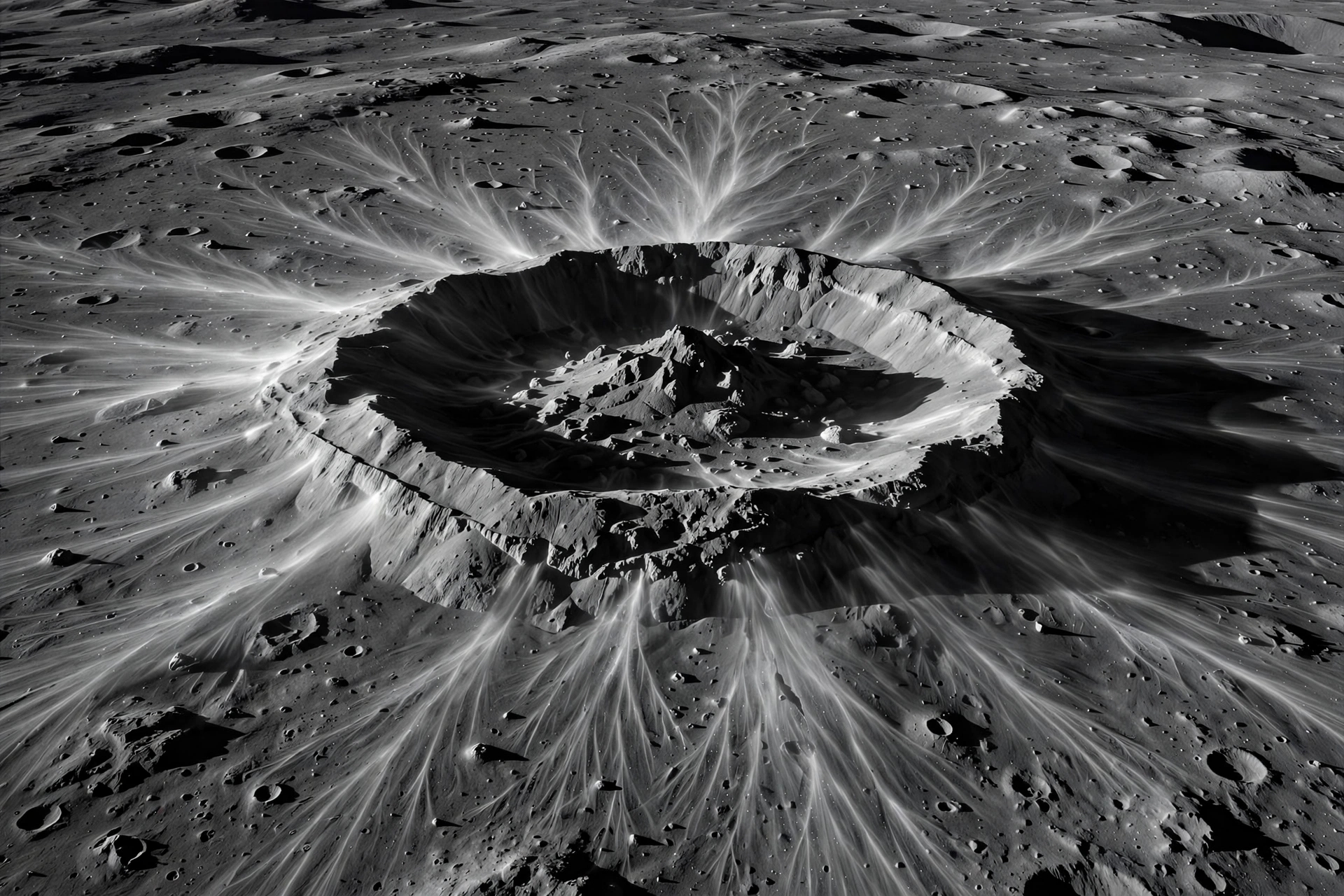
The Moon, our constant companion in the night sky, has long been considered a static world, its surface marked by ancient scars that tell the story of billions of years of cosmic bombardment. However, recent data from NASA’s Lunar Reconnaissance Orbiter (LRO) reveals that our celestial neighbor is still changing. A massive new crater, formed by a recent impact, has been identified, reminding us that the Moon is not a dead rock but a dynamic environment subject to the ongoing risks of space debris.
The crater, estimated to be several meters wide, was discovered through high-resolution imaging that compared recent photos with older archives. The fresh ejecta blanket surrounding the impact site appears bright against the darker lunar regolith, indicating its youth. Such discoveries are rare but significant, providing scientists with real-time data on the frequency and force of meteoroid impacts. This particular event underscores the volatility of the near-Earth space environment.
For planetary scientists, these fresh craters are valuable natural experiments. By studying the size and shape of the impact, researchers can better understand the properties of the lunar surface and the nature of the objects striking it. This information is crucial for future missions, particularly those involving human habitation. Knowing the risk of impacts helps engineers design safer habitats and plan protective measures for astronauts and equipment.
The discovery also highlights the effectiveness of NASA’s monitoring programs. The LRO, launched in 2009, continues to provide unprecedented detail of the lunar surface, capturing changes that were previously invisible. This long-term observation capability allows scientists to track geological activity and impact events with precision. It transforms the Moon from a static backdrop into a living laboratory for planetary science.
While the crater itself is too small to be seen from Earth with the naked eye, its implications are large. It serves as a reminder that space is not empty but filled with rocks and dust traveling at high speeds. As interest in lunar exploration grows, with plans for bases and mining operations, understanding these hazards becomes a priority. Each new impact adds to the statistical model used to assess risk for future settlers.
Furthermore, the find contributes to our understanding of the Moon’s seismic activity. Impacts generate moonquakes, which can be detected by seismometers left behind by Apollo missions. Correlating visual evidence of new craters with seismic data helps scientists map the interior structure of the Moon and understand how it responds to external forces. This holistic approach enhances our overall knowledge of lunar geology.
As we look toward a return to the Moon, such discoveries reinforce the need for vigilance. The lunar environment is harsh and unpredictable, requiring robust technology and careful planning. The new crater is a small mark on a vast surface, but it carries a big message: the Moon is active, and we must respect its dynamics. It is a testament to the enduring value of scientific observation.
In the end, the discovery of this new crater is a celebration of curiosity and technological achievement. It shows that even after decades of study, the Moon still has secrets to reveal. By continuing to watch and learn, we prepare ourselves for the next great leap in space exploration, ensuring that our steps on lunar soil are taken with eyes wide open.
AI Image Disclaimer: The images accompanying this article are AI-generated artistic interpretations of lunar landscapes and impact events, not actual raw data images from the LRO.
Published by Banx Network. This article is part of the Banx decentralized media programme, powered by the BXE token on the XRP Ledger.