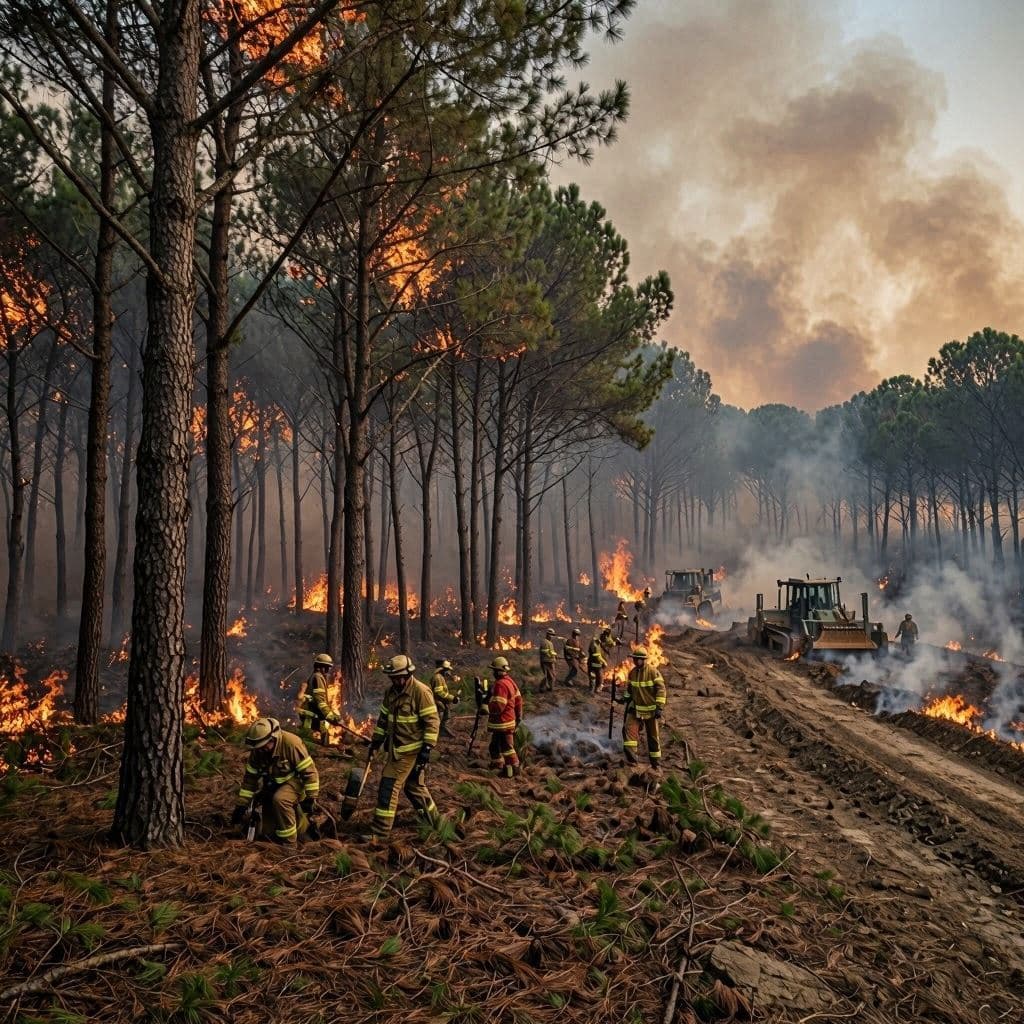
Forests often symbolize permanence, places where generations measure time by the growth of towering trees rather than the passing of seasons. Yet some forests tell a different story. They are not ancient landscapes shaped solely by nature, but carefully designed creations of human ambition. In southwestern France, one such forest has become the center of a devastating wildfire crisis, revealing how decisions made more than a century ago continue to shape the challenges of today.
The fires have spread across the Landes de Gascogne in the Gironde region near Bordeaux, forcing hundreds of thousands of residents and holidaymakers to evacuate while thousands of firefighters, supported by aircraft and military personnel, work to contain the flames. Although weather conditions have recently improved, authorities continue to battle flare-ups across an area that has become one of France's largest wildfire disasters in modern history.
Unlike many natural woodlands, the Landes forest was deliberately created during the nineteenth century under policies introduced during the reign of Napoleon III. Vast wetlands were drained and replaced with extensive plantations of maritime pine to stabilize the landscape and support the timber and resin industries. Over time, the project transformed the regional economy while creating what is now the largest artificial forest in Western Europe.
Scientists and environmental historians note that the very characteristics that once made the forest economically valuable may also contribute to wildfire behavior. Large areas dominated by a single tree species, combined with relatively uniform spacing and continuous vegetation, can allow fires to spread more rapidly than in more diverse natural forests where variations in vegetation sometimes help slow advancing flames. Experts emphasize that these factors interact with weather rather than acting alone.
Extreme heat, prolonged drought, and strong winds have created conditions highly favorable for wildfire development across France and neighboring countries. According to researchers from the World Weather Attribution initiative, climate change has significantly increased the likelihood of the hot, dry weather patterns that have fueled this year's fires. At the same time, officials stress that most wildfire ignitions in France are linked to human activity, whether accidental or intentional.
The disaster has prompted renewed discussion about long-term forest management. Specialists suggest that increasing tree diversity, creating strategic firebreaks, reducing fuel accumulation, and improving landscape planning could help lower future wildfire risks. Such measures are increasingly viewed as important complements to emergency firefighting efforts as Europe experiences more frequent periods of extreme fire weather.
Despite the destruction, emergency responders have continued protecting communities while restoring access for many evacuees as conditions gradually improve. Authorities caution, however, that burned areas remain hazardous and that isolated flare-ups may continue until the fire is fully extinguished. Recovery is expected to require months of ecological restoration and infrastructure repair.
The fires sweeping through the Landes forest illustrate how landscapes shaped by human hands can carry both remarkable achievements and unforeseen vulnerabilities. As France begins the long process of recovery, the experience is likely to inform future conversations about balancing economic development, biodiversity, and resilience in an era of increasingly challenging environmental conditions.
AI Image Disclaimer: The accompanying illustrations are AI-generated visual representations based on verified reporting and are intended to depict the general landscape and wildfire response rather than actual photographs.
Sources (Verified):
Reuters Associated Press (AP) Agence France-Presse (AFP) France 24 European Forest Fire Information System (EFFIS)
Published by Banx Network. This article is part of the Banx decentralized media programme, powered by the BXE token on the XRP Ledger.